The court gives you 30 blank forms. It does not give you the order to fill them in.
You've found the Uncontested Divorce Packet on nycourts.gov. You've downloaded the PDFs. And you're staring at UD-1, UD-2, UD-3, UD-5, UD-6, UD-7, UD-8, UD-9, UD-10, UD-11, UD-14, UD-15 — and wondering which one comes first, which one needs a notary, and which one will get your entire packet rejected if you fill it in before the Summons has an Index Number.
Meanwhile, a matrimonial attorney in New York charges $250 to $500 an hour. A $5,000 retainer covers roughly ten hours of their time. Half of those hours go to administrative work you could handle yourself — if someone told you what sequence to do it in.
You don't need a lawyer to fill in the forms. You need to know the exact order, the physical formatting rules, and the county clerk audit traps that cause rejections — before you write anything down.
The Supreme Court Filing Sequence System
This is a complete, step-by-step guide to filing for divorce in New York State — built for the specific rules that make New York different from every other state. It does not file your papers or provide legal representation. It is the sequencing, formatting, and verification intelligence that the blank forms leave out.
At its core is the Supreme Court Filing Sequence System — a structured method that walks you from "I have a stack of blank UD forms and no idea where to start" to a clean, correctly ordered, clerk-ready packet that meets the Supreme Court's filing standards. It handles the part everyone gets wrong: knowing that only the Supreme Court can grant a divorce (not Family Court), satisfying the residency thresholds under DRL § 230, choosing between a Summons with Notice and a Summons with Verified Complaint, executing personal service within the 120-day window, navigating the automatic asset freeze orders, and assembling the final Note of Issue packet in the physical format that county clerks accept on the first pass.
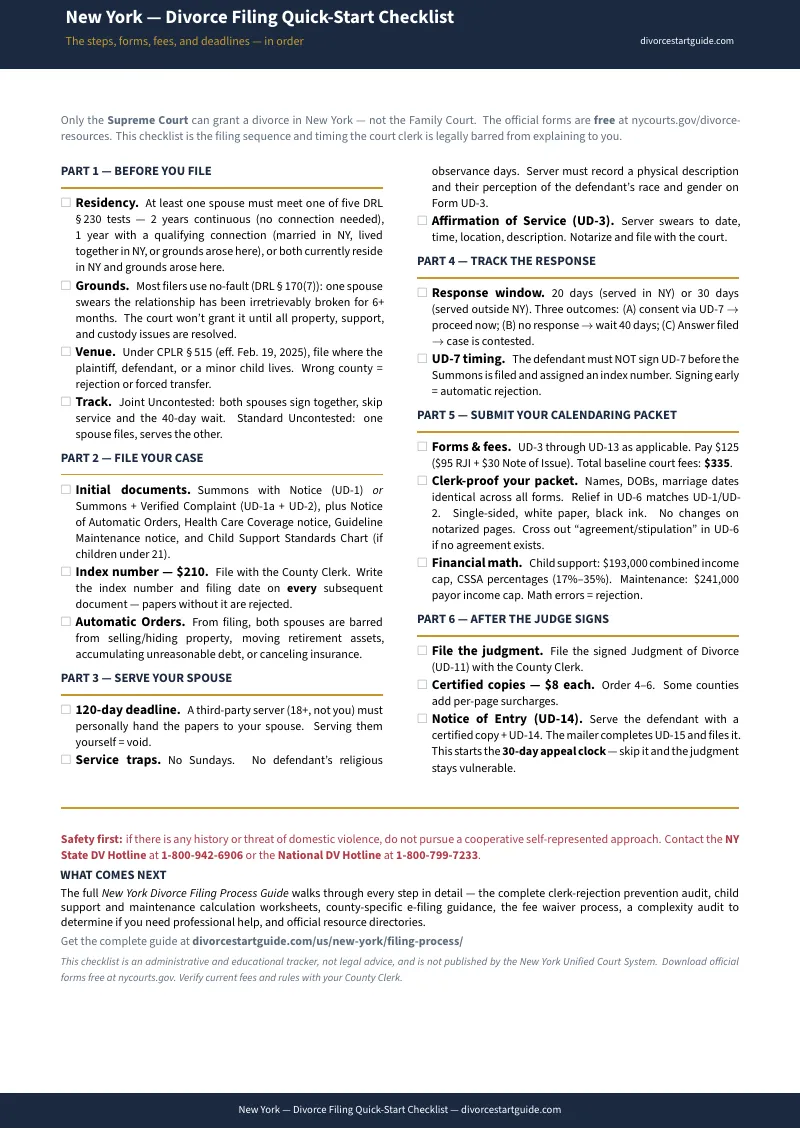
What's inside — the 17-chapter guide, 7 standalone worksheets, and the free quick-start checklist
- Jurisdiction and Residency Verification — the exact DRL § 230 residency rules, when the two-year requirement drops to one year, and how to determine which county to file in. Because filing in the wrong county means starting over with a new $210 Index Number.
- Grounds Selection and No-Fault Strategy — how to use DRL § 170(7) irretrievable breakdown, when fault-based grounds still matter, and the six-month oath requirement that trips up filers who think "no-fault" means "no waiting."
- The Commencement Sequence — purchasing the Index Number, choosing between UD-1 (Summons with Notice) and UD-1a/UD-2 (Summons and Verified Complaint), understanding the automatic orders under DRL § 236 Part B(2) that freeze assets the moment papers are filed, and when to use NYSCEF electronic filing versus physical filing.
- Service of Process Step-by-Step — who can serve papers (third party, 18+, not you), the Sunday and religious Sabbath prohibitions, the physical description requirements for the Affidavit of Service (UD-3), the 120-day deadline, and what to do when your spouse is cooperative versus evasive.
- The Clerk Rejection Prevention Audit — the top 20 most common filing mistakes that trigger immediate rejection, taken from the court system's own published list. Name inconsistencies across forms, premature UD-7 execution, double-sided printing, defective notarization, wrong notary block format, incomplete relief matching, and every other trap that sends you to the back of a 3-to-6-month backlog queue.
- Child Support and Maintenance Worksheets — step-by-step guidance for completing UD-8(1), UD-8(2), and UD-8(3), the CSSA percentage calculations (17% for one child, 25% for two, 29% for three), the spousal maintenance formulas for both with-child-support and without-child-support scenarios, and the mandatory deviation disclosure requirements.
- Default Divorce Navigation — what happens when your spouse does not respond after service, the 40-day waiting period, the additional scrutiny clerks apply to default packets, and the risk of the defendant later moving to vacate the judgment.
- The Note of Issue Assembly Guide — how to compile the final packet (RJI, Affirmation of Regularity, Plaintiff's Affidavit, Findings of Fact, Conclusions of Law, Proposed Judgment), the $125 fee, and the exact stacking and stapling order that local clerks expect.
- Post-Judgment Execution — securing certified copies from the County Clerk ($8 each), serving the Notice of Entry (UD-14), filing the final Affirmation of Service by Mail (UD-15), and the QDRO process for splitting retirement accounts without tax penalties.
- The Complexity Audit — a diagnostic self-assessment that identifies when your case is genuinely too complex for a DIY approach (business valuations, contested custody, real estate disputes) and shows you how to package your drafted papers for a flat-fee attorney review instead of handing over a $5,000 retainer.
- Fee Waiver Guidance — the Poor Person's Relief application under CPLR § 1101, income thresholds, and how to submit the request so the $335 in court fees does not become a barrier.
Who this is for
The spouse who has already decided to file and needs to know what comes first. The person who downloaded the entire UD packet from nycourts.gov and cannot figure out which form to fill in before which other form gets stamped. The filer who was rejected by a county clerk and does not know why. The couple who agree on everything but need to get the paperwork through the court without paying a $5,000 retainer. And the person who tried LegalZoom or 3StepDivorce, got their forms generated, and then realized the service ends at the print button — nobody tells you how to file, serve, or assemble the packet.
Why not just use the free court forms?
Because the court gives you forms, not a filing sequence. The nycourts.gov website provides every UD form — for free, as it should. But downloading 30 blank PDFs with no chronological roadmap is where the trouble starts. The court clerk is not your advisor. They are a proofreader bound by strict rules, and they are legally barred from telling you how to fix the errors they find. They just reject the packet and send you back to the queue.
The national document-prep platforms — LegalZoom at $150 to $500, 3StepDivorce at $299, YourForms at $49 to $69 per month — generate forms. Once you print them, the service stops. None of them tell you how to navigate NYSCEF e-filing, how to compile the Note of Issue packet in the physical format your county clerk expects, or how to avoid the specific New York formatting rules (single-sided printing, black ink only, no handwritten corrections on notarized pages) that cause silent rejections. And the monthly subscription platforms keep charging you while your case sits in a clerk's backlog for three to six months.
An honest guarantee
Work through the Supreme Court Filing Sequence System. If the guide does not make the New York divorce filing process clearer and more organized than any blank form, free article, or paid document-prep service could — email us at any time for a full refund. The risk of trying it is a fraction of one attorney billable hour. The risk of getting your packet rejected is measured in months of delay and potentially having to repay the $335 court fee.
For — less than fifteen minutes of attorney time — you get the filing sequence, the clerk rejection audit, the worksheets, and the step-by-step assembly instructions that the free forms leave out.
Stop guessing which form comes next. Get the guide, follow the sequence, and file your divorce correctly the first time.