The Court Clerk Cannot Help You. This Guide Can.
New Hampshire's Circuit Court Family Division provides free forms. The Financial Affidavit (NHJB-2065-F) is free. The Mandatory Self-Disclosure Checklist (NHJB-3248-F) is free. Every blank form you need to divide your property, disclose your finances, and finalize your decree is available at zero cost.
What is not free — and what the court self-help staff is legally prohibited from providing — is the instruction manual. The forms do not explain how to classify an asset when New Hampshire puts everything on the table under the all-property rule. They do not show you how to calculate a home buyout, how the LeGault 2025 Supreme Court decision just changed forty years of pension division practice, how the Hodgins coverture fraction works, how the 23% alimony formula under RSA 458:19-a is applied, or how the creditor trap on joint debts can leave you liable for a mortgage you thought the decree resolved.
The New Hampshire Divorce Financial Split & Asset Division Guide is the Equitable Division Workbook — the calculation manual, tracing worksheets, and New Hampshire-specific process map that turns those blank court forms into a finished settlement you can defend.
What Makes This Different From a $400 Online Divorce Service
Paid platforms like Hello Divorce charge $400–$4,000 to populate the same free forms through software. They give you filled-in blanks — but not the math behind those blanks. They do not include a separate-property tracing worksheet, a pension coverture calculator, a home equity buyout model, a debt-allocation worksheet, or a spousal support estimator calibrated to New Hampshire's statutory formula. You pay for convenience, not understanding.
This guide takes the opposite approach. You download the official forms for free. Then you use this guide to understand what numbers go into those forms, why, and what the financial consequences are. Every chapter links the New Hampshire statute to a concrete worksheet you fill in with your own figures.
What's Inside
The All-Property Framework
New Hampshire is one of a handful of states that uses the "all-property" approach under RSA 458:16-a. The court has authority over every asset and liability owned by either spouse — regardless of when it was acquired or how it is titled. Premarital assets, inheritances, and gifts are not automatically excluded. The guide walks you through the presumption of equal division, the 15 statutory factors judges use to deviate from 50/50, and why title does not determine ownership in New Hampshire.
Rule 1.25-A Mandatory Disclosure Walkthrough
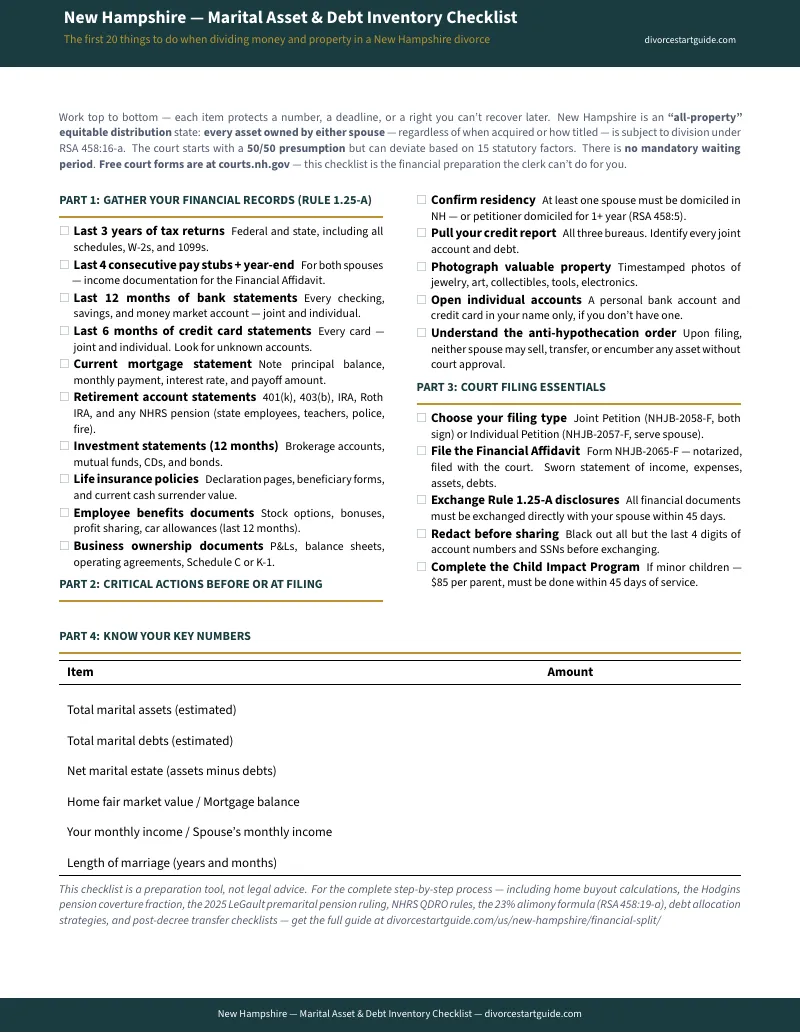
Within 45 days of service, both spouses must exchange three years of tax returns, four consecutive pay stubs, twelve months of bank and investment statements, and six months of credit card statements. The guide organizes this into a step-by-step preparation checklist so you gather everything systematically instead of scrambling under a deadline.
Dividing the Family Home
Sell and split, negotiate a buyout with a refinance deadline, defer the sale, or temporarily co-own. Each option has different tax consequences, credit implications, and cash-flow trade-offs. The guide covers net equity calculation, buyout math, RSA 458:16-a, V provisions for keeping the home, FICO requirements for refinancing, and the critical fallback clause if refinancing fails.
Retirement Accounts and Pension Division
Defined-contribution plans (401(k), IRA, 403(b)) are split via a Qualified Domestic Relations Order that allows a tax-free rollover. New Hampshire public pensions under the NHRS follow specific division procedures. The guide covers the Hodgins coverture fraction formula, the landmark 2025 LeGault decision that brought premarital pension accruals back into the marital estate, immediate-offset versus deferred-distribution approaches, QDRO drafting requirements, and the critical difference between dividing a pension at retirement versus taking a present-value buyout.
Debt Allocation and the Creditor Trap
New Hampshire treats debts equitably — but a divorce decree does not override your contract with the bank. If the court assigns the joint mortgage to your spouse and they stop paying, the lender comes after you. The guide covers mortgage liability, credit card allocation, student loan classification, dissipation claims, and the refinance deadline template and indemnification clauses that protect you after the decree.
Spousal Support Under the 23% Formula
New Hampshire uses a statutory formula under RSA 458:19-a: term alimony is capped at the lesser of the payee's reasonable need or 23% of the difference between gross incomes (30% if tax-deductible). Duration is capped at 50% of the marriage length in months. The guide walks through the three-part eligibility test, worked examples at multiple income levels, modification triggers, and the cohabitation rule that can terminate support.
Tax Consequence Analysis
Equal on paper is not equal after tax. A $100,000 traditional 401(k) is worth far less than $100,000 in cash after ordinary income tax on withdrawals. The guide covers IRC Section 1041 tax-free transfers, pre-tax versus after-tax retirement values, the home sale exclusion, and post-2018 TCJA alimony rules — so you compare assets on an after-tax basis before agreeing to a split.
Complete New Hampshire Filing Workflow
From verifying residency through the final decree: file the petition, serve, exchange financial disclosures within 45 days under Rule 1.25-A, attend mediation under Supreme Court Rule 48-B, draft the Property Settlement Agreement, submit QDROs for pre-approval, attend the final hearing, execute post-decree transfers. Every step mapped with the statute or rule that requires it.
Plus: 6 Fillable Worksheets
Every worksheet referenced in the guide is also included as a standalone printable PDF you can bring to mediation, your attorney meeting, or the courthouse:
- Marital Asset & Debt Inventory — every category the Financial Affidavit requires, organized for the Rule 1.25-A disclosure
- Home Equity & Buyout Calculator — net equity, refinance feasibility, and buyout math
- Retirement & Pension Division Planner — coverture fraction calculator, QDRO timeline, and NHRS rules
- Debt Allocation Worksheet — assign debts, calculate offsets, track refinance deadlines
- Spousal Support Estimator — 23% formula with duration limits and income scenarios
- Post-Decree Transfer Checklist — 30-day, 90-day, and 1-year action timeline
Who This Is For
- You are filing pro se and the Financial Affidavit is due within 45 days. The court self-help staff checks formatting but is legally barred from telling you how to calculate income, classify debts, or value assets. This guide shows you.
- You are hiring an attorney but want to walk in prepared. New Hampshire family law attorneys average over $9,000 in total fees. Arrive with completed worksheets and your retainer lasts longer.
- You are heading into mediation under Supreme Court Rule 48-B and need your numbers ready before the session starts. Show up with asset-split models, debt allocations, and spousal support scenarios already modeled.
- You have an NHRS pension and need to understand how the 2025 LeGault decision affects your case, what the coverture fraction means, and whether an offset strategy makes more sense than splitting the benefit directly.
Why the Free Court Forms Are Not Enough
The New Hampshire Judicial Branch self-help portal provides standardized forms and basic filing instructions. It does an excellent job of making the courthouse accessible. What it cannot do — by law — is advise you.
The Financial Affidavit has blank lines for asset values, income, and debts. It does not explain how to calculate those values. It does not tell you which assets the court will treat as marital versus separate. It does not mention the all-property rule, the LeGault pension decision, the Hodgins coverture fraction, the 23% alimony formula, the creditor trap on joint debts, or the post-decree transfers that must happen within specific windows. The court provides the form. This guide provides the understanding.
— Less Than 15 Minutes of Attorney Time
New Hampshire family law attorneys charge $288–$295 per hour on average, with initial retainers around $5,000. A single phone call to ask "how do I fill out the Financial Affidavit?" costs more than this entire guide. Whether you are doing this yourself or preparing to hire counsel, the guide pays for itself before you finish the first chapter.
Instant download. Printable PDF with fillable worksheets. No subscription, no upsell, no auto-renew.
100% Satisfaction Guarantee
If this guide does not help you organize your finances and understand the New Hampshire divorce process, email [email protected] for a full refund. No questions, no time limit.
Start with the free checklist or get the complete guide
Download the New Hampshire — Marital Asset & Debt Inventory Checklist for free — it covers the essential inventory you need before completing the Financial Affidavit. When you are ready for the full calculation manual, tracing worksheets, pension division walkthrough, and complete filing workflow, the full guide is available for instant download.
Frequently Asked Questions
What if the rules change after I buy?
We update the guide when the rules change. Email us any time, even years later, and we'll send you the current edition free.