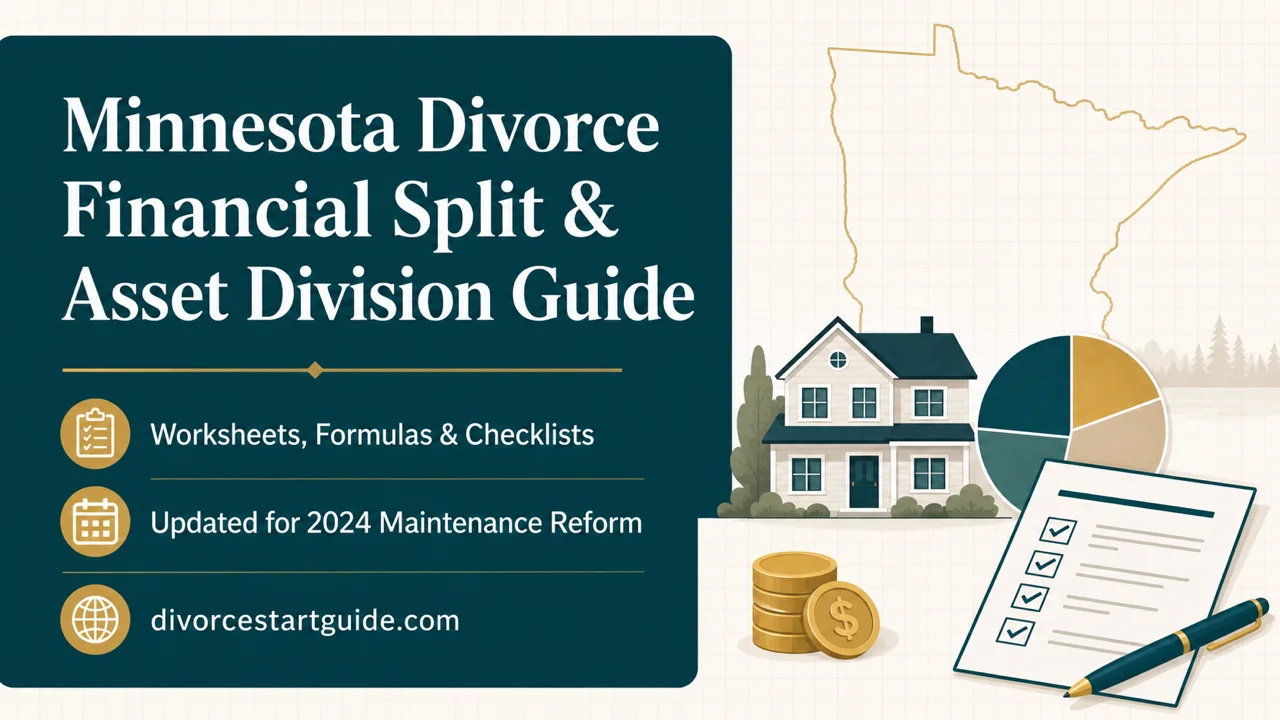
The Court Gives You Blank Forms. This Guide Gives You the Strategy to Fill Them Correctly.
Minnesota's Guide & File tool will generate your Joint Petition paperwork. It will not explain how to calculate a fair home buyout using the Schmitz formula, trace a pre-marital inheritance so it stays off the table, or navigate the brand-new 2024 spousal maintenance presumptions that changed everything about duration and burden of proof.
That gap between "here are your blank forms" and "here's how to negotiate a fair settlement" is where people lose money they were legally entitled to keep.
The Settlement Strategy System
This is a private, off-the-record workspace that walks you through every financial decision in a Minnesota dissolution — from your first asset inventory through the final QDRO filing and real estate transfer. It is not a blank form generator. It is the calculation engine, tracing method, and negotiation framework you use before filling in those free court forms.
Every worksheet, formula, and checklist is built specifically for Minnesota's equitable distribution statute (§ 518.58), Minnesota public pension systems, and the August 2024 maintenance reform. Nothing is generic. Nothing requires a legal dictionary to understand.
What's Inside
Marital vs. Non-Marital Property Worksheets
Minnesota presumes everything acquired during the marriage is marital — and the burden of proof is on you to show otherwise. These worksheets walk you through the classification of every asset and the tracing documentation you need to protect an inheritance, gift, or premarital account from being swept into the marital estate.
The Schmitz Formula Home Equity Calculator
If one spouse made a non-marital down payment on the family home, you don't lose that contribution just because the house appreciated. The Schmitz formula calculates the exact percentage that remains non-marital — but the court won't calculate it for you. This section walks you through it step by step, with worked examples, so you know your real number before you negotiate.
Retirement & Pension Division (PERA, TRA, MSRS)
A divorce decree alone cannot touch an employer-sponsored retirement plan. You need a QDRO — and Minnesota's three public pension systems (PERA, TRA, MSRS) each have their own division procedures, forms, and timelines. This section covers the coverture formula, Karon waiver decisions, QDRO drafting steps, and how to avoid the 10% early withdrawal penalty that catches people who try to "just cash out" their share.
2024 Spousal Maintenance Reform — Decoded
The August 1, 2024 overhaul replaced Minnesota's old maintenance framework with a three-tier presumption system based on marriage length. Under 5 years: presumption of no maintenance. 5–20 years: transitional maintenance capped at half the marriage length. 20+ years: indefinite maintenance. This section explains who bears the burden of proof, what rebuts the presumption, and how the "debt-funded lifestyle" factor changes the calculation.
Debt Allocation Strategy
A divorce decree that assigns a joint credit card to your ex does not release you from the creditor agreement. If your ex defaults, the creditor still comes after you. This section covers the legal reality of debt division, joint account closure timelines, and the strategies that protect your credit score through the dissolution.
SREDJ & Post-Decree Transfer Checklists
Minnesota's Summary Real Estate Disposition Judgment (SREDJ) lets you transfer the family home without a separate quitclaim deed — but only if filed correctly with the county recorder. This section walks you through every post-decree transfer: real estate via SREDJ, vehicles via title reassignment, retirement via QDRO, and bank/brokerage accounts via incident-to-divorce transfers.
FAM102 & FAM108 Preparation Workbooks
The court requires a FAM102 Financial Affidavit and a FAM108 Disclosure Statement with supporting documents. These workbooks walk you section by section through both forms — including which confidential identifiers go behind the CON112 cover sheet and which supporting documents you must attach.
Settlement Negotiation Framework
Trade-off worksheets for house-vs-retirement swaps, present-value pension calculations, and the statutory factors that push an equitable split toward 60/40. Built for couples negotiating their own terms before submitting a Joint Petition — or preparing for a productive mediation session that doesn't burn through billable hours.
Who It's For
- Self-represented spouses filing a Joint Petition who need to agree on every asset and debt before submitting their paperwork to the court.
- Anyone with a family home, a 401(k), or a public pension who wants to see the real numbers — not just a vague "equitable" promise — before negotiating.
- People protecting an inheritance or premarital contribution who need to understand Minnesota's tracing burden before a pre-marital asset gets absorbed into the marital estate.
- Spouses hiring a mediator or attorney who want to arrive organized and cut the billable hours spent sorting bank statements and building an asset inventory from scratch.
Why the Court's Free Tools Aren't Enough
Minnesota's Guide & File system is genuinely useful — it generates your Joint Petition forms and instructions for free. But it's a data collection tool, not a strategy tool. It asks you to enter your asset division. It does not help you calculate it.
It will not tell you that a Schmitz formula calculation protects your down payment. It will not warn you that a 401(k) withdrawal triggers a 10% penalty without a QDRO. It will not explain the new maintenance presumptions that could mean the difference between five years of transitional support and none at all.
Generic national guides (Nolo, DivorceNet) cover concepts but miss Minnesota-specific mechanisms: the Schmitz formula, SREDJ transfers, PERA/TRA/MSRS division procedures, and the 2024 statutory overhaul. A $200–$600/hour family attorney will get you there — eventually — but much of that first meeting is spent organizing the same financial inventory you could have prepared yourself.
This guide occupies the space between "here are your free court forms" and "here's a $4,000 legal retainer." It gives you the Minnesota-specific strategy, calculations, and worksheets to prepare a defensible settlement — whether you file on your own or hand it to an attorney for a final review.
What You Get
- The full guide — 13 chapters covering every stage from asset inventory through post-decree execution
- 8 standalone printable worksheets — property classification, Schmitz formula calculator, home equity buyout calculator, retirement division summary, debt allocation, maintenance estimator, Karon waiver self-assessment, and post-decree action tracker
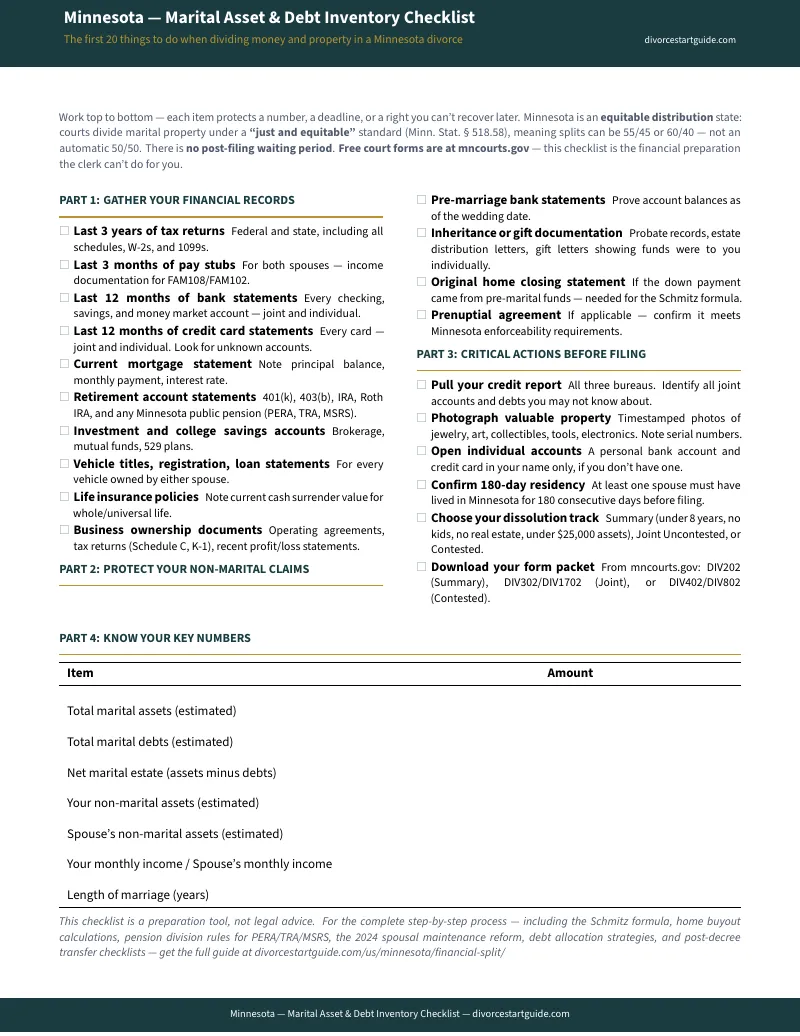
- Quick-start checklist — a compact inventory framework to catalogue every asset and debt before you start dividing
- Updated for the August 2024 maintenance reform — the new presumptions, burden-of-proof shift, and duration caps that most existing guides haven't incorporated yet
— Less Than One Hour of a Mediator's Time
The average Minnesota family mediator charges $150–$300 per hour. A full-scope attorney retainer starts at $1,500. This guide costs less than a single hour of professional time — and every hour you spend preparing with it is an hour you don't spend paying someone else to organize your finances for you.
Satisfaction guarantee, no time limit. If the guide doesn't help you organize your dissolution finances, email us for a full refund — no questions asked.
Start with the Free Checklist
Not ready for the full guide? Download the Minnesota Marital Asset & Debt Inventory Checklist — a one-page inventory framework to get your financial picture organized tonight. No payment required.
Frequently Asked Questions
What if the rules change after I buy?
We update the guide when the rules change. Email us any time, even years later, and we'll send you the current edition free.