
The judge signed your Judgment of Divorce. Your bank, the Secretary of State, and Social Security still think you're married.
You sat through the waiting period — 60 days without kids, 180 days with — and finally heard the judge pronounce your divorce complete. Then you walked out of the courthouse and realized something nobody tells you: the Judgment doesn't actually change anything. It doesn't update your name at the Social Security Administration. It doesn't remove your ex from the joint checking account. It doesn't transfer the house deed, split the pension, cancel the shared credit card, or tell your life insurance company to stop listing your former spouse as the primary beneficiary. Every single one of those tasks falls on you — and if you do them in the wrong order, you'll waste weeks undoing the damage.
Try updating your Michigan driver's license before the SSA processes your name change, and the Secretary of State system rejects you at the counter. Record a quitclaim deed at the Register of Deeds without meeting Wayne County's 2.5-inch top margin requirement, and the entire document gets sent back. Miss the window on your QDRO for a Michigan state employee pension through MERS or the State Employees' Retirement System, and your ex-spouse's plan administrator processes a withdrawal you can't claw back. These aren't theoretical problems — they are the most common post-divorce administrative failures in Michigan, and the free resources on Michigan Legal Help don't cover them in one place.
Hiring a family law attorney at $225 to $600 an hour to handle paperwork you could do yourself makes no financial sense when you've already spent thousands on the case. You don't need a lawyer for this. You need a step-by-step execution plan.
The Michigan Post-Divorce Execution System
This is a chronological, task-by-task roadmap for every administrative action between "the judge signed it" and "my life is fully separated" — built specifically for Michigan's equitable distribution rules, Michigan retirement systems, and Michigan agency procedures. It is not legal advice. It is the execution layer your Judgment of Divorce leaves out.
At its core is the Post-Divorce Execution System — a timed, sequenced method that tells you exactly what to file, at which agency, in what order, with which forms, by which deadline. It handles the part everyone gets wrong: the mandatory name-change sequencing (SSA → SOS → Passport), the county-specific Register of Deeds requirements for real property transfers, the vehicle title tax exemption that saves you Michigan's 6% use tax, and the three completely separate retirement division processes for private-sector QDROs, Michigan state employee plans (MERS, SERS), and defined-contribution accounts.
What's inside — 12-chapter guide, worksheets, and the free checklist
- The 21-Day Finality Window — explains the 21-day motion-for-relief period after entry of judgment, when your ex can still challenge the decree. Separates the tasks you can safely start immediately from the ones that should wait until the window closes.
- Certified Copies Strategy — why the $34 MDHHS record is not the same as a certified copy of your actual Judgment from the county clerk, how many copies to order, and which agencies accept photocopies versus requiring originals.
- Name Change Sequencing — the mandatory SSA → Secretary of State → Passport order with exact forms (SS-5, Michigan SOS application), processing times, and the critical distinction between free name restoration under MCL 552.391 versus the separate probate court petition if your Judgment omitted it.
- Bank and Credit Separation — account-by-account scripts for joint closures, authorized user removal, credit freeze procedures, and the critical warning that creditors do not honor divorce decrees (if both names are on the debt, both remain jointly and severally liable regardless of what the judge ordered).
- Real Property Transfer Kit — quitclaim deed execution, Register of Deeds recording requirements (including margin specifications that vary by county), the due-on-sale clause risk when transferring between former spouses, and why Michigan title companies prefer quit-claim deeds over warranty deeds in divorce transfers.
- Vehicle Title Transfer — TR-11L and TR-54 form walkthrough, the divorce exemption from Michigan's 6% use tax, the 15-day transfer deadline, and what to do when your ex-spouse refuses to sign the title in person at the Secretary of State office.
- Retirement Division for Michigan Systems — private-sector QDROs (401(k), 403(b), traditional pension), Michigan MERS retirement division, State Employees' Retirement System orders, Michigan Public School Employees Retirement System (MPSERS), and the separate IRA transfer-incident-to-divorce rules. Each system gets its own step-by-step section with forms, timelines, and common rejection reasons.
- Estate Planning Overhaul — the ERISA beneficiary trap (designations on employer-sponsored plans override your will and your decree under federal law), Michigan's Estates and Protected Individuals Code revocation rules that apply to wills but not to financial accounts, and a beneficiary audit covering life insurance, IRAs, POD bank accounts, and TOD brokerage registrations.
- Health Insurance Transition — COBRA election within 60 days of the qualifying event, Special Enrollment Period for marketplace plans, Healthy Michigan Plan eligibility check, and gap-coverage options.
- Child Support and Income Withholding — how the Friend of the Court manages enforcement, income withholding orders, and what to do if support terms need modification.
- Enforcement Tools — Motion to Enforce (available 21 days post-judgment) and Motion to Show Cause for contempt, step by step, including when the Friend of the Court gets involved and when you need to file independently.
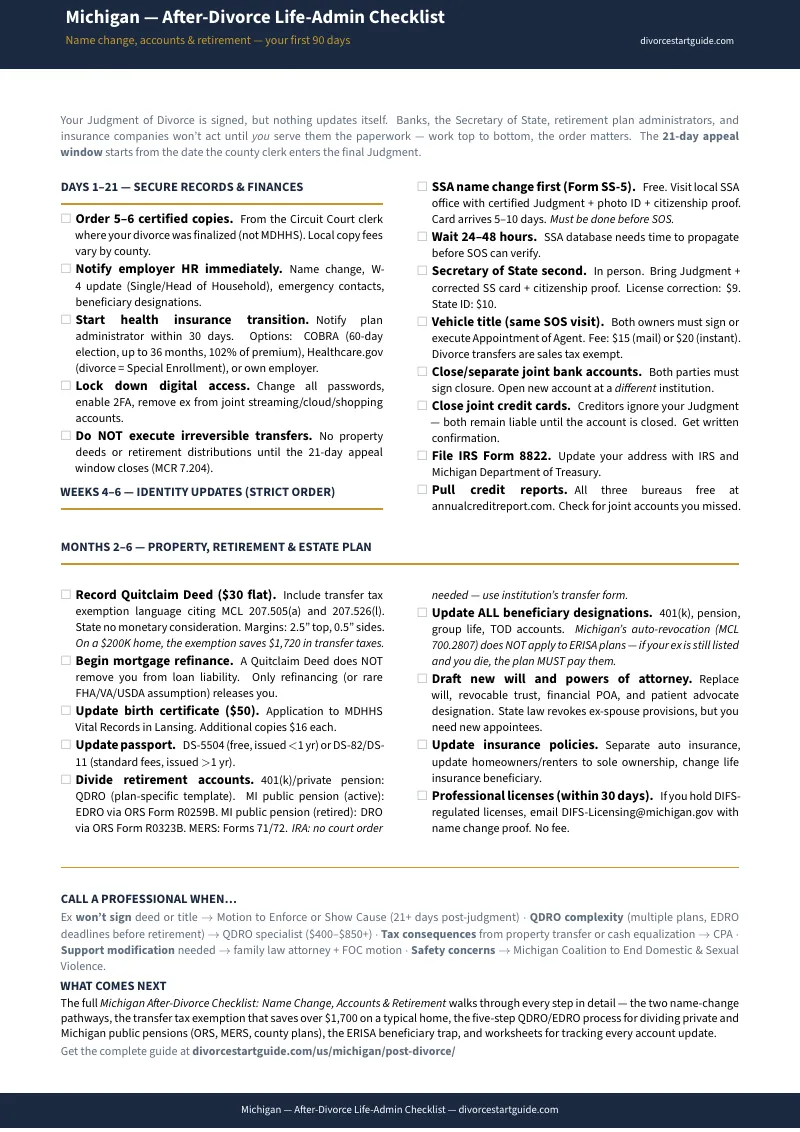
- Master Timeline — every task organized into 72-hour, 30-day, 90-day, and ongoing blocks with deadlines, forms, fees, and completion checkboxes.
7 Standalone Printable Worksheets (included)
- Name Change Sequencing Card — print and bring to your SSA and SOS appointments
- Real Property Transfer Worksheet — deed recording, mortgage separation, and title tracker
- Vehicle Title Transfer Checklist — Secretary of State forms and tax exemption steps
- Retirement Division Reference — QDRO/DRO filing tracker for each plan type
- Beneficiary Audit Worksheet — ERISA and non-ERISA account tracker
- Bank & Credit Separation Log — joint account inventory and closure tracker
- Master 90-Day Timeline — every task in chronological order with checkboxes
The free checklist is a 20-item priority planner covering the most critical first steps — digital security, certified copies, joint credit freeze, and the SSA name-change appointment. It gets you through the urgent window. The full guide covers the next 90 days and beyond.
Who this is for
The person staring at a signed Judgment of Divorce and realizing that none of the practical separation is actually done yet. The pro se filer who handled the divorce without an attorney and now needs to finish the administrative cleanup without paying $225 an hour for someone to explain Secretary of State forms. The spouse who was awarded the house and just discovered that the deed and the mortgage are two completely separate legal instruments — and that recording one doesn't satisfy the other. The state employee, teacher, or municipal worker whose pension runs through MERS, SERS, or MPSERS — each with its own domestic relations order requirements and rejection criteria. And the person who is simply exhausted from the divorce process and needs every remaining task laid out in chronological order so they can work through it one item at a time without missing a deadline.
Why not just use the free information on Michigan Legal Help?
Because Michigan Legal Help covers filing for divorce — not what happens after it's final. Its post-divorce content is scattered across unlinked articles, each handling one narrow topic. Name restoration is in one guide. The Friend of the Court is in another. QDROs aren't covered at all. The Secretary of State has its own vehicle transfer instructions. The Register of Deeds has county-specific margin and formatting rules buried in subpages nobody reads until their document gets rejected. The national platforms — LegalZoom and Rocket Lawyer — generate generic forms with no Michigan-specific procedural guidance on agency sequencing, tax exemptions, or the four separate retirement systems.
This guide is the single document that puts the entire post-divorce execution sequence in one place — forms, fees, deadlines, and the agency-specific procedural traps that free resources don't cover.
A straightforward guarantee
Work through the Post-Divorce Execution System. If the guide doesn't save you at least one wasted trip to a government office, one rejected form, or one expensive administrative mistake — email us at any time for a full refund. The risk of trying it is a fraction of one attorney phone call. The risk of guessing on the sequencing is measured in weeks of delay, rejected filings, and money left on the table.
For — less than six minutes of attorney time — you get the full execution system, every form reference, every deadline, and the chronological roadmap that the Judgment of Divorce doesn't include.
Your divorce is final. Now finish the paperwork — in the right order, on the first try.
Frequently Asked Questions
What if the rules change after I buy?
We update the guide when the rules change. Email us any time, even years later, and we'll send you the current edition free.