
Maine gives you the forms. It does not give you the math.
You found the Family Division forms on courts.maine.gov — the Financial Statement (FM-043), the Asset Identification Worksheet, the Divorce Complaint. You downloaded the packet. And then you opened FM-043 and saw thirty-seven lines asking for values you have no idea how to calculate: "fair market value of real estate," "present value of retirement benefits," "value of non-marital property set aside to each party."
The form is a sworn document. Under Rule 108(c), you have exactly 21 days from the scheduling order to file it. Under Rule 112(a)(1), all formal discovery is blocked until both spouses exchange completed financial statements. If yours is late, inaccurate, or incomplete, the entire case stalls — and the judge draws inferences from the silence.
Meanwhile, a family law attorney in Cumberland County charges $150–$500 an hour. A $3,000 retainer buys you roughly twelve hours. Three of those hours will go toward organising your bank statements into the categories their paralegal needs. That's $600+ in document-sorting work you could have done yourself — if someone told you the classification rules and the order.
You do not need someone to fill in boxes. You need to know what the numbers mean before you write them down.
The Maine Equitable Distribution Preparation System
This is a complete, step-by-step guide to dividing money and property in a Maine divorce — built for the specific statutes, rules, and court procedures that make Maine different from every other state. It is not legal representation and it does not file your papers. It is the classification, calculation, and sequencing intelligence that Maine's blank forms leave out.
At its core is the Equitable Distribution Preparation System — a structured method that walks you from "I have a pile of bank statements and no idea what's marital vs. separate" to a clean, defensible asset-and-debt inventory that meets the court's standard under 19-A M.R.S. § 953. It handles the part everyone gets wrong: classifying property using the statutory presumption and source-of-funds rule, calculating a home equity buyout that accounts for refinancing costs and the custodial-parent preference, applying the coverture fraction to MainePERS and employer plans, allocating debts equitably using the factors courts actually weigh, and building a spousal support estimate using the 2026 presumptive formula under § 951-A.
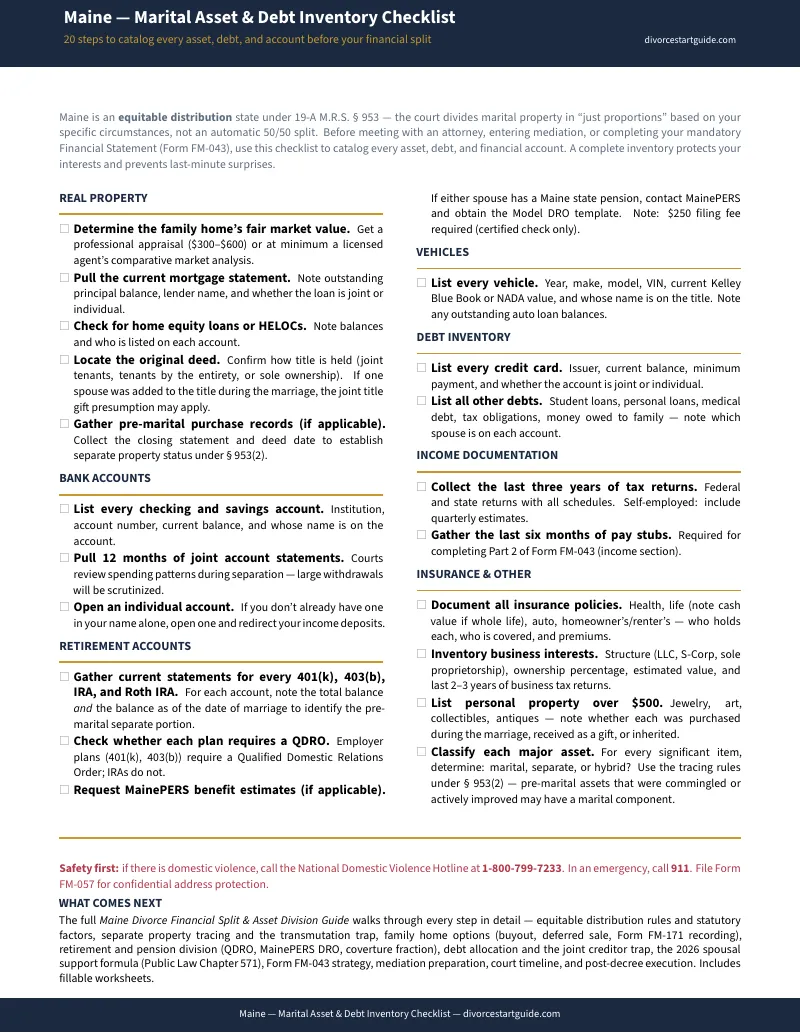
What's inside — the 12-chapter guide, 9 standalone worksheets, and the free checklist
- Marital vs. Separate Property Classification — the tracing method that turns commingled accounts into documented separate-property claims. Because depositing an inheritance into a joint checking account triggers the marital presumption under § 953(3) — unless you can trace the funds back to their pre-marriage origin with clear documentation.
- FM-043 Preparation Workflow — a line-by-line approach to completing the sworn Financial Statement accurately and on time. Know exactly which values to pull from which documents, how to handle assets you cannot yet appraise, and how to annotate disputed classifications before the 21-day deadline hits.
- The Family Home Decision Framework — sell, buyout, or deferred co-ownership? Calculate net equity after mortgage, HELOCs, liens, and transaction costs. Covers the refinance-into-one-name requirement, the § 953(1)(C) custodial-parent preference, and post-decree title transfer via Form FM-171 at the Registry of Deeds.
- Retirement and Pension Division — coverture fraction math for MainePERS defined-benefit pensions (including the $250 DRO review fee timeline), the QDRO process for employer 401(k)s and 403(b)s, IRA transfer mechanics under IRC § 1041, and the offset strategy for trading retirement claims against home equity.
- The Debt Allocation Method — how Maine courts assign responsibility based on who incurred the debt, what funds were used for, and each spouse's ability to pay. Includes the critical distinction between what the court orders and what creditors can still enforce on joint accounts, plus a credit-freeze action plan for the transition period.
- 2026 Spousal Support Formula — the presumptive calculation under amended § 951-A, the four support types (general, transitional, reimbursement, nominal), and the factor-weighting worksheet for estimating your range before mediation.
- Case Management Conference Preparation — what happens at the Rule 110A conference for cases with children, how magistrates issue binding interim orders on bill responsibility and temporary support, and the 63-day timeline under Rule 108(f)(2) for temporary child support orders.
- Mediation Strategy and CADRES — preparing for court-mandated mediation, building a settlement proposal with trade-off scenarios, and understanding when to request a contested hearing vs. when agreement saves months.
- Post-Decree Administration Checklist — every deed transfer (FM-171), title change, beneficiary update, insurance policy change, and account retitling that must happen after the final decree is entered.
Who this is for
The spouse quietly gathering records before filing the Complaint for Divorce. The person staring at FM-043 with a stack of bank statements and no idea which column each account belongs in. The homeowner calculating whether they can afford to keep the house after a refinance at current interest rates. The state employee wondering how MainePERS divides their pension and what the $250 DRO review means for their timeline. The cooperative couple who want to reach a fair agreement at CADRES mediation without spending $8,000 on attorneys — but need the math to prove the deal is actually fair. And the spouse who already has an attorney but wants to stop paying $300 an hour for document organisation they can handle themselves.
Why not just use the free resources?
Because the free resources give you forms, not calculations. Maine's courts.maine.gov provides FM-043 — a blank sworn statement with thirty-seven lines of empty boxes. Pine Tree Legal Assistance offers plain-language explainers but restricts services to low-income individuals below poverty thresholds. DivorceNet and Nolo publish general articles about equitable distribution concepts that apply to half the states in the country.
The national platforms — DivorceWriter at $137, 3 Step Divorce at $299 — generate paperwork based on your inputs. They do not show you how to classify commingled property, trace separate-fund origins, or calculate the coverture fraction for a MainePERS pension. They do not prepare you for the dynamics of CADRES mediation or explain the Rule 112 discovery block. They fill in boxes. This guide tells you what the right numbers are before you write them down.
An honest guarantee
Work through the Equitable Distribution Preparation System. If the guide doesn't make your financial split clearer and better organised than any blank form or free article could — email us at any time for a full refund. The risk of trying it is a fraction of one attorney billable hour. The risk of guessing on a sworn financial statement is a permanent division you cannot modify after the decree.
For — less than fifteen minutes of attorney time — you get the classification system, the FM-043 preparation workflow, the coverture math, and the step-by-step sequence that Maine's free forms leave out.
Stop staring at empty boxes and 21-day deadlines. Get the guide, build your inventory, and walk into your divorce with the numbers already done.
Frequently Asked Questions
What if the rules change after I buy?
We update the guide when the rules change. Email us any time, even years later, and we'll send you the current edition free.