Indiana Gives You the Blank Forms. Nobody Gives You the Sequence.
You can download every divorce form from the Indiana Supreme Court website right now, for free. The Verified Petition. The Summons. The Financial Declaration. They're all there.
Here's what's not there: which form to file first, how to fill in the boxes that aren't labeled, when to serve your spouse versus when to skip service entirely, what the 60-day waiting period is actually for, or why Indiana's One-Pot rule means that inheritance from your grandmother might be on the table.
The county clerk can't help you — they're legally prohibited from explaining any of it. And most free articles online are attorney marketing funnels designed to make the process sound so terrifying that you reach for your checkbook.
This guide is the instruction manual that should have come with those blank forms.
The Filing Sequence System
Most pro se filers don't fail because the law is too complicated. They fail because they do things out of order — serve papers before filing the petition, skip the financial declarations, miss the 20-day response window, or try to finalize before the 60-day clock has run.
The Indiana Divorce Filing Process Guide turns the entire process into a step-by-step sequence with built-in checkpoints. You'll know exactly what to file, when to file it, which county office to walk into, and what to do if your spouse doesn't respond.
What's Inside
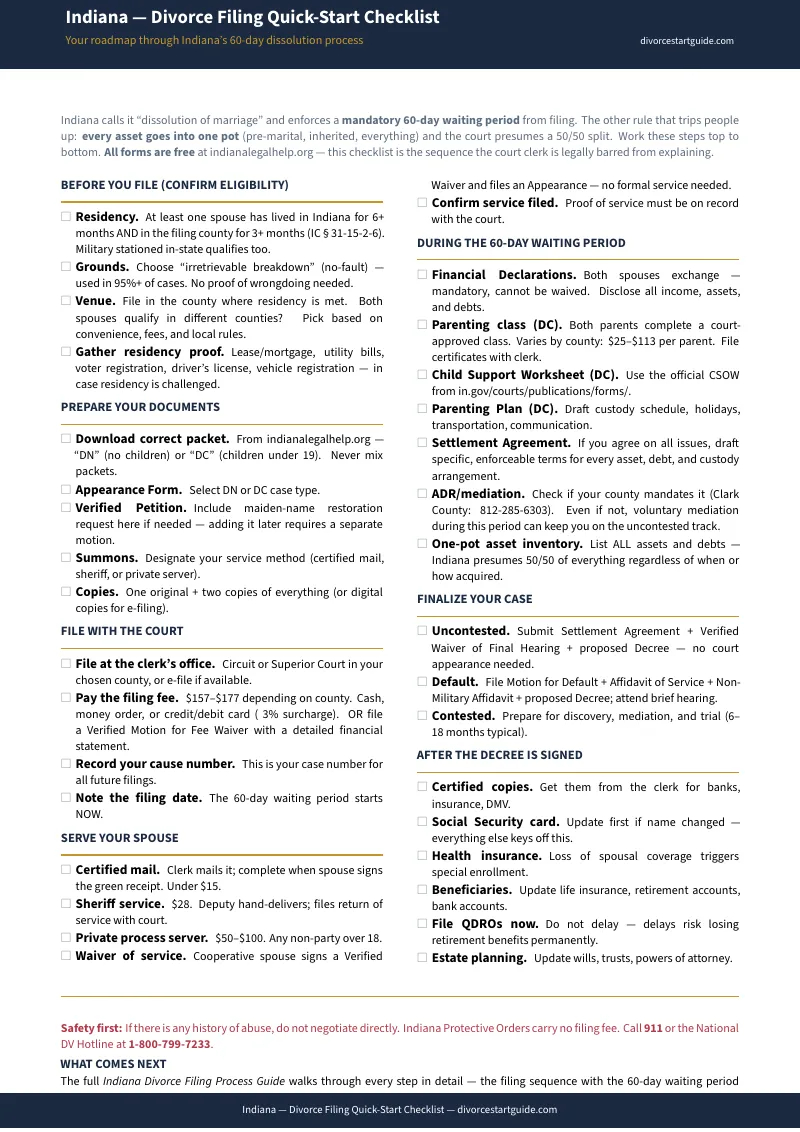
- The complete filing sequence — from verifying residency under IC § 31-15-2-6 to walking out with a signed decree, in chronological order with nothing skipped
- One-Pot asset inventory worksheet — Indiana presumes everything is marital property. This worksheet helps you list every asset and debt, document acquisition dates and values, and model different split scenarios (50/50, 60/40) before you negotiate
- Service of process decision tree — certified mail, Sheriff, private server, or waiver of service, with exact steps, costs, and proof-of-service filing instructions for each option
- 60-day waiting period action calendar — the specific tasks you need to complete during the mandatory cooling-off period: financial declarations, parenting classes, child support worksheets, and settlement drafting
- Parenting plan framework — aligned with Indiana Parenting Time Guidelines and the "best interests" factors under IC § 31-17-2-8, with prompts for custody schedules, holiday rotations, communication methods, and expense splits
- Settlement agreement checklist — line-by-line guidance for drafting enforceable terms covering real estate, debt allocation, vehicle transfers, retirement accounts, and tax filings
- Four resolution paths mapped — uncontested with waiver of final hearing, default judgment, mediated settlement, and contested trial, with realistic timelines and cost ranges for each
- County-level cost breakdown — filing fees ($157–$177), service costs, parenting class fees, and extras like QDRO preparation, so you can budget the full amount before filing
- Resources directory — official Indiana court websites, free legal help contacts, and fill-in fields for your county clerk, parenting class provider, and local legal aid
- Post-divorce action checklist — what to update after the decree is signed, organized by timeline: first week, 30 days, and 90 days
Who This Guide Is For
- You and your spouse agree on most issues and want to file without paying thousands for an attorney
- You've been served papers and need to understand your rights and the 20-day response deadline
- You're preparing for court-ordered mediation and want to walk in organized, not scrambling
- You want to know the real process, timeline, and costs before you make any decisions
Why Not Just Use Free Resources?
Indiana's free court forms are genuinely free — and genuinely incomplete. The state provides blank PDFs with no explanation of the choices embedded in each field. Legal aid sites cover eligibility screening, not step-by-step navigation. Attorney blogs explain just enough to make you anxious, then ask you to call for a consultation.
Automated form-filling services like 3 Step Divorce charge $299 or more, and they generate your paperwork without teaching you how the county clerk system works, how to handle local rules that vary across Indiana's 92 counties, or what to do when your spouse doesn't cooperate.
This guide sits in the gap between free confusion and expensive hand-holding. It gives you the sequence, the worksheets, and the checklists to navigate the process yourself — for less than the cost of one hour with a paralegal.
What This Guide Is Not
This is an educational navigation toolkit, not a law firm. It doesn't draft your forms, file your paperwork, or represent you in court. It teaches you how to do those things yourself, clearly marks the boundaries where professional help becomes necessary, and helps you prepare so thoroughly that if you do hire an attorney for a specific issue, you won't waste their billable hours on things you could have organized in advance.
100% Satisfaction Guarantee
If the guide doesn't help you feel more organized and confident about your filing process, email us and we'll refund your purchase. No hoops, no conditions.
— Less Than Your Court Filing Fee
A filing fee in Indiana runs $157 to $177. An attorney retainer starts at $2,000. Automated form software costs $299 or more. This guide costs a fraction of any of those — and it's designed to make sure you don't waste any of them on preventable mistakes.
Start with the free checklist to see the filing sequence at a glance, or get the full guide with every worksheet and walkthrough included.
Frequently Asked Questions
What if the rules change after I buy?
We update the guide when the rules change. Email us any time, even years later, and we'll send you the current edition free.