You Googled "how to file for divorce in Florida." You found the state court website. You downloaded a few free forms. And then you sat there — staring at Form 12.901(a) and Form 12.901(b)(1) — with no idea which one applies to your situation, which forms come next, or whether filing in the wrong order means your $408 filing fee is gone and your case is dismissed.
That's not a knowledge problem. It's a sequencing problem. Florida gives you every form you need — for free — but nowhere does it tell you what to file first, what to file after your spouse is served, when your financial disclosures are due, or what happens if your spouse ignores the papers. The courthouse clerks? They're legally barred from answering those questions. The self-help centers? They hand you packets and wish you luck.
The Filing Sequence Navigator
This is the Florida Divorce Filing Process Guide — a chronological roadmap that picks up where Florida's free forms leave off. Not form generation. Not legal advice. A step-by-step execution sequence that tells you exactly what to do on Day 1, Day 5, Day 25, and Day 45 of your case — so every form lands in the right office, in the right order, on time.
It covers all four of Florida's dissolution paths — simplified, regular uncontested, regular contested, and default — so you start on the right track from the beginning instead of discovering halfway through that you filed the wrong petition.
What's inside — 10 printable PDFs
- The Four-Path Decision Map. A printable worksheet that determines whether you qualify for Florida's Simplified Dissolution (no children, no alimony, full agreement) or need Regular Dissolution — and whether your case is uncontested, contested, or headed for default. Includes which petition form to file. For the person staring at two different petition forms with no idea which one to file.
- Residency & Venue Verification. How to prove Florida's six-month residency requirement using your driver's licence, state ID, voter card, or a corroborating witness affidavit (Form 12.902(i)) — plus how to determine which county's circuit court has jurisdiction. For the person who moved counties recently and doesn't know where to file.
- The Filing Packet Builder. A printable checklist of every form you need for your specific situation, in the exact order you file them — petition, summons, cover sheet, UCCJEA affidavit (if children), and notice of social security number. No guessing which of the 40+ approved forms apply to you. For the person who doesn't want a rejected filing because they forgot one cover sheet.
- Service of Process Coordinator. Four service methods compared side by side — county sheriff ($40–$100), private process server, Waiver of Service for cooperative spouses, and constructive service by publication when a spouse cannot be located. For the person whose spouse left the state or won't sign anything.
- The Financial Disclosure Worksheet. A fillable worksheet to gather your income and expense numbers before completing Florida's official Financial Affidavit — Short Form 12.902(b) versus Long Form 12.902(c). Plus the legal waiver option cooperative couples can use to skip the 17-document exchange. For the couple who agreed on everything but doesn't want to hand over twelve months of bank statements.
- The Asset & Debt Division Worksheet. Printable inventory for every marital and nonmarital asset and debt, with a classification guide and space to assign each item. For the couple drafting their Marital Settlement Agreement.
- Parenting Plan & Child Support Worksheets. Florida requires a parenting plan for every case involving minor children. This section walks through the mandatory elements, time-sharing schedules, and how to calculate guideline child support using Florida's income-shares model. For the parent who wants a plan that passes judicial review the first time.
- Safety Planning Protocols. Confidential filing procedures, domestic violence injunction coordination, address confidentiality (Attorney General's program), and separate hearing logistics. For the person who needs to file safely.
- The Default & Final Hearing Sequence. What happens when 20 days pass with no response — how to file Form 12.922(a) Motion for Default, prepare the Nonmilitary Affidavit (Form 12.912(b)), and schedule your final hearing. Plus a printable final hearing prep sheet with what to bring and the exact questions the judge will ask. For the person whose spouse is ignoring the paperwork.
- Alimony Under the 2023 Reform. Florida's 2023 overhaul eliminated permanent alimony. This section explains the three remaining types — bridge-the-gap, rehabilitative, and durational — with the new statutory duration caps and factors judges consider. For anyone who needs to understand what alimony is actually available now.
- Florida Divorce Forms Quick Reference. Every Florida Supreme Court-approved form organized by stage — filing, service, disclosure, children, default, settlement — with checkboxes. For the person who drove to the courthouse only to discover they needed a money order.
- Chronological Deadline Tracker. A fillable timeline from Day 1 through final judgment, with every deadline and space for your actual dates — so you always know the single next thing to do and the deadline attached to it.
Who this is for
You've decided to file for divorce in Florida — or your spouse already has — and you're handling it yourself. You might qualify for simplified dissolution and want to confirm you meet every requirement before paying the filing fee. You might have children and need to know exactly which forms and plans the court requires. You might be dealing with a spouse who won't cooperate, and you need the default process explained in plain English. Whatever your situation, you want a clear sequence — not a pile of blank forms and a "good luck."
Why not just use the free court forms?
Because the forms aren't the problem. Florida's Supreme Court provides every approved form for free at flcourts.org — and we encourage you to use them. The problem is that nobody tells you which forms apply to your situation, what order to file them in, or what deadlines you'll trigger the moment you file. The courthouse self-help staff are legally prohibited from advising you. The clerk's office accepts your paperwork but can't tell you if it's complete. Miss a form, file in the wrong sequence, or blow a 20-day deadline, and your $408 filing fee doesn't come back.
Online document-prep services like 3StepDivorce ($299) or Divorce.com ($499–$1,999) generate forms but don't walk you through what happens after you file — the service coordination, the disclosure deadlines, the default motion, the final hearing preparation. A family attorney handles all of that, but retainers start at $2,000–$5,000 for even a simple uncontested case.
This guide sits in the gap: it works with the free forms, not instead of them, and gives you the step-by-step sequence that no government website, clerk's office, or form-filler provides.
A quick, honest boundary
This is a process-navigation tool and document organizer, not legal advice and not a law firm. It helps you gather the right forms in the right order before you walk into the courthouse or log into the e-filing portal. For contested custody disputes, hidden assets, complex business valuations, or domestic violence situations that require immediate court protection beyond what's covered here, it will tell you plainly when to bring in a professional — and save you money on everything else.
Our guarantee
If this guide doesn't make your divorce filing process clearer and less stressful, email us at any time for a full, no-questions-asked refund. The risk is entirely ours.
— less than one hour with a paralegal
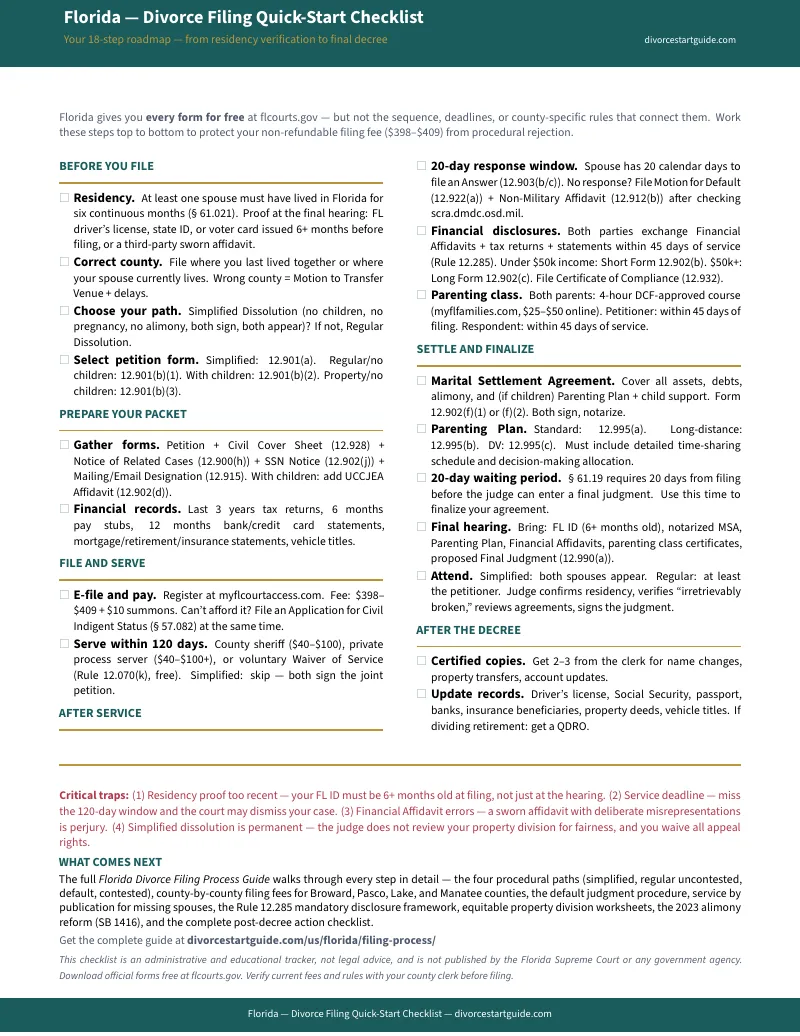
Not sure yet? Start with the free Florida Divorce Filing Quick-Start Checklist — a one-page overview of the filing steps, residency rules, and waiting period. When you're ready for the complete Filing Sequence Navigator — all four dissolution paths, financial disclosures, service coordination, default procedures, and the full chronological worksheets — the paid guide is waiting.
Get the Florida Divorce Filing Process Guide →
The forms are free. Knowing what to do with them shouldn't cost you your filing fee.