You downloaded the blank forms. Now you're staring at twenty pages of financial schedules with no instructions.
The Nunavut Court of Justice makes Form 8 and Form 9 available as free PDFs. They ask you to list every asset, every debt, and every dollar of income — going back three years. They ask you to classify property as family, excluded, or pre-marital. They ask you to calculate your net family property. And they assume you already know how to do all of it.
A family lawyer in Iqaluit charges $300 to $500 per hour. A $2,000 retainer covers about five hours — half of which gets spent on document organization. The Legal Services Board only covers residents below strict income thresholds. If you earn a government salary, a teacher's wage, or a housing officer's income, you're on your own. The national DIY kits advertise "quick Canadian divorce" but they're built for Ontario — they've never heard of the Nunavut Court of Justice's single-level structure, your NEBS pension, or the fact that common-law partners here have the same equalization rights as married spouses.
You don't need someone to fill out forms for you. You need the calculation system that tells you which numbers go where, which assets get shared, and how the equalization math works — before you walk into a lawyer's office, a mediation session, or the Iqaluit registry.
The Equalization Navigation System
This is a step-by-step guide to dividing money and property in a Nunavut divorce — built entirely around the territorial Family Law Act, the Nunavut Divorce Rules, and the northern pension frameworks that generic Canadian kits ignore. It does not provide legal advice and does not file your papers. It provides the classification logic, the NFP calculation method, and the fillable worksheets that blank government forms leave out.
At its core is the Equalization Navigation System — a structured method that takes you from a pile of bank statements and pension documents to a clean, documented financial inventory that satisfies the Court of Justice standard. It handles the part that trips everyone up: tracing pre-marital property to prove what you brought in, classifying Nunavut Housing Corporation holdings and Land Claims Beneficiary assets, calculating what portion of a NEBS or Public Service pension is shareable, running the NFP equalization formula, and turning the result into numbers that map directly onto Form 8 and Form 9.
What's inside — 11 chapters, 8 standalone worksheets, and the free checklist
- The NFP Equalization Calculator — the five-step formula explained in plain English. Calculate each spouse's net family property, determine the equalization payment, and understand exactly who owes whom. No spreadsheet skills required — the worksheets walk you through each line.
- The Asset Classification System — how to identify what counts as family property (shared), what stays excluded (inheritances, third-party gifts, personal injury awards), and how pre-marital deductions work. Covers the critical matrimonial home exception: a home brought into the marriage cannot be deducted from the NFP calculation — its entire separation-date value gets shared.
- The Matrimonial Home Decision Framework — sell, buyout, or defer? Calculates net equity after mortgage discharge and transaction costs. Covers the equal right to possess the home, Nunavut Housing Corporation and social housing structures, land-lease properties, and what happens when the home is the couple's only significant asset.
- Northern Pension Division Guide — NEBS, Public Service Pension Plan, and private registered plans each have different splitting rules. The guide explains the PBSA vs. PBDA distinction (up to 100% assignment vs. immediate lump-sum transfer), commuted value calculations, and the step-by-step CPP credit splitting application through Service Canada using Form ISP-1901.
- The Debt Allocation Method — debts reduce your NFP, which means they directly affect the equalization payment. Covers joint-and-several liability (your separation agreement does not bind your creditors), the treatment of reckless or bad-faith debts the court can exclude, and a credit card closure strategy to prevent new joint debt from accumulating.
- Spousal Support Estimator — SSAG formula ranges based on income difference and marriage length, duration rules (including the Rule of 65 for indefinite support), how Northern Living Allowances affect the income calculation, and the statutory priority of child support over spousal support.
- Form 8 & Form 9 Preparation Workbook — a plain-English translation of every section of both forms, the documents you need before you start each schedule, formatting requirements the Iqaluit registry expects, and a formal disclosure demand checklist for when your spouse won't cooperate.
- Post-Divorce Execution Checklist — the administrative tasks the court does not handle: pension transfer requests, CPP credit splitting, beneficiary designation changes (under the Nunavut Insurance Act, divorce does not automatically revoke life insurance or RRSP beneficiaries), title transfers, mortgage discharge, CRA marital status update, and support enforcement registration.
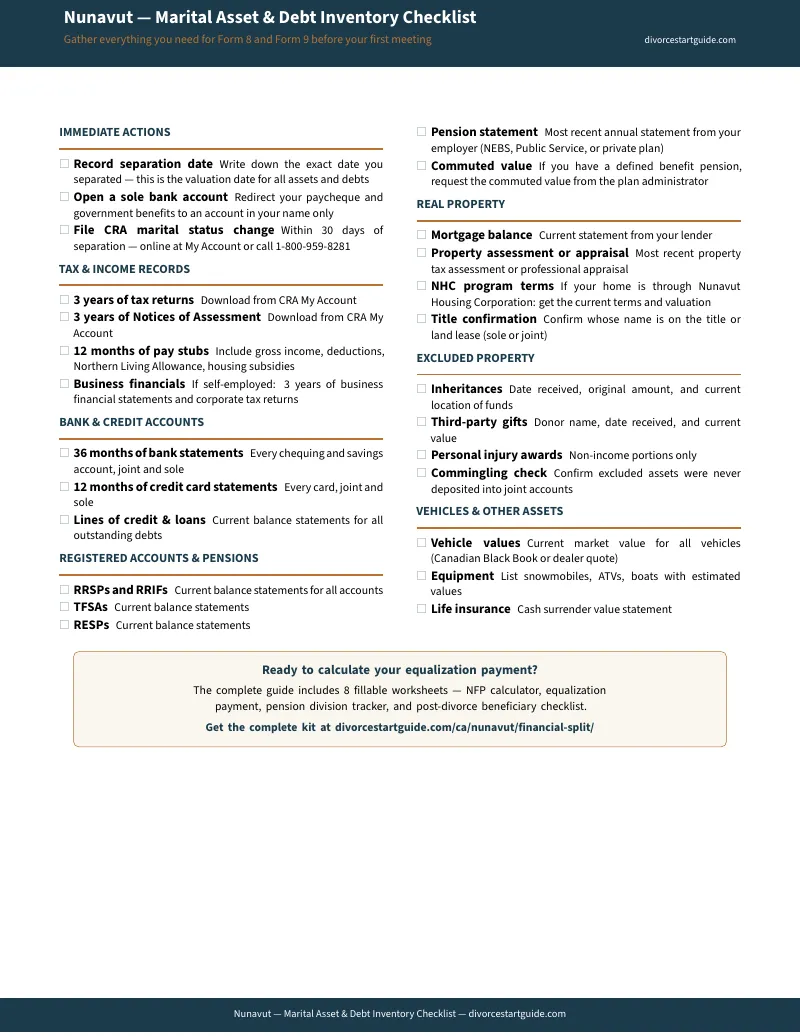
The free checklist is a 24-item marital asset and debt inventory — everything you need to gather before you touch any court form. It covers tax records, bank statements, pension documents, real property, excluded property tracing, and the three immediate actions to take on the day of separation.
Who this is for
The self-represented filer who downloaded Form 8 and Form 9 and realized they need a translation workbook, not just a blank template. The couple heading into private mediation who want to arrive with an organized financial binder instead of paying a mediator $150 to $250 per hour to sort through unsorted bank statements. The lower-earning spouse who is quietly gathering documentation to understand their equalization rights before the formal process begins. The common-law partner who just learned they have statutory property rights after two years of cohabitation — and a deadline to exercise them. The person who finished their divorce but still needs to execute the pension transfers, CPP split, beneficiary changes, and title updates that don't happen automatically. And the person with a lawyer who wants to cut billable hours by arriving with their classification and calculation already done.
Why not just use the free resources?
The Nunavut Court of Justice posts blank PDFs of Form 8 and Form 9. No step-by-step instructions, no tracing worksheets, no calculators. The Legal Services Board provides free legal aid — if you qualify, which most middle-income earners don't. The Law Society of Nunavut's Access to Justice program focuses on criminal law and family violence, not property division calculations.
The national alternatives — 3StepDivorce, LegalContracts.ca, Rocket Lawyer — generate fill-in-the-blank documents designed for provinces with standard two-level court systems. They don't account for Nunavut's single-level Court of Justice, the territorial Family Law Act's equalization model, NEBS or northern public service pensions, Nunavut Housing Corporation property structures, or the fact that your filing goes through one registry in Iqaluit.
The specialized tools — OurFamilyWizard, Custody X Change — handle co-parenting schedules but have zero property division, asset valuation, or equalization calculation functionality.
This guide fills the gap between blank government forms and a $2,000 lawyer retainer.
A straightforward guarantee
Work through the Equalization Navigation System. If the guide does not make your financial split clearer and better organized than any blank form or free resource could — email us at any time for a full refund. The risk of trying it is a fraction of one lawyer hour. The risk of rushing into a separation agreement without running the numbers is permanent: once equalization is finalized, it is extremely difficult to reopen.
For — less than fifteen minutes of a family lawyer's time — you get the classification system, the NFP calculation, the pension division walkthrough, the worksheets, and the step-by-step Form 8 and Form 9 preparation that blank court PDFs leave out.
Stop guessing at the numbers. Get the guide, build your financial inventory, and walk into your separation with the equalization math already done.
Frequently Asked Questions
What if the rules change after I buy?
We update the guide when the rules change. Email us any time, even years later, and we'll send you the current edition free.