The court forms ask for your parenting plan. They don't help you write one.
You've found the Supreme Court forms — the Originating Application (F4.03A), the Consent Order (F34.02B), the parenting statement. You've found the blank boxes that ask you to describe your "regular parenting schedule," your "holiday and special occasion schedule," and your "decision-making arrangements." And you've discovered the gap: the forms don't tell you how to structure a schedule that crosses — or avoids — the 40% shared-parenting threshold that changes your child support calculation entirely. They don't tell you how to divide decision-making responsibility across education, health, religion, and extracurriculars so you don't end up back in court because one parent enrolled the child in competitive hockey without the other's agreement. And they don't explain whether a 2-2-3 rotation or an alternating-week schedule fits a toddler versus a teenager — or how to handle pickup logistics when one parent is in Corner Brook and the other is in Conception Bay South.
Meanwhile, a family lawyer in St. John's charges $225–$365 per hour plus HST. A $5,000 retainer buys you roughly fifteen hours. Three or four of those hours go to your lawyer asking you questions you could have answered yourself — if someone had told you what the questions were and how to think through the answers.
You don't need someone to draft your parenting plan for you. You need to know what the plan requires before you sit down at your kitchen table to build it.
The Parenting Plan Navigation System
This is a complete, step-by-step guide to building a parenting plan in Newfoundland and Labrador — designed for the specific rules that make this province different. It is not legal representation and it does not file your papers. It is the planning and structuring intelligence that the blank court forms leave out.
At its core is the Parenting Plan Navigation System — a structured method that walks you from "I know I need a parenting schedule but I don't know what the court expects" to a comprehensive, child-focused plan that meets the best-interests standard. It handles the part everyone gets wrong: translating the new legal terminology introduced by Bill 12 (decision-making responsibility, parenting time, contact) into concrete, enforceable plan language. Mapping age-appropriate schedules from infancy through adolescence with overnight calculations that track the 40% threshold. Building communication protocols and dispute resolution clauses that prevent the small disagreements from becoming $300-per-hour court applications. And navigating the mandatory Family Justice Services process — the mediation intake, the three-hour "Living Apart, Parenting Together" course — so you don't walk into your first session unprepared.
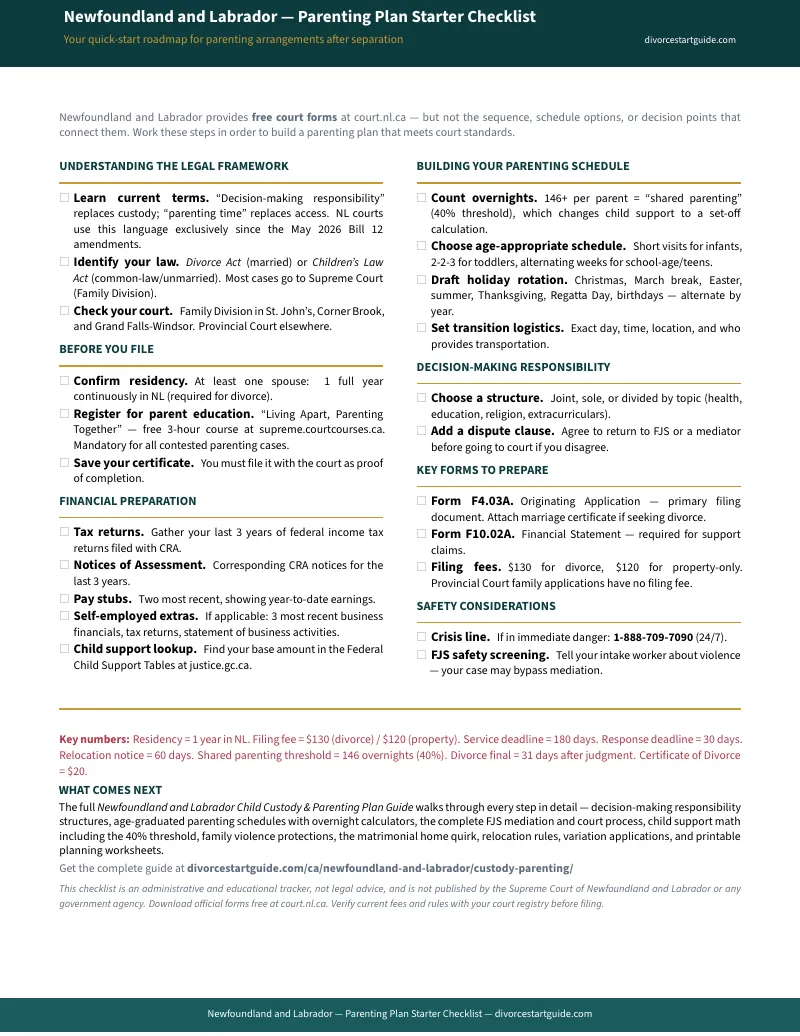
What's inside — the 16-chapter guide, 8 standalone worksheets, and the free checklist
- Decision-Making Responsibility Worksheet (standalone PDF) — turns vague "we'll share decisions" into documented, enforceable terms across the four categories the court recognises: health, education, cultural and religious upbringing, and significant extracurriculars. Because "joint decision-making" without a disagreement process means you're back in court the first time one parent wants to switch schools or refuse a vaccination.
- Age-Based Schedule Templates (standalone PDF) — six developmental stage templates (infancy through adolescence), each with specific parenting-time patterns, transition logistics, and overnight math. Includes the critical 40% threshold calculation: 146 overnights per year triggers shared-parenting classification under the Federal Child Support Guidelines, which shifts your support to a set-off formula. A few overnights per month can mean thousands of dollars per year in either direction.
- FJS Mediation Prep Workbook (standalone PDF) — pre-session worksheets for the mandatory Family Justice Services intake, the "Living Apart, Parenting Together" parent education course, and the mediation sessions that follow. Covers what to bring, what to expect, and how to present your proposals so the mediator's clock doesn't start at zero while you figure out what you want.
- Court Process Roadmap (standalone PDF) — which court to file in (Supreme Court Family Division at 21 Kings Bridge Road for the Avalon Peninsula, Provincial Court or General Division elsewhere), which forms, the $130 filing fee, and the response timelines. Because filing in the wrong court can delay your case by months.
- Holiday and Special Occasion Rotation Planner (standalone PDF) — a fillable worksheet for alternating every holiday between parents, including Newfoundland-specific dates. Space for specific pickup and drop-off times so there's nothing left to argue about on December 24th.
- Communication Protocol Templates (standalone PDF) — ready-to-use frameworks for co-parenting emails, schedule change requests, handoff logistics, and conflict de-escalation. Written to reduce parent-to-parent friction so your children aren't caught in the middle of hostile text messages about who forgot the snow pants.
- Relocation Framework — the 60-day notice requirement, what the notice must contain, the 30-day objection window, and how the court evaluates a contested move. If you're thinking about relocating — or your ex-partner is — this chapter explains every step before you make a decision that could trigger a court application.
- Family Violence and Safety Planning — structured protocols for supervised parenting time, safe handoff arrangements, and the protective measures available through the Supreme Court when standard co-parenting boundaries are not sufficient.
- Property Division — The Matrimonial Home Rule — the 50/50 presumption under the Family Law Act, the unique protections on the matrimonial home (both spouses have equal possession regardless of whose name is on the title), and why common-law partners face entirely different rules. This matters for your parenting plan because the family home is often the child's primary residence — and neither spouse can sell, mortgage, or encumber it without written consent.
- Child Expense Tracking Worksheet (standalone PDF) — Section 7 extraordinary expenses tracker with income-proportional cost sharing, payment logistics, and receipt management. Covers childcare, medical, dental, school, sports, and post-secondary savings.
- Variation and Modification Worksheet (standalone PDF) — the "material change in circumstances" standard for changing an existing order, with a worksheet to document your evidence and proposed new arrangement so your application is organised from day one.
Who this is for
The parent who just learned that "custody" and "access" are no longer the legal terms in Newfoundland and Labrador — and needs to understand what the new terminology actually means for their agreement. The self-represented filer preparing a parenting application who needs a plan that won't get sent back by the court registry for missing elements. The parent heading into mandatory FJS mediation who wants to arrive with draft schedules already mapped so the mediator's clock doesn't start at zero. The parent calculating whether a proposed 4-3 schedule puts them above or below the 40% shared-parenting threshold — and what that means for child support. And the parent with an existing agreement that no longer works because the children are older, one parent has a new job in another province, or the pickup logistics have become a weekly battle.
Why not just use the free resources?
Because free resources give you definitions, not decisions. PLIAN's publications explain what decision-making responsibility means. The Family Justice Services website provides an overview of the mediation process. The Department of Justice distributes "Making Plans," a general guide to parenting arrangements. None of them give you a worksheet that maps your specific week across two households and calculates the overnight percentage. None provide communication templates for handling schedule change requests without escalating. None walk you through the difference between a basic parenting plan and a detailed plan for higher-conflict situations — or help you decide which one your family actually needs.
The co-parenting apps — OurFamilyWizard at $110–$300 per year per parent, Custody X Change starting at $6 per month — are built for ongoing communication logging, not initial plan drafting. They require both parents to pay, both parents to participate, and they don't address Newfoundland and Labrador's specific filing requirements, Bill 12 terminology, FJS process, or the matrimonial home protections under the Family Law Act. They are useful tools after you have an agreement. This guide helps you write the agreement.
An honest guarantee
Work through the Parenting Plan Navigation System. If the guide doesn't make your parenting arrangements clearer and better organised than any free government page or blank court form could — email us at any time for a full refund. The risk of trying it is a fraction of one mediator session. The risk of filing an incomplete parenting plan is a rejected application and months of delay.
For — less than fifteen minutes of attorney time — you get the scheduling worksheets, the decision-making framework, the communication templates, and the step-by-step filing roadmap that the blank forms leave out.
Stop guessing what the court expects. Get the guide, build your parenting plan, and walk into your next step — whether that's FJS mediation, a lawyer's office, or the courthouse registry — with the work already done.