New Brunswick's court forms ask for your parenting plan. They don't tell you how to write one — or which court track you're even on.
You've found the forms on Family Law NB — the Application (Form 81A in Saint John or Moncton) or the Petition for Divorce (Form 72A everywhere else). And you've discovered the problem: the forms have blank fields for your parenting schedule, your decision-making arrangements, and your dispute resolution process. But they don't tell you how to structure a schedule that holds up in court. They don't explain how to divide decision-making responsibility across healthcare, education, religion, and extracurriculars when the Divorce Act uses terminology your existing arrangement doesn't recognise. And they don't warn you that the schedule you're proposing might land you 10 hours short of the 40% parenting-time threshold — a line that completely changes how child support is calculated.
Meanwhile, a New Brunswick family lawyer charges C$300 to C$600 per hour. Private family mediators run C$250 to C$400 per hour, with multi-session packages averaging C$2,000 to C$10,000. The free government resources — PLEIS-NB booklets, the Justice Canada Parenting Plan Tool — give you definitions and blank fields. The online parenting plan tool from the federal government doesn't even let you save your progress. It emails your final text in one block with no formatting.
You don't need someone to write your parenting plan for you. You need to know what the plan requires, how to structure it for the court track your district uses, and how to avoid the mistakes that force people back to court six months later.
The Dual-Track Parenting Plan System
This is a complete, step-by-step guide to building a parenting plan in New Brunswick — designed for the specific reality that this province runs two entirely different court procedures depending on where you live. It is not legal representation and it does not file your papers. It is the planning and structuring intelligence that the blank court forms leave out.
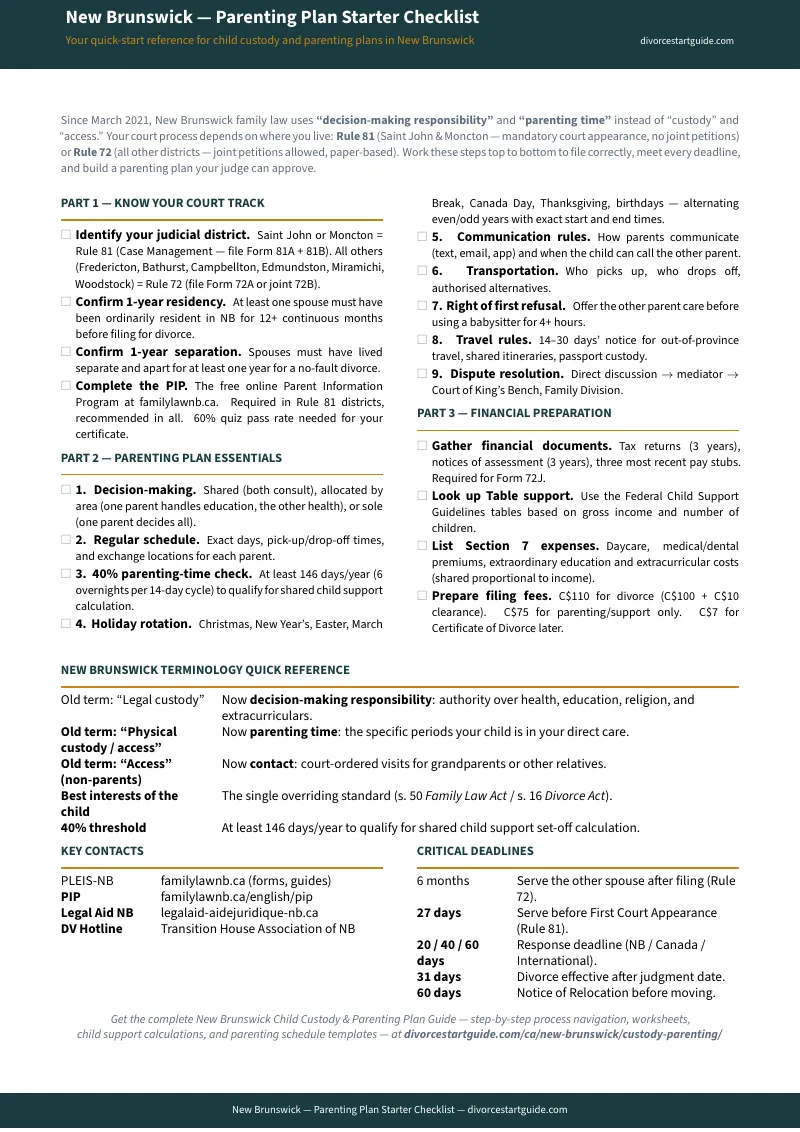
At its core is the Dual-Track Parenting Plan System — a structured method that walks you from "I know I need a parenting plan but I don't know what the court expects" to a comprehensive, child-focused agreement a New Brunswick judge can take seriously. It handles what everyone gets wrong: translating the modern terminology (decision-making responsibility, parenting time, contact) into concrete, enforceable plan language. Figuring out whether you're filing under Rule 81's Case Management Model or Rule 72's standard process — because the forms, the procedures, and the intermediate steps are different. Calculating whether your proposed schedule crosses the 40% shared-parenting threshold that shifts child support from a simple table amount to a set-off formula using both incomes. And building a plan that covers the provisions most parents forget until they become disputes — right of first refusal, rules for new partners, vacation travel authorisation, and a dispute resolution clause.
What's inside — the 12-chapter guide, worksheets, and the free checklist
- Decision-Making Responsibility Worksheet — a structured planner that turns vague "we'll share decisions" into documented, enforceable terms across four categories: healthcare, education, religion and spirituality, and major extracurricular activities. For each area, specify sole or joint authority, notice requirements, and what happens when parents disagree. Because agreeing to "shared decision-making" without defining it is how parents end up back in court.
- Parenting Schedule Templates with the 40% Calculator — side-by-side visual comparisons of common schedules: alternating weekends (roughly 80/20), 5-2 rotations (70/30), alternating weeks and 2-2-5-5 patterns (50/50). Each schedule is mapped to actual overnights and hours per year. The worksheet calculates whether your proposed arrangement puts you above or below the critical 40% shared-parenting threshold under Section 9 of the Federal Child Support Guidelines. Miss that threshold by even a few hours and child support is calculated on a completely different basis.
- Holiday and Special Day Matrix — a step-by-step planning sheet for dividing Christmas, Easter, March Break, summer vacation, Thanksgiving, birthdays, Mother's Day, Father's Day, and other important dates. Covers both alternating and split holiday structures, with transport and exchange logistics built into each plan.
- Rule 81 vs Rule 72 Filing Roadmap — two separate, step-by-step court process walkthroughs. One for parents in Saint John or Moncton, where the Family Case Management Model uses Triage Coordinators, mandatory case conferences, and Case Management Masters who can make interim orders. One for parents in Fredericton, Bathurst, Campbellton, Edmundston, Miramichi, and Woodstock, where the standard process runs without triage or case management. Each roadmap covers the exact forms, filing fees (C$75 for parenting applications, C$110 for divorce petitions), service requirements, and what to expect at each stage.
- PIP Course Walkthrough — New Brunswick requires the free online Parent Information Program before the court schedules a custody hearing. The guide covers registration, the three-part video series, the multiple-choice quiz with its 60% passing threshold, and how to get the Certificate of Completion. Most parents don't realise this is a prerequisite until the court clerk sends them back to complete it.
- Child Support and the 40% Threshold Explained — how the Federal Child Support Guidelines calculate support based on your parenting-time split. Covers the sole-custody table amount, the shared-parenting set-off formula, Section 7 extraordinary expenses (childcare, medical, extracurriculars), and the New Brunswick Child Support Recalculation Service for adjusting amounts without returning to court.
- Financial Disclosure Worksheet — a complete document-gathering checklist and monthly expense tracker. New Brunswick requires full financial disclosure in every custody and support case. The worksheet ensures you collect income tax returns, pay stubs, employment letters, bank statements, and property valuations before your first court date or mediation session — not during it at C$400 per hour.
- Property Division Overview — the basics of New Brunswick's marital property regime for married couples (presumption of equal division under the Marital Property Act) and the different rules for common-law partners (no automatic equal split). Covers pension division and the property division worksheet.
- Modification and Relocation Rules — the "material change in circumstances" standard for varying an existing order. Covers the difference between a contested motion (Form 81F) and a joint Consent Motion to Change (Form 81I). Explains the Divorce Act's strict 60-day relocation notice requirement, the 30-day objection window, and what happens if the other parent files a court application.
- Mediation and Case Conference Preparation — how to prepare for private mediation or a Rule 81 case conference. Includes pre-mediation worksheets for organising your proposals, a priorities-and-flexibility planner, and a child's needs inventory. Parents who bring structured proposals to mediation resolve faster and spend less on professional fees.
Who this is for
The parent who just learned that "custody" and "access" are no longer the legal terms — and needs to understand what decision-making responsibility and parenting time actually mean for their agreement. The self-represented filer who needs the step-by-step sequence for their specific judicial district — Rule 81 in Saint John or Moncton, or Rule 72 in Fredericton, Bathurst, and everywhere else. The parent heading into mediation or a case conference who wants to arrive with draft schedules already mapped so the session doesn't start from zero. The parent calculating whether a proposed schedule puts them above or below the 40% shared-parenting threshold — and what that means for child support. And the parent with an existing order that no longer works because of a relocation, a changed work schedule, or a child's evolving needs.
Why not just use the free resources?
Because free resources give you definitions, not decisions. The PLEIS-NB booklets explain what decision-making responsibility means. Family Law NB provides intake information. The court registry distributes blank PDF forms. The federal Parenting Plan Tool walks you through considerations — but it can't save your progress, and it delivers the output as a single unformatted email. None of these give you a worksheet that maps your specific parenting week, calculates the overnight percentage, and checks it against the 40% threshold. None provide separate filing roadmaps for Rule 81 and Rule 72 districts. None walk you through the provisions most parents forget — right of first refusal, new-partner protocols, vacation travel authorisation, and a dispute resolution clause that keeps future disagreements out of court.
The co-parenting apps — Custody X Change at $10 to $40 per month per parent, OurFamilyWizard at $110 to $300 per year per parent — are built for ongoing communication logging, not initial plan drafting. They offer generic Canadian templates, not the New Brunswick filing sequences and form numbers your district requires. They are useful tools after you have an agreement. This guide helps you write the agreement.
An honest guarantee
Work through the Dual-Track Parenting Plan System. If the guide doesn't make your parenting arrangements clearer and better organised than any free government page or blank court form could — email us at any time for a full refund. The risk of trying it is a fraction of one mediation session. The risk of filing an incomplete parenting plan is a rejected application and months of delay in a court system that is already backlogged.
For — less than fifteen minutes of attorney time — you get the 12-chapter guide, 10 standalone printable worksheets, and the step-by-step court process roadmap that the blank forms leave out.
Stop guessing what the Court of King's Bench expects. Get the guide, build your parenting plan, and walk into your next step — whether that's mediation, a lawyer's office, or the court registry — with the work already done.
Frequently Asked Questions
What if the rules change after I buy?
We update the guide when the rules change. Email us any time, even years later, and we'll send you the current edition free.