
The court gives you blank forms. It doesn't tell you how to calculate the property pool or navigate the SA state agencies.
You've found the FCFCOA's free DIY kit for Consent Orders — Form 11 and Form 12. But blank fields don't explain how to value your superannuation interest, calculate the net equity in your family home after mortgage discharge, or write enforceable property transfer clauses that the registry won't reject.
Meanwhile, a family lawyer in Adelaide charges $300–$700 per hour. A $500 initial consultation buys you thirty minutes of useful advice — after the first twenty are spent organising the statements you brought in a folder. Even the free government platform amica.gov.au caps out at $990 for Consent Order documents — and it can't handle trusts, business structures, or complex super splits.
You don't need someone to fill in forms for you. You need to know what goes into the property pool, how to value it, how to draft clauses that work, and how to claim the SA stamp duty exemption through Revenue SA when you transfer the title — all in the right sequence.
The Dual-Track Settlement Navigation System
This is a complete, step-by-step guide to dividing money, property, superannuation, and debts in a South Australia divorce — built around the federal Family Law Act 1975 (Cth) and the South Australian state agency processes that national guides skip entirely. It is not legal advice. It is the calculation and sequencing intelligence that blank government forms leave out.
At its core is the Dual-Track Settlement Navigation System — a structured method that walks you from "I have a pile of bank statements and no idea what's matrimonial" to a clean, documented asset-and-debt inventory that satisfies the court's "just and equitable" standard under Section 79. It handles the dual-track problem: federal court applications on one side, and SA state agencies (Land Services SA, Revenue SA, Consumer and Business Services) on the other — with the exact chronological sequence that tells you which step feeds into which, when the state paperwork must happen relative to the court order, and what happens if you get the order wrong.
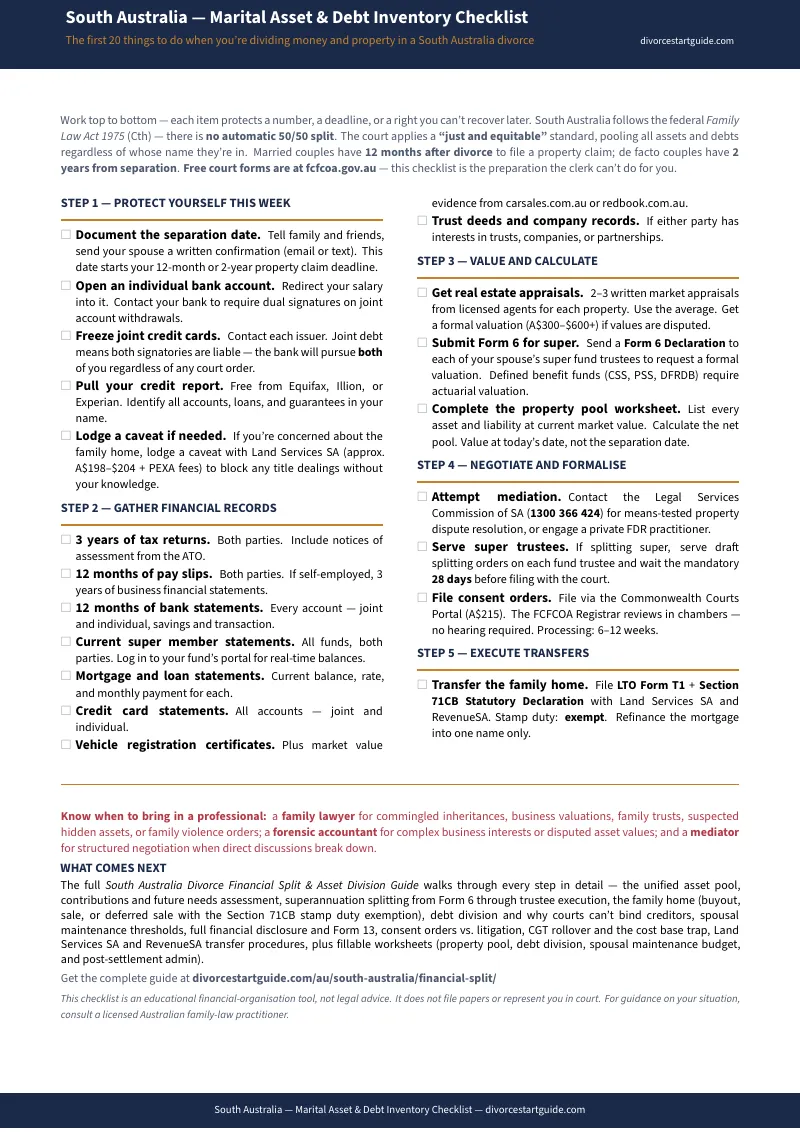
What's inside — 15 chapters, 8 standalone worksheets, and the free checklist
- The Asset & Debt Inventory System — a structured method to catalogue every item in the property pool. Real estate equity calculations, super valuations, bank accounts (including offsets and redraw), vehicles, shares, crypto, business interests, trust interests, and every type of liability. Covers the commonly missed items — redraw facility balances, offset account split implications, negative gearing positions, and ATO tax debts — that skew an asset pool by thousands when they're left out.
- The Contribution Assessment Framework — exactly how to document and quantify financial, non-financial, and homemaker/caregiver contributions. The law gives these equal weight, but the free court kit doesn't explain how to present them. This framework does — with worksheets structured around the factors the court actually weighs under Section 79.
- The Superannuation Splitting Procedure — step-by-step from Form 6 information request to final court filing. How to request valuations from accumulation and defined benefit funds, draft splitting clauses, give the fund trustee the mandatory 28-day procedural fairness period, and handle the administrative fees. Includes the critical decision framework: split vs. offset vs. preservation — because taking $80,000 in super and taking $80,000 in cash are not the same thing after tax and access restrictions.
- The Family Home Decision Framework — sell, buyout, defer, or exclusive occupancy? Calculates net equity after mortgage discharge, agent fees, and transaction costs. Covers refinancing into a sole name, the borrowing capacity reality check, caveats through Land Services SA, and why you need a sealed Consent Order before transferring the title.
- The SA Stamp Duty Exemption Walkthrough — the administrative step every national guide misses. How to complete the Section 71CB statutory declaration for Revenue SA to claim the matrimonial transfer duty exemption. Get this wrong and you pay full stamp duty on your own property transfer — thousands of dollars on a court-ordered transaction that should be exempt.
- The SA State Agency Transfer Guide — the three agencies you'll deal with after the court order is sealed: Land Services SA for real estate title transfers (including PEXA registration), Service SA for motor vehicle transfers, and Consumer and Business Services for name changes. Each with the forms, fees, and the sequence that avoids delays and duplicate charges.
- The Consent Order Preparation Method — section-by-section guidance for drafting your Application for Consent Orders. Registry-compliant terminology, enforceable property transfer clauses, debt allocation language that protects you, and superannuation splitting orders — written so the registry approves your application rather than sending it back for redrafting.
- The Debt Allocation Strategy — how debts are treated as liabilities in the net pool, why a Consent Order assigning a debt to your ex-spouse does not release you from the bank's claim, and the refinancing-before-filing approach that actually protects you.
- Spousal Maintenance Assessment — the two-part federal test (inability to self-support vs. capacity to pay), the factors that determine amount and duration, the strict statutory time limits, and a feasibility worksheet. Covers periodic vs. lump sum, tax treatment, and when to apply for variation.
- Tax, CGT & Transfer Duty Chapter — capital gains rollover relief on property transfers between spouses, the stamp duty exemption procedure through Revenue SA, spousal maintenance tax treatment, and the cost base trap. Because a $200,000 investment property and $200,000 in super are not worth the same after CGT.
Who this is for
The spouse who has just separated and needs to know: what do I do first, what can wait, and what has a hard deadline? The self-represented couple preparing their own Consent Orders — amicable or tense — who need the calculations and the drafting guidance that the free DIY kit leaves out. The primary caregiver worried about being out-negotiated by a more financially literate partner, who needs an objective framework to value their homemaker contributions. The person with $400,000 in combined super who needs to understand what a splitting order actually does to their fund. And the person who has engaged a solicitor but wants to stop paying $400 per hour for document organisation they can do themselves.
Why not just use the free resources?
Because the free resources give you procedures, not calculations. The FCFCOA website explains that you can apply for Consent Orders and that assets should be divided fairly. It doesn't tell you how to calculate the net property pool, write enforceable splitting clauses your super fund trustee will accept, or claim the SA stamp duty exemption through Revenue SA without triggering a full duty assessment.
Amica — the government-backed digital tool — starts at $297 for a basic agreement and goes to $990 for Consent Order documents. But that agreement is not legally binding until approved by the court, it excludes complex superannuation splitting, and it cannot handle trusts or company structures. Peaceful Path's kits run $97–$147 and are designed to upsell into $1,950–$3,397 fixed-fee legal review packages. None of them cover the South Australian state agency processes — Land Services SA title transfers, Revenue SA stamp duty exemptions, Service SA vehicle transfers — that only apply in this jurisdiction.
An honest guarantee
Work through the Dual-Track Settlement Navigation System. If the guide doesn't make your financial split clearer and better organised than any blank form or free article could — email us at any time for a full refund. The risk of trying it is a fraction of one solicitor consultation. The risk of getting your Consent Orders rejected by the registry — or missing your 12-month filing deadline — is permanent.
For — less than fifteen minutes of an Adelaide solicitor's time — you get the inventory system, the contribution framework, the super splitting procedure, the SA stamp duty walkthrough, the state agency transfer guide, and the step-by-step sequence that the free forms leave out.
Stop staring at blank Form 11 fields. Get the guide, build your asset pool, and walk into your negotiation — or your solicitor's office — with the numbers already done.