You Agreed on the Kids. But You Have No Idea How to Write It Down.
You and your co-parent have talked it through. You have a rough plan — who has the kids on weekdays, how you'll split school holidays, what happens at Christmas. Maybe you even agree on most of it. But now you need to turn that verbal understanding into something that actually works: a document specific enough that neither of you can reinterpret it later, formatted correctly for the Federal Circuit and Family Court of Australia, and aligned with the May 2024 legal reforms that changed how parenting arrangements work in this country.
You could download a free government fact sheet from Legal Aid ACT. It will tell you that parenting plans exist. It will not show you how to draft a changeover clause that prevents arguments, how to structure holiday rotations so your child isn't shuttled back and forth on Christmas morning, or how to write "major long-term issues" clauses using the exact statutory language the FCFCOA registrar expects to see.
You could hire a Canberra family lawyer at $350-$550 per hour. For an amicable arrangement that both parents already agree on, that's thousands of dollars to format what you've already decided.
The ACT Parenting Arrangement System
This guide sits in the gap between blank government forms and expensive legal representation. It's a complete navigational system for ACT parents — from your first Family Dispute Resolution session through to sealed, enforceable Consent Orders via the Commonwealth Courts Portal.
It covers the full sequence: mandatory FDR mediation (with cost comparisons for Canberra's Family Relationship Centres, the Conflict Resolution Service, and private practitioners), drafting your parenting plan using correct Australian terminology, structuring age-appropriate schedules, and converting your agreement into legally binding orders without a court appearance.
Every chapter is built specifically for the Australian Capital Territory — the Nigel Bowen Commonwealth registry, Access Canberra requirements for name changes and school enrolments, ACT school term dates for holiday scheduling, and the post-May 2024 best interests framework that abolished the old presumption of equal shared parental responsibility.
What's Inside — 10 PDFs
- Complete Guide (guide.pdf) — 16 chapters covering the full parenting arrangement process from first steps through court filing, with tables, decision flowcharts, and fillable worksheets
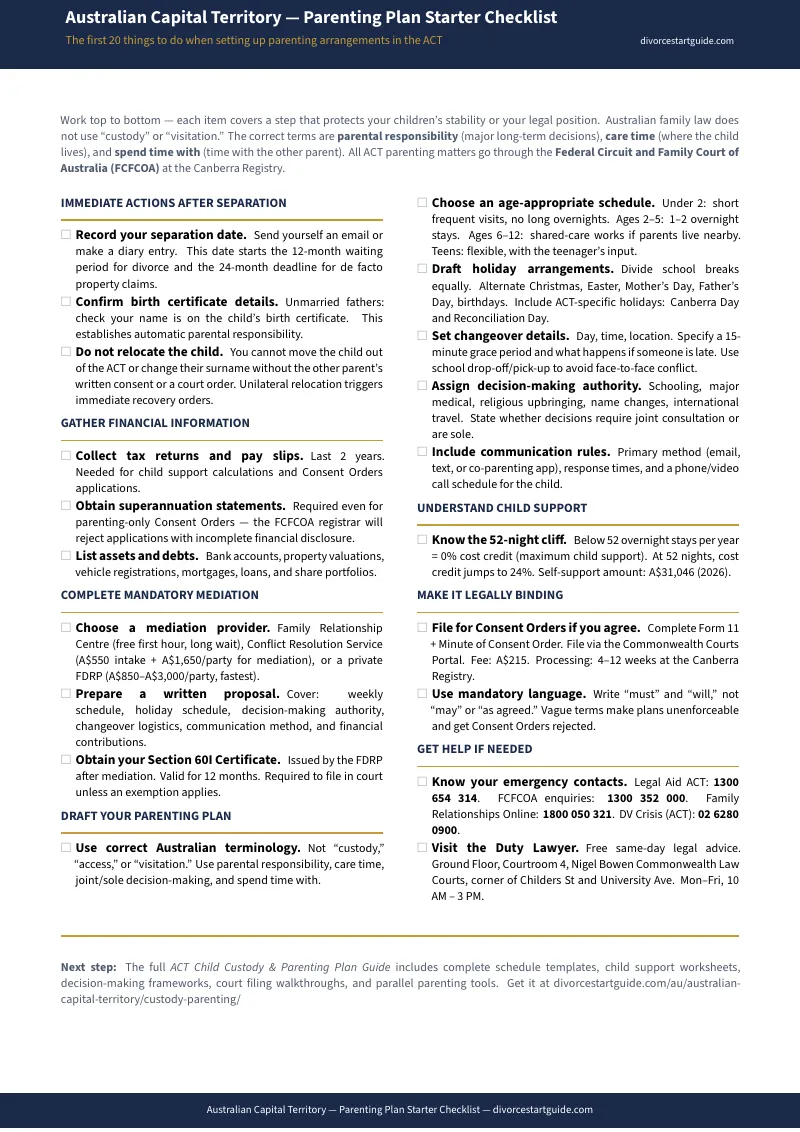
- Quick-Start Checklist (checklist.pdf) — one-page overview of all 20 action items with the correct sequence and target agencies (also available free)
- Weekly Schedule Planner (weekly-schedule-planner.pdf) — fillable care-time table with changeover details and overnight count guidance
- Holiday Schedule Planner (holiday-schedule-planner.pdf) — school holidays, public holidays, and special occasions with alternating-year columns
- Decision-Making Authority (decision-making-authority.pdf) — allocate joint or sole decision-making for each major long-term issue
- Financial Contributions Worksheet (financial-contributions.pdf) — record how child-related expenses beyond child support are shared
- Communication Protocol (communication-protocol.pdf) — establish co-parent communication rules, response times, and dispute resolution
- Child Support Calculation Inputs (child-support-inputs.pdf) — gather the figures Services Australia needs before your assessment
- Key Deadlines and Timelines (key-deadlines.pdf) — quick-reference fridge sheet for every critical time limit
- ACT Support Services Directory (act-support-services.pdf) — free legal services, FDR providers, court contacts, and practical registry information
The guide covers:
- FDR mediation preparation — what to bring, how to present a structured proposal, and side-by-side cost/wait-time comparisons for all three Canberra pathways (FRC, CRS, private FDRP)
- Age-specific parenting schedules — concrete weekly templates for infants, toddlers, primary school, and teenagers, with the developmental reasoning behind each pattern
- Holiday and special-occasion splitting — alternating Christmas, school holiday blocks, ACT-specific public holidays (Canberra Day, Reconciliation Day, Family & Community Day), and birthday arrangements
- Parallel parenting for high-conflict situations — zero-contact changeover protocols, communication app frameworks, and strict clause structures that eliminate room for reinterpretation
- The consent orders pathway — exact eFiling steps through the Commonwealth Courts Portal, the mandatory Notice requirements, and formatting rules that prevent registrar rejection
- Child support thresholds — how your care-percentage (nights per year) directly determines your Services Australia assessment, with the key threshold boundaries that trigger payment changes
- Relocation and interstate travel — the legal requirements before moving a child out of the ACT region, including the border with NSW that many parents don't realise triggers the same restrictions as interstate moves
Who This Is For
- Separating or divorcing parents in the ACT who have reached a general agreement and need to formalise it correctly
- Parents preparing for mandatory FDR mediation at a Canberra Family Relationship Centre, CRS, or private practitioner — and want to walk in with a structured proposal instead of vague hopes
- De facto or unmarried parents who need clarity on their identical legal standing under the Family Law Act 1975
- Self-represented parents filing consent orders through the Commonwealth Courts Portal without a solicitor
- Parents whose informal verbal agreement has broken down and need a watertight written plan that eliminates ambiguity
Why Not Just Use Free Templates?
You can download blank forms from the FCFCOA portal and read fact sheets from Legal Aid ACT. They're free. Here's what they don't give you:
- No drafting guidance. A blank field labelled "Holiday Arrangements" doesn't show you how to split Christmas Eve without a logistics disaster, or warn you against phrases like "as agreed" that are structurally unenforceable in a low-trust co-parenting environment.
- No terminology correction. Templates you find online often use American terms — "sole custody," "visitation rights," "joint legal custody." These have no statutory standing in Australia. FCFCOA registrars will flag or reject filings that use them. The guide uses only the correct post-2024 statutory language.
- No sequencing. Government websites explain individual steps in isolation. They don't map the end-to-end process: when to do FDR, when to draft, when you need a Section 60I certificate, what triggers the 12-month filing deadline after divorce, and how to avoid accidentally locking yourself out of the consent orders pathway.
- No ACT-specific detail. Generic Australian templates don't address Access Canberra's requirements for name changes, the specific FDR providers operating in the territory, or the practical realities of the ACT-NSW border crossing rules for relocation.
Free forms give you empty fields. This guide gives you the exact language, sequence, and ACT-specific detail to fill them correctly the first time.
Satisfaction Guarantee
If the guide doesn't give you a clearer picture of your parenting arrangement within 24 hours of downloading it, email us and we'll refund you in full. No forms, no justification needed.
Get Your Parenting Arrangement Right the First Time
Every week without a written plan is another week of verbal agreements that can be reinterpreted, changeovers that can be missed, and decisions made unilaterally. The checklist below is free — it shows you the full scope of what needs to happen. The complete guide gives you the how: every clause structure, every form, every ACT-specific sequence.
Download the free checklist to see what's ahead. Get the full guide for to finish this properly — without a single rejected filing or ambiguous clause.
Frequently Asked Questions
What if the rules change after I buy?
We update the guide when the rules change. Email us any time, even years later, and we'll send you the current edition free.