
Tennessee Gives You Every Divorce Form for Free. It Doesn't Give You the Filing Sequence.
The Tennessee Administrative Office of the Courts publishes complete, universally accepted divorce form packets — one for couples with children, another for couples without. Both free. Help4TN adds a legal chatbot and a helpline. All free.
Here's the problem: you download the packet and realize there's no filing order. No explanation of whether you file in Circuit Court or Chancery Court. No timeline for when the Marital Dissolution Agreement gets signed versus when it gets filed. No guidance on what happens if your spouse doesn't respond within 30 days, or how to navigate the default judgment process under TRCP Rule 55. The clerk's office can accept your papers — they cannot tell you which papers to bring, in what order, or whether your case follows the Agreed Divorce path or the Irreconcilable Differences path.
The gap between "here are the forms" and "here's how to execute them through the courthouse" is exactly where pro se filers lose weeks, refile paperwork, or forfeit a non-refundable filing fee of $235 to $360. The forms are the raw materials. This guide is the construction sequence.
The Tennessee Court Process Navigator
This is not a document-preparation service. It's not auto-filled forms repackaged behind a $137 paywall. It's the step-by-step operational sequence that no Tennessee court publishes — which procedural path your case follows, what to file at each stage, every deadline that matters from complaint to final decree, and the decision logic that determines whether you qualify for the simple Agreed Divorce track or need the fuller Irreconcilable Differences route.
Every chapter is built around Tennessee's actual procedural rules — T.C.A. Title 36 Chapter 4, the Tennessee Rules of Civil Procedure (TRCP), and county-level filing procedures for Davidson, Shelby, Knox, Hamilton, and beyond. Not recycled national content with "Tennessee" dropped into the headings.
What You Get
The Complete Filing Process Guide
A 13-chapter guide covering the entire arc of a Tennessee divorce case, plus 7 standalone printable worksheets you can use throughout your case:
- Four-Path Decision Framework — how your case proceeds based on your situation: the Agreed Divorce (simplest, 60–90 days, couples with no children or complex assets), the Irreconcilable Differences path (most common for couples with children or property), the Default Judgment path (when your spouse doesn't respond within 30 days), or the Contested track. Each path gets its own chapter with a step-by-step walkthrough
- Circuit vs. Chancery Court Guide — Tennessee splits divorce cases between two courts, and which one you use depends entirely on your county. This section maps the routing rules so you don't file in the wrong court and lose your filing fee
- Waiting Period Calculator (standalone PDF) — the mandatory 60-day cooling-off period (no children) or 90-day period (with children) under T.C.A. § 36-4-101 cannot be waived or shortened by any Tennessee court. This worksheet calculates your earliest possible decree date and maps every critical deadline between filing and finalization
- Total Cost Estimator (standalone PDF) — budget every expense before you visit the clerk's window: filing fees by county, service of process costs, parenting seminar fees, certified copies, and the fee postponement process for filers who cannot afford the upfront cost
- Service of Process Guide — four legal methods to notify your spouse: the free notarized Waiver of Service (Rule 4.07) for amicable couples, Sheriff's service, private process server, and Certified Mail with restricted delivery. When to use each one, what constitutes valid proof of service, and how defective service can void your entire case
- Default Judgment Walkthrough — the complete TRCP Rule 55 timeline when your spouse doesn't respond: the 30-day answer window, Application for Clerk's Entry of Default, Motion for Default Judgment, the mandatory 5-day hearing notice, and default hearing preparation
- Document Preparation Checklist (standalone PDF) — check off every required form before you visit the clerk's window, organized by filing path with separate sections for cases with and without children
- Deadline Timeline Tracker (standalone PDF) — record your actual dates as you progress from filing through final hearing, with every critical milestone and its statutory deadline
- Parenting Class Tracker (standalone PDF) — both parents must complete a state-approved 4-hour parenting education seminar under T.C.A. § 36-6-408 before the judge signs anything in cases with minor children. Lists approved online providers (from $24.97), the filing deadline, and how to avoid contempt issues if one parent drags their feet
- Property and Debt Inventory (standalone PDF) — structured inventory for marital vs. separate property under Tennessee's equitable distribution rules, with the commingling traps that turn protected separate property into divisible marital property
- Income and Expense Worksheet (standalone PDF) — gather both parents' income figures and child-related expenses before running the official TN DHS Child Support Calculator
- Safety Planning Chapter — Orders of Protection under T.C.A. § 36-3-601, the domestic violence exception to Tennessee's six-month residency requirement, address confidentiality, and how abuse changes the filing sequence
Quick-Start Checklist (Free Download)
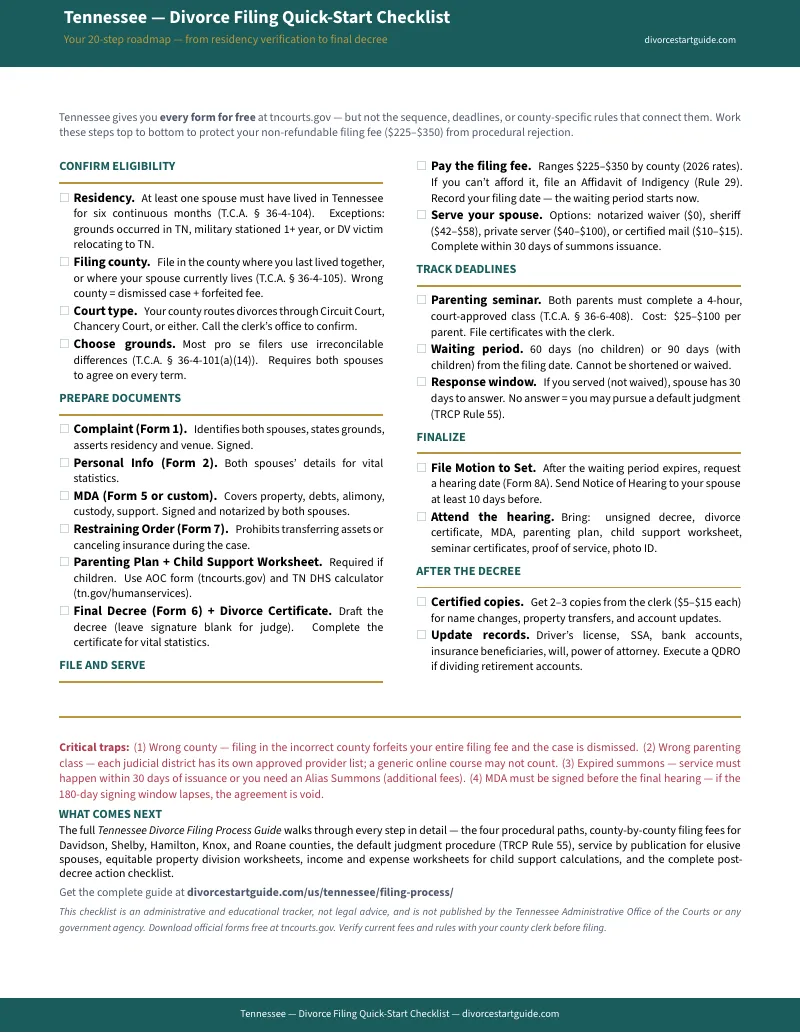
A printable 1-page overview of the entire Tennessee divorce filing sequence — residency rules, the four procedural paths, key deadlines, and what documents to gather before you start. Enough to see the full picture and decide whether you need the complete guide.
Who This Is For
- You and your spouse agree on most or all terms and want to handle the paperwork without a $3,000–$5,000 attorney retainer
- Your spouse was served but hasn't responded and you need to navigate the default judgment process without guessing at TRCP Rule 55 deadlines
- You downloaded the free state forms and realized there's no instruction manual — no filing order, no deadline tracker, no explanation of what happens after you serve papers
- You want to understand the full process before deciding whether to hire a lawyer, use a Rule 31 mediator, or handle it yourself
- You're confused about Circuit vs. Chancery Court and need to know which court handles divorces in your county before you drive to the wrong clerk's window
Why Free Court Forms and $137 Document Services Don't Solve This
The Tennessee Administrative Office of the Courts provides every divorce form you need, for free, at tncourts.gov. Download them. They're universally accepted. The problem isn't the forms — it's that the state gives you no filing sequence, no deadline calculations, and no decision logic for which procedural path to take. The clerk cannot legally answer those questions for you.
National document-preparation services (LegalZoom at $150–$500, 3StepDivorce at $299) charge you to auto-fill those same free forms through a questionnaire. They generate paperwork. They don't tell you whether your county routes divorces through Circuit or Chancery Court. They don't explain how Tennessee's no-fault ground requires mutual consent — meaning if your spouse refuses to sign, you cannot file under Irreconcilable Differences and must allege a fault ground instead. They don't walk you through the Rule 55 default judgment timeline when your spouse goes silent. And they don't map the waiting period math or the fee postponement process that can defer hundreds of dollars in upfront costs.
This guide costs — less than a single billable hour with a Tennessee family law attorney. One purchase, instant download, no subscription. You keep it for your entire case.
100% Satisfaction Guarantee
If the guide doesn't give you a clear, usable path through Tennessee's divorce filing process, email [email protected] and we'll make it right — no hoops, no time limit.
— Less Than One Hour of Attorney Time
A typical Tennessee family law attorney charges $200–$350 per hour. An uncontested divorce with full representation runs $1,500–$3,500 in flat fees. This guide gives you the complete filing sequence, deadline calculators, county-specific instructions, and worksheets for a fraction of a single billable hour — and you keep it for your entire case.