You Searched for Oklahoma Divorce Forms. Oklahoma Doesn't Have Any.
Oklahoma is a "non-form-supplied state." The court system does not publish a standardized divorce packet, a fill-in-the-blank petition, or a step-by-step guide. Each of Oklahoma's 77 district courts has its own clerk preferences, copy requirements, and cover sheet rules. Oklahoma County requires three physical copies of every petition, waiver, and decree. Other counties require two. Some clerks demand a specific cover sheet format that isn't posted anywhere online.
That's the first problem. The second one is new. Since November 1, 2025, House Bill 2138 rewrote the default judgment rules under 12 O.S. § 2012. If your spouse is served and fails to file a written response with the court clerk within 20 calendar days, a judge can sign a final divorce decree immediately — no motion required, no hearing scheduled, no advance notice sent. A text message to your spouse's lawyer doesn't count. An email doesn't count. Only a written filing with the clerk stops the clock.
Free websites give you blank forms. National document-prep services ($299–$1,999) fill out those same blank forms and leave you to figure out the courthouse. Neither one tells you that your spouse's waiver signed 23 hours after filing is automatically invalid, that Oklahoma County's filing fee is $258 while Tulsa County charges $235, or that the In Forma Pauperis process requires a personal appearance at the uncontested docket.
The Oklahoma Courthouse Filing Navigator
This guide is not forms, not legal advice, and not a document-preparation service that prints the same free PDFs the state provides elsewhere. It's the step-by-step operational sequence the court system doesn't publish: what to file, in what order, by what deadline, and what happens at each decision point — whether your spouse cooperates, disappears, or fights back.
Every chapter is built around Oklahoma's actual statutes and District Court Rules, not generic "how to get divorced" content recycled from a national template. The guide covers the specifics that make Oklahoma different: the non-form-supplied system, the 24-hour waiver signing window, the HB 2138 snap-default rules, the Automatic Temporary Injunction that takes effect the moment you file, the 90-day waiting period for cases with minor children, and the 6-month remarriage restriction that no other guide seems to mention.
What You Get
The Complete Filing Process Guide
A 14-chapter guide plus 7 standalone printable worksheets (separate PDFs you can print individually and take to the courthouse, your mediator, or your negotiation table):
- The Filing Sequence Navigator — the exact order for Oklahoma's non-form-supplied system: establishing residency and venue under 43 O.S. § 102, drafting the verified petition, filing with your county's district court clerk, issuing the summons and Automatic Temporary Injunction, serving your spouse, and navigating the waiting period. Each step includes the documents you need, the number of copies your county requires, and the fee you'll pay
- The 24-Hour Waiver Rule — Oklahoma's strictest timing trap explained in plain English. Your spouse cannot sign a notarized Entry of Appearance and Waiver until at least one full calendar day after the petition is filed and stamped. Sign too early and the waiver is void, your case stalls, and you restart the service clock
- HB 2138 Default Judgment Protection — whether you're the petitioner or the respondent, you need to understand the November 2025 changes. The guide covers how to file a timely written appearance, when and how to request a Motion for Enlargement of Time, and what happens when the 20-day window closes
- Four-Path Decision Tree — your case follows one of four tracks depending on how your spouse responds: the uncontested waiver path (often 2–3 weeks for childless couples), the standard uncontested path with service, the default path when your spouse doesn't respond, and the contested track through discovery and trial. Each path mapped with the specific paperwork required at every stage
- Property Division Worksheet — structured inventory for Oklahoma's equitable distribution rules, including marital vs. separate property classification, commingling analysis, and the statutory factors courts weigh when dividing assets
- Child Support Calculator Prep — input-by-input walkthrough of the DHS computation form, common adjustments for health insurance and childcare, and the income imputation rules that catch most self-represented filers off guard
- County Filing Fee Reference — current fees for major Oklahoma counties (Oklahoma County $258, Tulsa County $235–$252, Cleveland and Payne $252) plus the full In Forma Pauperis fee waiver process under District Court Rule 21
- Service Tracking Log — printable tracker for every service method (sheriff, private process server, certified mail, or waiver) with proof-of-service checklists and response deadline calculations
- Professional Referral Guide — a clear checklist for when you can handle it yourself vs. when you need an attorney, mediator, CPA, or QDRO specialist, including the Limited Scope Representation option where a lawyer handles discrete tasks without a full retainer
Quick-Start Checklist (Free Tier)
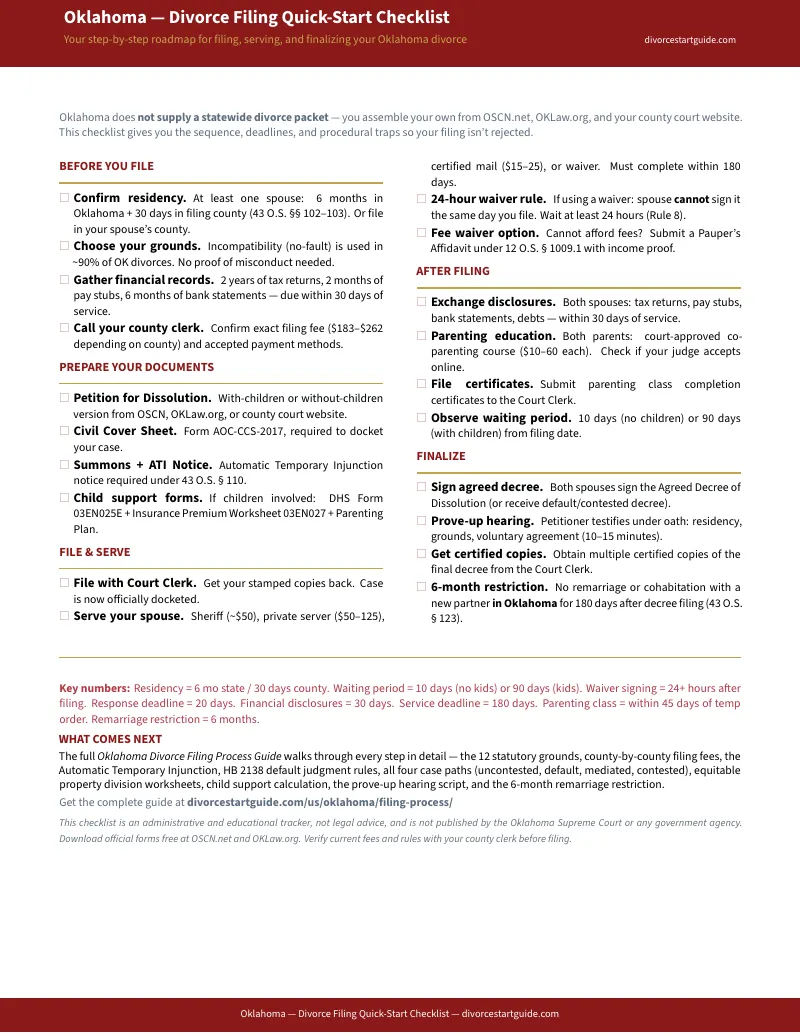
A printable 1-page process map covering the entire Oklahoma divorce sequence — from confirming eligibility through finalization. Includes the non-form-supplied system, the 24-hour waiver rule, the 20-day default window, and all four case paths, with space to track your county's specific requirements.
Who This Is For
- You and your spouse agree on most or all terms and want to handle the filing without a $2,500–$5,000 attorney retainer
- You've been served with divorce papers and need to understand the 20-day response window before a snap default judgment locks in your spouse's proposed terms
- You've already tried filing and the clerk returned your papers — wrong number of copies, missing cover sheet, or a waiver signed too early
- You qualify for a fee waiver and need step-by-step instructions for the Pauper's Affidavit process, including what to bring to the uncontested docket
- You want to understand the full process before deciding whether to go pro se or hire a family law attorney
Why Free Forms and $299 Document Services Don't Solve This
Oklahoma's OSCN and OKLaw.org provide blank form templates and basic guides for free. But court clerks are legally prohibited from explaining the order, the deadlines, or what to do next. The forms are excellent. The absence of a filing sequence is the problem.
National document-preparation services ($299–$1,999) charge you to fill out those same free forms through a questionnaire. They print the papers. They don't tell you about the 24-hour waiver signing window. They don't explain that Oklahoma County requires three copies of every document. They don't walk you through the Pauper's Affidavit hearing when you can't afford the filing fee. And none of them cover HB 2138's new default judgment rules.
Hello Divorce and similar SaaS tools charge $99–$499/month in a subscription model. If your uncontested case takes three months (common when children are involved, due to the 90-day waiting period), that's $297–$1,497 in recurring fees for a case that resolves with a 5-minute prove-up hearing.
This guide costs — less than a single hour of the $175–$400/hour attorney billing rate in Oklahoma. One purchase, instant download, no subscription, no recurring fee. And you keep it for your entire case.
100% Satisfaction Guarantee
If the guide doesn't give you a clear path through Oklahoma's divorce filing process, email [email protected] and we'll make it right — no hoops, no time limit.
— Less Than One Hour of Attorney Time
A typical Oklahoma family law attorney bills $175–$400 per hour. A full-service retainer runs $2,500–$5,000 upfront. This guide gives you the complete filing sequence, deadline trackers, and decision tools for a fraction of one billable hour — and you keep it for your entire case.