The court forms are blank boxes. They don't tell you how to calculate what goes inside them.
You've found the forms on the Ohio Supreme Court website — the mandatory Uniform Domestic Relations Affidavit 1 (Income and Expenses) and Affidavit 2 (Property and Debt). And you've realised the problem: the forms ask you to list every asset, every debt, every monthly expense. But they don't tell you how to trace a commingled inheritance back to its separate-property origin. They don't tell you how to calculate the marital share of an OPERS pension using the coverture fraction. And they certainly don't tell you whether keeping the house or selling it is the better financial move once you factor in the refinancing, the capital gains exposure, and the equity you'll need to equalize.
Meanwhile, a family law attorney in Franklin County charges $200–$500 an hour. A $3,000 retainer buys you about ten hours. Three of those hours go to sorting your bank statements into categories their paralegal can read. That's $1,000 in administrative work you could have done yourself — if someone had told you what the categories were.
You don't need someone to fill in the forms for you. You need to know what the numbers mean before you write them down.
The Ohio Equitable Division Navigation System
This is a complete, step-by-step guide to dividing money and property in an Ohio divorce — built for the specific rules that make Ohio different from every other state. It is not legal representation and it does not file your papers. It is the calculation and sequencing intelligence that the blank forms leave out.
At its core is the Equitable Division Navigation System — a structured method that walks you from "I have a pile of bank statements and no idea what's marital vs. separate" to a clean, defensible asset-and-debt inventory that meets the court's equitable distribution standard under R.C. 3105.171. It handles the part everyone gets wrong: tracing commingled funds with the documentation courts require, applying the coverture fraction to split OPERS and STRS pensions, calculating a home equity buyout that accounts for dower rights and refinancing costs, and building a spousal support estimate using the statutory factors that Ohio courts actually weigh.
What's inside — the 14-chapter guide, 6 standalone worksheets, and the free inventory checklist
- Marital vs. Separate Property Classification — the tracing method that documents pre-marital assets, inheritances, and gifts through commingled accounts. Ohio abolished transmutation by title under R.C. 3105.171(A)(6)(b) — putting a spouse's name on a deed does not automatically convert separate property. But you still need the paper trail to prove it.
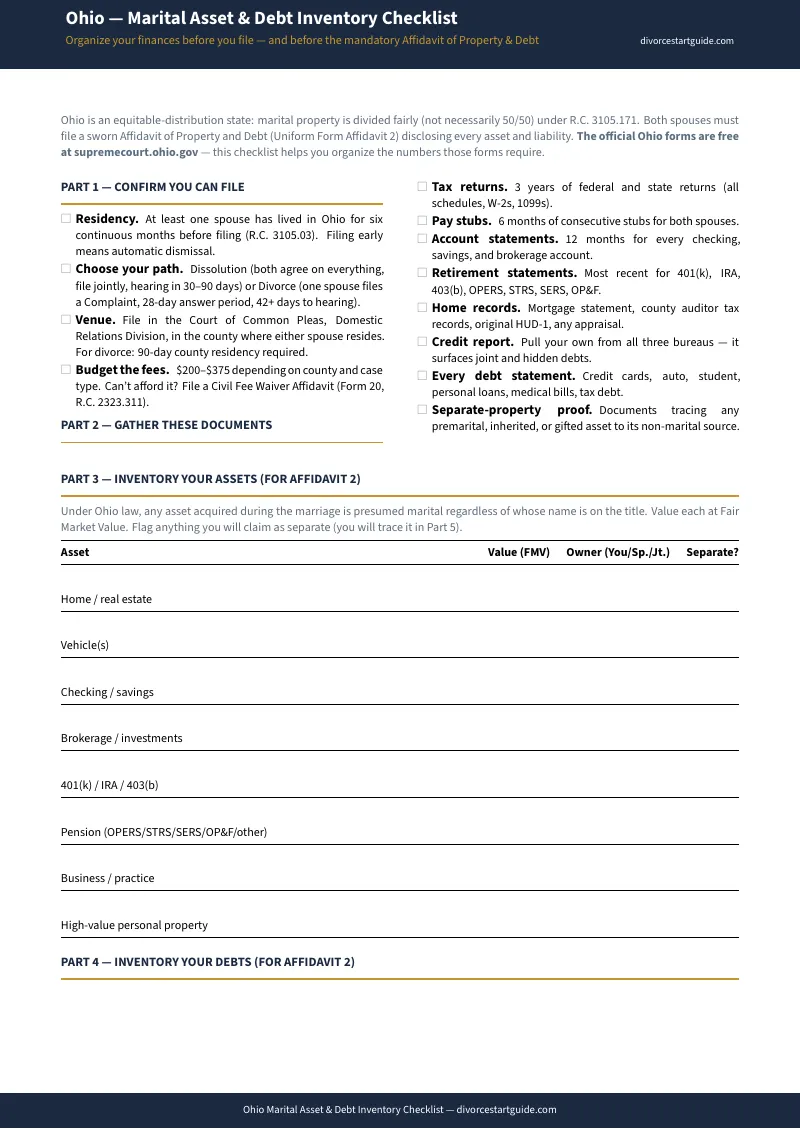
- The Affidavit Prep System — exactly which documents to gather (three years of tax returns, six months of pay stubs, twelve months of bank statements), how to organise them for maximum efficiency, and how to complete the mandatory Uniform Domestic Relations Affidavits accurately.
- The Family Home Decision Framework — sell, buyout, refinance, or defer? The guide calculates net equity after mortgage, HELOCs, liens, and transaction costs. It covers dower rights on property transfers, the refinance-into-one-name requirement, and the capital gains exposure if you defer the sale.
- The Pension & Retirement Division Method — coverture fraction math for Ohio public pensions (OPERS, STRS, SERS), the QDRO process for 401(k)s, and the critical distinction between a QDRO and a Division of Property Order (DOPO). Includes the offset strategy for trading retirement claims against home equity.
- The Spousal Support Estimator — Ohio has no fixed formula for spousal support. The guide maps your situation against the 14 statutory factors under R.C. 3105.18, including earning capacity, marriage duration, and standard of living. It helps you project post-divorce cash flow and prepare your financial arguments.
- The Debt Allocation Method — marital debt presumption, pre-marital debt tracing, credit card freeze strategy, joint account action plan, and the critical distinction between what the court orders and what creditors can still enforce against you.
- The Dissolution vs. Divorce Decision — Ohio's dual-track system means cooperative couples can file a joint dissolution petition, but with a permanent catch: the court loses jurisdiction to modify the property division after a Decree of Dissolution. The guide helps you decide which track fits your situation and what to watch for in a separation agreement.
- Tax Chapter — IRC §1041 tax-free transfers, the hidden tax basis trap (receiving $40,000 in cash vs. $40,000 in a traditional 401(k) are not the same), Ohio's 3.125% capital gains rate, and the primary residence exclusion rules.
- Net Worth Equalization Balance Sheet — the single worksheet that pulls every classification, valuation, and allocation together into a defensible settlement proposal. It shows you whether the proposed division is actually equitable once you account for after-tax values, liquidity, and carrying costs.
Plus 6 standalone printable worksheets — extracted from the guide so you can print just the page you need and fill it in by hand or with a PDF editor:
- Separate Property Tracing Ledger — document every pre-marital asset, inheritance, and gift with the paper trail Ohio courts require under R.C. 3105.171
- Family Home Decision Worksheet — the buyout formula, a four-option comparison (sell, buyout, defer, distributive award), and a tax checklist covering dower rights and capital gains
- Pension & Retirement Division Matrix — coverture fraction math, the QDRO workflow, Ohio DOPO rules for public pensions, and a deadline tracker for every account type
- Debt & Credit Freeze Action Planner — a debt-by-debt strategy table and joint account freeze plan built around the fact that divorce decrees do not bind creditors
- Spousal Support Factor Analysis — income worksheets and a fill-in table for all 14 statutory factors under R.C. 3105.18
- Net Worth Equalization Balance Sheet — the master asset-and-debt worksheet that calculates whether the proposed division is actually equitable
Who this is for
The spouse quietly gathering records before filing. The person staring at Affidavit 2 and a stack of bank statements with no idea how to connect the two. The nurse or teacher wondering whether their STRS pension is marital property. The homemaker calculating whether they can afford to keep the house after refinancing. The cooperative couple who want to reach a fair deal through dissolution without spending $15,000 on attorneys — but need the math to prove the deal is actually fair. And the spouse with an attorney, who wants to stop paying $350 an hour for document organisation they can handle themselves.
Why not just use the free resources?
Because the free resources give you forms, not calculations. The Ohio Supreme Court website provides the Uniform Domestic Relations Affidavits — blank PDFs with empty boxes. County self-help pages provide checklists that name the required documents. Neither one tells you how to calculate a coverture fraction, estimate a home equity buyout, or figure out whether taking the retirement account or the house gives you a better after-tax position.
The national DIY platforms — 3StepDivorce at $299, Nolo's generic books — are built for a national audience. They don't cover Ohio's dual-track dissolution system, they don't reference the mandatory Affidavits 1 and 2, they don't address OPERS or STRS pension rules, and they don't help you with the specific calculations that Ohio courts expect to see in a settlement proposal or separation agreement.
An honest guarantee
Work through the Equitable Division Navigation System. If the guide doesn't make your financial split clearer and better organised than any blank form or free article could — email us at any time for a full refund. The risk of trying it is a fraction of one attorney billable hour. The risk of guessing on your asset division is measured in years of financial consequences.
For — less than fifteen minutes of attorney time — you get the 14-chapter guide, 6 standalone printable worksheets, the inventory checklist, and the step-by-step sequence that the free forms leave out.
Stop staring at blank boxes. Get the guide, build your inventory, and walk into your divorce with the numbers already done.