
North Dakota's free court forms ask for your final property numbers. They don't tell you how to get them.
You've found the forms on ndcourts.gov — the Summons and Complaint, the Exhibit A Property and Debt Listing, the Summary Real Estate Disposition Judgment. And you've discovered the problem: the North Dakota Legal Self-Help Center gives you blank boxes for asset values, debt allocations, and spousal support figures. But it doesn't tell you how to trace a premarital inheritance through a commingled farm account under the Ruff-Fischer "origin of property" factor. It doesn't tell you how to calculate the marital share of your NDPERS pension or TFFR retirement. And it doesn't explain how to prepare a defensible Preliminary Property and Debt Listing for the mandatory Rule 8.3 conference that happens 30 days after service — when you're still reeling from the Summons.
Meanwhile, a family law attorney in Cass County charges $200–$300 an hour. In rural counties west of the Missouri, rates run $150–$225. A $3,500 retainer buys you roughly fifteen hours. Three of those hours go to sorting through your bank statements and tax returns into categories a paralegal can work with. That's over $600 in administrative labour you could have done yourself — if someone had told you what the categories were.
You don't need someone to fill in the forms for you. You need to know what the numbers mean before you write them down.
The Ruff-Fischer Property Navigation System
This is a complete, step-by-step guide to dividing money and property in a North Dakota divorce — built for the specific rules that make North Dakota different from every other state. It is not legal representation and it does not file your papers. It is the calculation and sequencing intelligence that the blank forms leave out.
At its core is the Ruff-Fischer Property Navigation System — a structured method that walks you from "I have a pile of bank statements and no idea what a judge can actually divide" to a clean, defensible asset-and-debt inventory that meets the court's "just and equitable" standard under N.D.C.C. Section 14-05-24. It handles the part everyone gets wrong: understanding that North Dakota has no strict separate-property exclusion (everything is technically on the table), preparing for the mandatory Rule 8.3 preliminary meeting, tracing premarital and inherited property with the documentation courts require, applying the coverture fraction to split NDPERS and TFFR pensions, calculating a home equity buyout using the Form 4b framework, and building a spousal support estimate using the Ruff-Fischer factors that North Dakota judges actually apply.
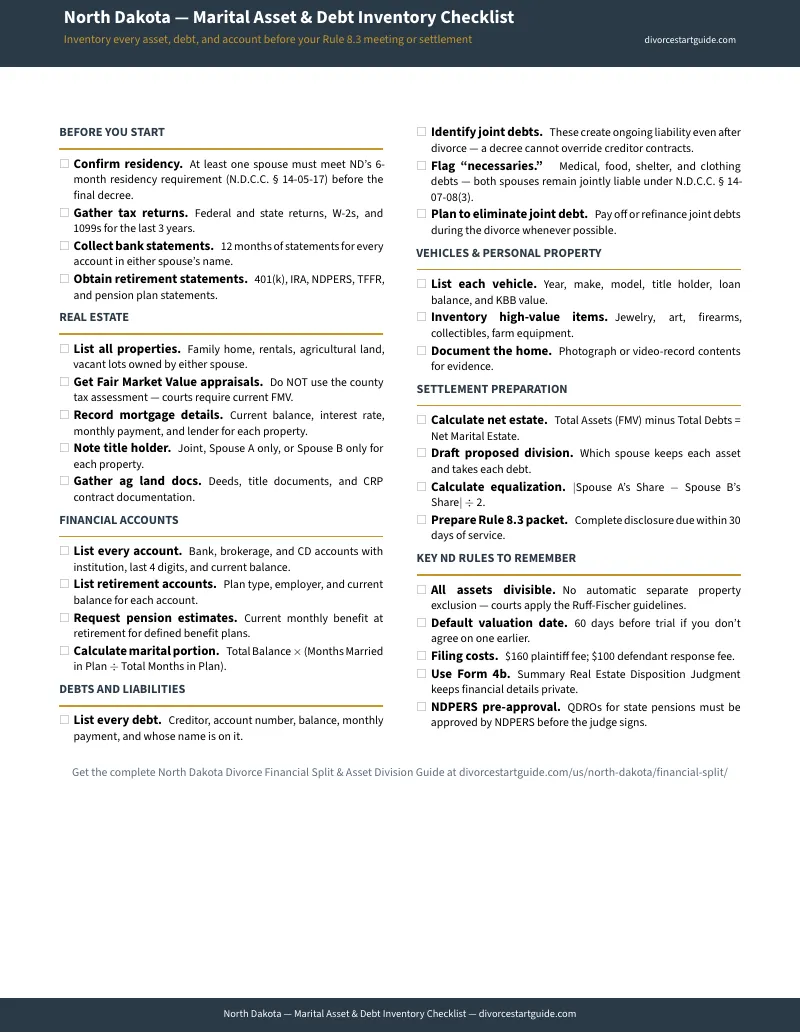
What's inside — the 13-chapter guide, standalone worksheets, and the free checklist
- The Ruff-Fischer Factor Analysis — the six-factor framework North Dakota courts use to decide what "equitable" actually means in your case. Marriage length, earning ability, age and health, marital conduct, station in life, and necessities of each party — with a self-assessment worksheet so you can evaluate where you stand before your attorney does.
- Marital vs. Separate Property Classification + Separate Property Tracing Worksheet — North Dakota courts can divide everything, including premarital assets and inheritances. The tracing method documents the origin of each asset so you can argue for keeping what you brought in. Covers the commingling risk: depositing inheritance into a joint farm operating account, using marital earnings to improve inherited land.
- The Rule 8.3 Conference Prep System — exactly what to bring, what to disclose, and how to organise your financial records for the mandatory 30-day meeting. Includes the Joint Informational Statement framework and the Preliminary Property and Debt Listing structure courts expect.
- The Family Home Decision Framework + Home Decision Comparison Worksheet — sell, equity buyout, or deferred sale. The worksheet calculates net equity after mortgage, liens, and transaction costs. Covers the Form 4b real estate summary, refinance requirements, and the Summary Real Estate Disposition Judgment process for transferring title.
- The Pension & Retirement Division Method + Retirement Account Division Matrix — coverture fraction math for NDPERS defined-benefit pensions and TFFR, the QDRO process for 401(k) and employer plans, and the present-value-buyout vs. deferred-distribution comparison. Explains why the state's Legal Self-Help Center cannot help with QDROs and what to do about it.
- The Spousal Support Estimator + Support Budget Worksheet — North Dakota has no spousal support formula. This chapter maps the Ruff-Fischer factors against rehabilitative vs. permanent support, the necessaries doctrine, and statutory caps. The worksheet builds your monthly income-and-expense case.
- The Debt Allocation Method + Debt Inventory Worksheet — marital debt presumption, pre-marital debt tracing, student loan treatment, necessaries liability, and the critical distinction between what the court orders and what creditors can still enforce against you.
- The Equitable Division Proposal Builder — a structured method for assembling your complete asset and debt schedule into a settlement proposal, calculating offsets between categories, and stress-testing whether the split meets ND's "just and equitable" standard before you present it.
- Tax-Safe Division Rules — IRC §1041 tax-free transfers, the hidden tax basis trap ($40,000 in cash vs. $40,000 in a traditional 401(k) are not the same), and primary residence capital gains exclusion rules.
- Post-Decree Transfer Tracking — every deed transfer, title change, beneficiary update, and account retitling that must happen after the judgment is signed. The decree divides property on paper; you still have to move it.
Who this is for
The spouse quietly gathering records before filing — trying to understand what a judge can actually divide before alerting anyone. The person served with a Summons who now has 21 days to file an Answer and 30 days to sit down for the Rule 8.3 property disclosure — with no idea what to bring. The state employee wondering how their NDPERS pension or TFFR retirement gets split, and whether a present-value buyout or deferred distribution makes more sense. The farm family trying to protect multi-generational agricultural land from forced sale or partition. The couple in the six-month residency waiting period, using the downtime to map out a fair property agreement before the decree can enter. And the spouse with an attorney, who wants to stop paying $250 an hour for document organisation they can handle themselves.
Why not just use the free resources?
Because the free resources give you forms, not calculations. The North Dakota Legal Self-Help Center provides blank packets for uncontested cases — administrative containers with empty boxes. The forms are "use at your own risk," and staff explicitly cannot help you fill them out, explain asset trade-offs, or draft QDROs. Legal Services of North Dakota is limited to residents who meet strict federal poverty guidelines. Neither tells you how to trace a premarital asset, calculate a coverture fraction, or figure out whether keeping the house or taking the retirement account gives you a better after-tax position.
The national DIY platforms — Hello Divorce at $1,500+, Divorce.com at $499–$1,999 — are built around generic automated form assembly. They don't reference the Ruff-Fischer guidelines, they don't prepare you for the mandatory Rule 8.3 conference, and they don't address North Dakota's serve-first procedure or the state-specific pension division rules for NDPERS and TFFR that district courts expect to see.
An honest guarantee
Work through the Ruff-Fischer Property Navigation System. If the guide doesn't make your financial split clearer and better organised than any blank form or free article could — email us at any time for a full refund. The risk of trying it is a fraction of one attorney billable hour. The risk of guessing on your asset division is measured in years of financial consequences.
For — less than fifteen minutes of attorney time — you get the classification system, the coverture math, the worksheets, and the step-by-step sequence that the free forms leave out.
Stop staring at blank Exhibit A boxes. Get the guide, build your inventory, and walk into your Rule 8.3 conference with the numbers already done.