The court forms tell you where to write your parenting schedule. They don't tell you how to build one that survives the Pathfinder process.
You've found the C100 on GOV.UK. You've seen Cafcass Cymru's "Our Child's Plan" template. You've Googled "child custody Wales" and landed on ten generic UK articles that don't mention the Pathfinder model, don't explain how a Welsh Family Proceedings Officer will assess your case differently from Cafcass in England, and don't tell you how overnight stay bands change your Child Maintenance Service liability by thousands of pounds a year.
Meanwhile, a family solicitor in Wales charges £150–£500 per hour. Getting them to draft a C100 and supporting statement costs £500–£1,000. A contested hearing runs £3,000–£15,000. Even a fixed-fee document completion service charges £240 just to fill in the form — without any guidance on structuring your actual parenting plan.
You don't need someone to fill in a court form for you. You need to know what Cafcass Cymru actually looks for in that 20-minute safeguarding call, how the welfare checklist shapes every judicial decision, and how to build a parenting schedule that's genuinely child-centred rather than a hastily negotiated compromise.
The Pathfinder Parenting Plan System
This is a complete, step-by-step guide to navigating child arrangements in Wales — designed specifically for the way Welsh family courts actually work. It is not legal advice and it does not replace a solicitor. It is the planning and structuring intelligence that blank court forms and free government pages leave out.
At its core is the Pathfinder Parenting Plan System — a structured method that takes you from "I don't know what the court expects" to a comprehensive, child-focused agreement that a Welsh family court can take seriously. It handles what everyone gets wrong: understanding that "custody" is an outdated term replaced by specific legal concepts. Preparing for the Cafcass Cymru safeguarding call with a clear, child-centred summary instead of an emotional narrative. Building schedules that account for school terms, handover logistics, and the overnight bands that directly affect your child maintenance calculation. Knowing when a parenting plan is enough and when you need a Consent Order to make it enforceable.
What's inside — the 13-chapter guide and the free starter checklist
- The Welsh Pathfinder Court Roadmap — a step-by-step walkthrough of the entire process from MIAM to final hearing. Covers how the gatekeeping phase works in Wales, when the Child Impact Report is produced, and why most Welsh cases resolve within two to four months instead of the ten months common in England.
- Parenting Plan Builder — structured prompts covering all 12 core areas: weekly routines, school holidays, Christmas and Easter arrangements, birthday protocols, communication rules, healthcare decisions, education choices, extended family contact, travel and passports, new partner introductions, finances, and review dates. Based on the statutory welfare checklist, not a generic template.
- Common Schedule Templates — concrete layouts for alternating weekends, 2-2-3 splits, 2-2-5-5 rotations, week-on/week-off, and primary-residence-with-regular-contact. Each template includes overnight counts and shows exactly where it falls against the CMS shared care bands so you know your child support position before agreeing to terms.
- CMS Overnight Bands Explained — practical guidance on how the Child Maintenance Service calculates shared care reductions. Covers the five overnight bands (from zero reduction at under 52 nights to nil liability at equal care), the interaction between schedule design and financial outcomes, and how to discuss this constructively without turning it into a fight.
- Cafcass Cymru Preparation — what to expect during the safeguarding call, what the Welsh Family Proceedings Officer is actually assessing, how to present your case calmly and factually, and a preparation worksheet to organise your child's routine, school details, and medical information before the call.
- Welfare Checklist Deep Dive — all seven statutory criteria under Section 1(3) of the Children Act 1989 broken down with practical examples. Shows how each factor is assessed and how to frame your proposals around the checklist rather than against your co-parent.
- C100 Filing Walkthrough — step-by-step guidance through the application form, the C8 confidentiality form, the C1A allegations of harm form, the FM1 MIAM certificate, and the EX160 Help with Fees application. Includes the updated fee schedule from July 2026.
- Parental Responsibility Chapter — who has automatic PR, how unmarried fathers acquire it (Form C(PRA1), court order, or marriage), why PR must be secured before addressing contact arrangements, and special rules for step-parents.
- WT4C Programme Guide — what the Working Together for Children programme involves, how it differs from the English equivalent, what happens in the e-learning and group workshop sessions, and how to use it constructively rather than treating it as a box-ticking exercise.
- Relocation and Emergency Orders — the consent requirements for moving a child, Specific Issue Orders and Prohibited Steps Orders, the "material change in circumstances" standard for varying an existing order, and what qualifies as a genuine emergency for a without-notice application.
- Welsh Language Rights — your absolute right under the Welsh Language Act 1993 to conduct your entire case in Welsh, how to request bilingual hearings, and practical guidance on using Welsh-language forms.
Who this is for
The parent who just discovered that "custody" and "access" are no longer the legal terms — and needs to understand what Child Arrangements Orders, Parental Responsibility, and the welfare checklist actually mean for their agreement. The self-representing litigant preparing a C100 who wants a parenting plan that won't get challenged at the first hearing for missing elements. The parent about to attend mediation who wants to arrive with draft schedules already mapped so the session doesn't start from scratch. The parent trying to work out whether a proposed schedule puts them in CMS Band 1 or Band 2 — and what that means financially. And the parent navigating the Pathfinder system for the first time who needs to know how it differs from everything they've read about English family courts.
Why not just use the free resources?
Because free resources give you definitions, not decisions. The GOV.UK website explains what Parental Responsibility means. Cafcass Cymru's "Our Child's Plan" gives you a template to fill in. The court registry distributes blank C100 forms. None of them give you a worksheet that maps your specific parenting week and calculates whether you've crossed the 52-night threshold. None provide schedule templates with overnight counts pre-calculated. None explain how the Pathfinder model's early information gathering changes your preparation strategy compared to the standard English process. None walk you through the safeguarding call with specific "what to say" and "what to avoid" guidance.
The co-parenting apps — OurFamilyWizard at £99–£108 per year per parent, TalkingParents, AppClose — are built for ongoing communication logging after you have an agreement. They don't help you write the agreement. They don't explain the welfare checklist. They don't prepare you for Cafcass Cymru. They are useful tools for later. This guide helps you build the plan they'll track.
An honest guarantee
Work through the Pathfinder Parenting Plan System. If the guide doesn't make your child arrangements clearer and better organised than any free government page or blank court form could — email us at any time for a full refund. The risk of trying it is a fraction of one mediation session. The risk of filing an incomplete parenting plan is a rejected application and months of delay on an already busy Welsh family court docket.
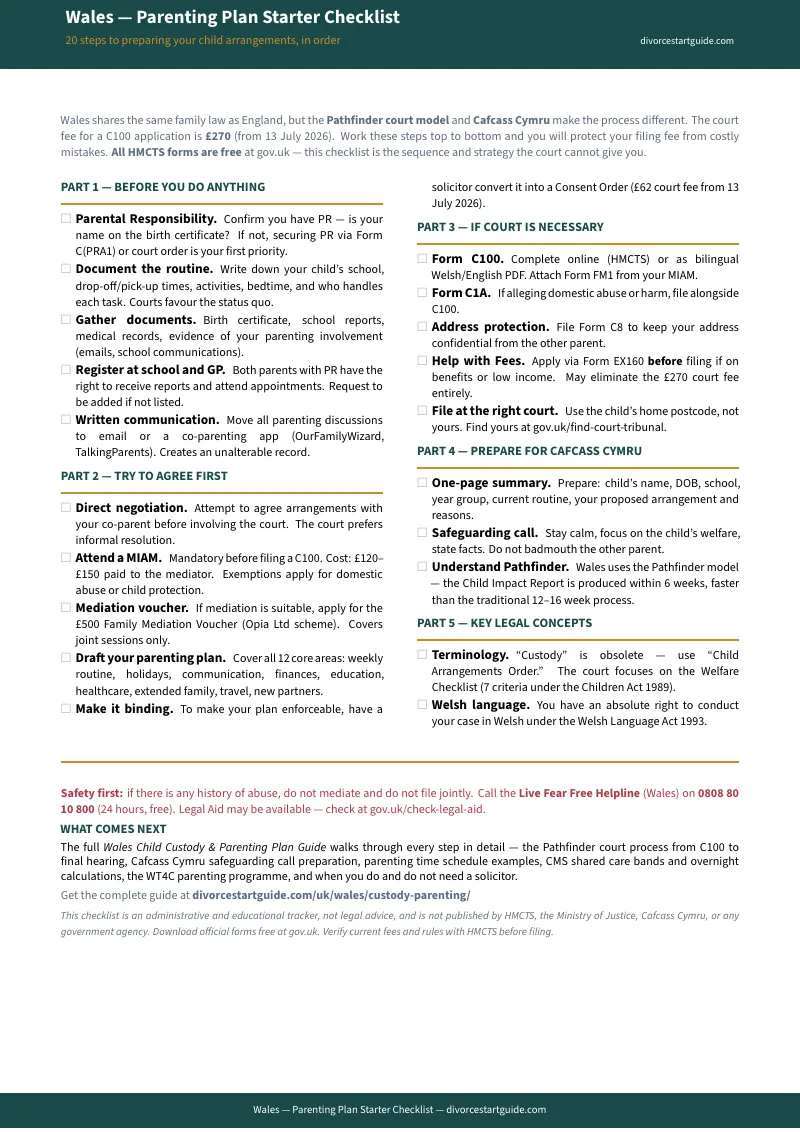
For — less than fifteen minutes of solicitor time — you get the 13-chapter guide, the parenting plan starter checklist, and 7 standalone printable worksheets and reference sheets: the Parenting Plan Worksheet, Schedule Templates with CMS bands, CMS Overnight Bands Reference, Cafcass Cymru Preparation Worksheet, Welfare Checklist Reference, Filing Checklist, and Court Process Roadmap.
Stop guessing what the Welsh family court expects. Get the guide, build your parenting plan, and walk into your next step — whether that's mediation, a solicitor's office, or the court — with the work already done.