Nunavut's court forms ask for your parenting plan. They don't tell you how to build one for a territory with no roads.
You've found the Nunavut Court of Justice civil registry forms — the Petition for Divorce, the parenting statement, the financial affidavit. And you've discovered the problem: the forms have blank fields for your parenting schedule, your decision-making arrangements, and your dispute resolution process. But they don't tell you how to structure a schedule when your co-parent lives in a different hamlet reachable only by charter flight. They don't tell you how to divide decision-making responsibility across education, healthcare, language preservation, and cultural upbringing when the Divorce Act uses terminology your existing court order doesn't recognise. And they don't explain how a 2-2-3 rotation that works in Iqaluit becomes structurally impossible when one parent takes a mine-site rotation in Baker Lake.
Meanwhile, private family lawyers in Nunavut are among the scarcest in Canada. If you can find one, retainers start in the thousands. Legal Aid through the Legal Services Board covers low-income residents — but if you own a home, the Board registers a minimum $5,000 lien against your property to recover costs. That's not a fee you choose. It's a charge placed on your title.
You don't need someone to write your parenting plan for you. You need to know what the plan requires — and how to adapt it for a jurisdiction where the judge flies in on circuit, supervised access centres don't exist, and traditional Inuit child-rearing practices are part of the legal analysis.
The Arctic Parenting Plan Navigation System
This is a complete, step-by-step guide to building a parenting plan in Nunavut — designed for the specific conditions that make this territory fundamentally different from every other Canadian jurisdiction. It is not legal representation and it does not file your papers. It is the planning and structuring intelligence that the blank court forms leave out.
At its core is the Arctic Parenting Plan Navigation System — a structured method that walks you from "I know we need a parenting schedule but I don't know what the court expects" to a comprehensive, child-focused agreement the Nunavut Court of Justice can take seriously. It handles what everyone gets wrong: translating the modern terminology (decision-making responsibility, parenting time, contact) into concrete, enforceable plan language. Building schedules that work across fly-in hamlets, not just within a single city. Accounting for rotational shift work, seasonal land-based activities, and inter-community travel logistics. Designing informal supervised parenting arrangements using family and community members — because Nunavut has no staffed supervision centres anywhere in the territory.
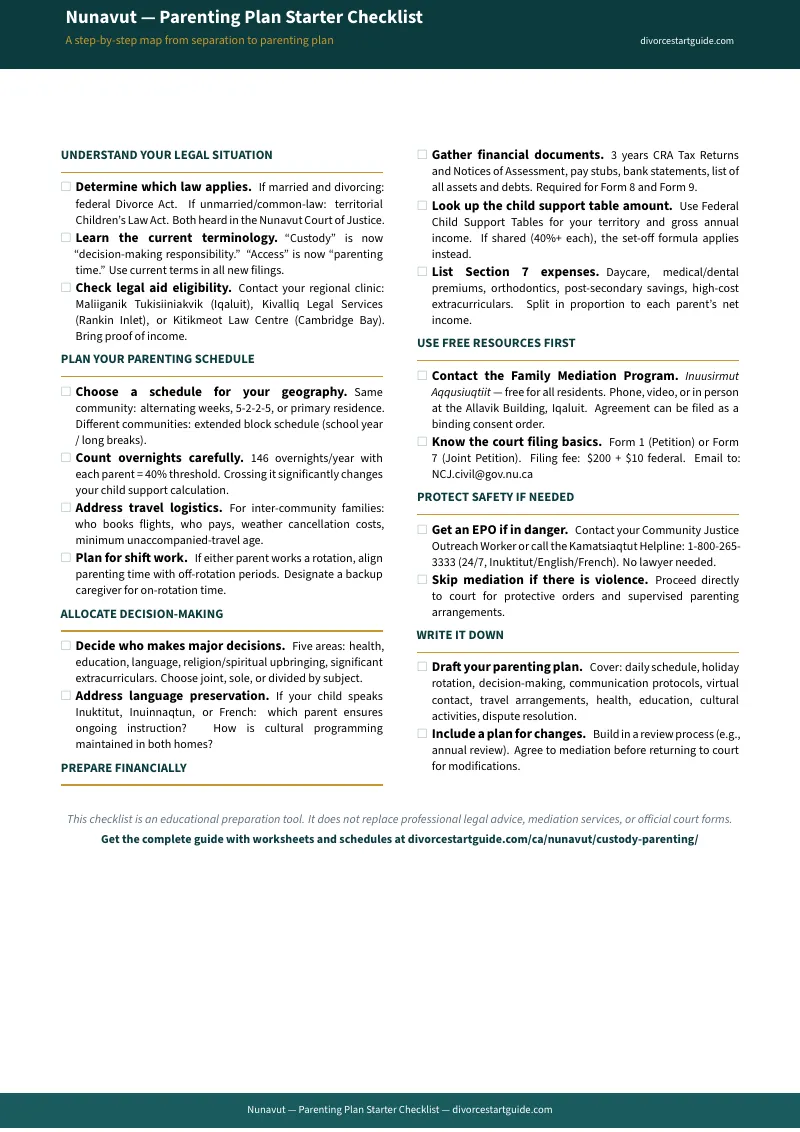
What's inside — the 14-chapter guide, 8 standalone worksheets, and the free checklist
- Decision-Making Responsibility Worksheet — a structured planner that turns vague "we'll share decisions" into documented, enforceable terms across four categories: health, education, cultural upbringing, and extracurricular activities. Includes language preservation considerations for Inuktitut and Inuinnaqtun — because in Nunavut, a child's linguistic heritage is part of the best-interests analysis.
- Same-Community Schedule Templates — standard rotation patterns (alternating weeks, 2-2-3, 2-2-5-5) with overnight calculations for parents living in the same hamlet. Maps each schedule against the 40% shared-parenting threshold that changes your child support calculation under the Federal Child Support Guidelines.
- Inter-Community Block Scheduling Templates — the schedules nobody else provides. When parents live in different fly-in communities, mid-week handovers are impossible. These templates structure extended-stay blocks around school breaks, summer, and cultural seasons, with regular phone and video contact between visits. Includes travel cost-sharing frameworks for charter flight expenses.
- Shift-Work Schedule Builder — rotation patterns for parents working mining, government, or aviation schedules with fixed on-off cycles. Maps three-weeks-on/three-weeks-off, two-weeks-on/two-weeks-off, and similar rotations against the 40% threshold so you know your child support position before you agree to terms.
- Custom Adoption (ACARA) Chapter — the only parenting guide that explains how the Aboriginal Custom Adoption Recognition Act intersects with parenting disputes. If your family includes a child placed through traditional Inuit custom adoption, this chapter covers how ACARA certificates carry the same legal weight as court orders and what happens when parenting disputes arise involving custom-adopted children.
- Court Process Roadmap — a step-by-step walkthrough of filing in the Nunavut Court of Justice, from the initial Petition for Divorce through financial disclosure, interim orders, and final resolution. Covers email filing to [email protected], the circuit court schedule reality, and when teleconference hearings are available for interim motions.
- Informal Supervision Safety Protocols — structured worksheets for designing supervised parenting time when no professional centre exists. Covers designating a supervisor (family member, friend, or community elder), defining reporting obligations, setting exchange locations and boundaries, and building the arrangement into your formal parenting plan.
- Child Support and the 40% Threshold Explained — how the Federal Child Support Guidelines calculate support based on your parenting-time split. Covers the sole-parenting table amount, the shared-parenting offset formula, Section 7 extraordinary expenses, and the Child Support Recalculation Service for adjusting amounts without returning to court.
- Mediation Preparation — how to access the government-funded Inuusirmut Aqqusiuqtiit Family Mediation Program in Iqaluit, what to expect from shuttle mediation, and pre-mediation worksheets for organising your proposals before intake.
- Modification and Relocation Rules — the "material change in circumstances" standard for varying an existing order, the mandatory 60-day relocation notice under the 2021 Divorce Act amendments, and how to propose schedule modifications that account for Nunavut's geography.
- Safety and Crisis Resources — Emergency Protection Orders under the Family Abuse Intervention Act, crisis contacts, and guidance on when mediation should not be used.
Who this is for
The parent who just learned that "custody" and "access" are no longer the legal terms — and needs to understand what decision-making responsibility and parenting time actually mean for their agreement. The self-represented filer preparing a Petition for Divorce who needs a parenting plan that won't get sent back by the court registry for missing elements. The parent heading into mediation at the Iqaluit Family Mediation Program who wants to arrive with draft schedules already mapped so the session doesn't start from zero. The parent calculating whether a proposed block schedule puts them above or below the 40% shared-parenting threshold — and what that means for child support. The parent navigating a custom adoption situation who needs to understand how ACARA intersects with parenting law. And the parent with an existing order that no longer works because of a relocation, a shift-work change, or a child starting school in a different community.
Why not just use the free resources?
Because free resources give you definitions, not decisions. The Justice Canada website explains what decision-making responsibility means. The Legal Services Board provides intake information. The court registry distributes blank PDF forms. None of them give you a worksheet that maps your specific parenting week across two fly-in communities and calculates the overnight percentage. None provide block scheduling templates for rotational shift workers. None explain how Inuit Qaujimajatuqangit principles affect the best-interests analysis — or how to use community-based caregiving patterns as a strength in your parenting plan rather than a liability. None walk you through the difference between a basic parenting plan and a detailed plan for higher-conflict situations.
The co-parenting apps — Custody X Change, OurFamilyWizard — are built for ongoing communication logging, not initial plan drafting. They assume parents live in the same metro area. They don't address circuit court filings, inter-community travel logistics, ACARA custom adoptions, or the absence of supervised access centres. They are useful tools after you have an agreement. This guide helps you write the agreement.
An honest guarantee
Work through the Arctic Parenting Plan Navigation System. If the guide doesn't make your parenting arrangements clearer and better organised than any free government page or blank court form could — email us at any time for a full refund. The risk of trying it is a fraction of one mediation session. The risk of filing an incomplete parenting plan is a rejected application and months of delay on a circuit docket that was already backlogged.
For — less than fifteen minutes of attorney time — you get the 14-chapter guide, 8 printable standalone worksheets, and the step-by-step court process roadmap that the blank forms leave out.
Stop guessing what the Nunavut Court of Justice expects. Get the guide, build your parenting plan, and walk into your next step — whether that's mediation, a lawyer's office, or the court registry — with the work already done.