
The Manitoba government gives you blank forms. It doesn't tell you how to calculate the numbers that go inside them.
You've found Form 70D on the Court of King's Bench website. Twenty-two pages of financial disclosure — income, assets, debts, expenses — all categorized into family assets, commercial assets, and exempt property. Size 14 font, double spacing, 40mm left margin. No calculator, no examples, no explanation of what "deferred sharing" actually means for your bank account.
Meanwhile, a family lawyer in Winnipeg charges $350 to $400 per hour. A $2,000 retainer buys you roughly five hours. Half of that gets consumed by document organization their junior clerk could have handled — if you'd known what to bring and how to categorize it.
You don't need someone to fill out forms for you. You need to know which assets get shared, how to value them at the separation date, how to calculate the equalization payment, and how to turn that into a proposal you and your spouse can sign without spending $15,000 each on a litigated outcome.
The Equalization Navigation System
This is a complete, step-by-step guide to dividing money and property in a Manitoba divorce — built entirely around The Family Property Act, The Homesteads Act, and the pension rules that changed on October 1, 2021. It is not legal advice and it does not file your papers. It is the calculation and sequencing intelligence that blank government forms leave out.
At its core is the Equalization Navigation System — a structured method that walks you from "I have a pile of bank statements and no idea what's shareable" to a clean, documented asset-and-debt inventory that satisfies the Court of King's Bench standard for financial disclosure. It handles the part everyone gets wrong: classifying assets into family versus commercial categories, tracing exempt property through mixed accounts (and avoiding the conversion trap that permanently kills your exemption), applying the pension proration formula, evaluating a family home buyout against the real costs, and building a spousal support estimate using the Spousal Support Advisory Guidelines and Manitoba's priority rules.
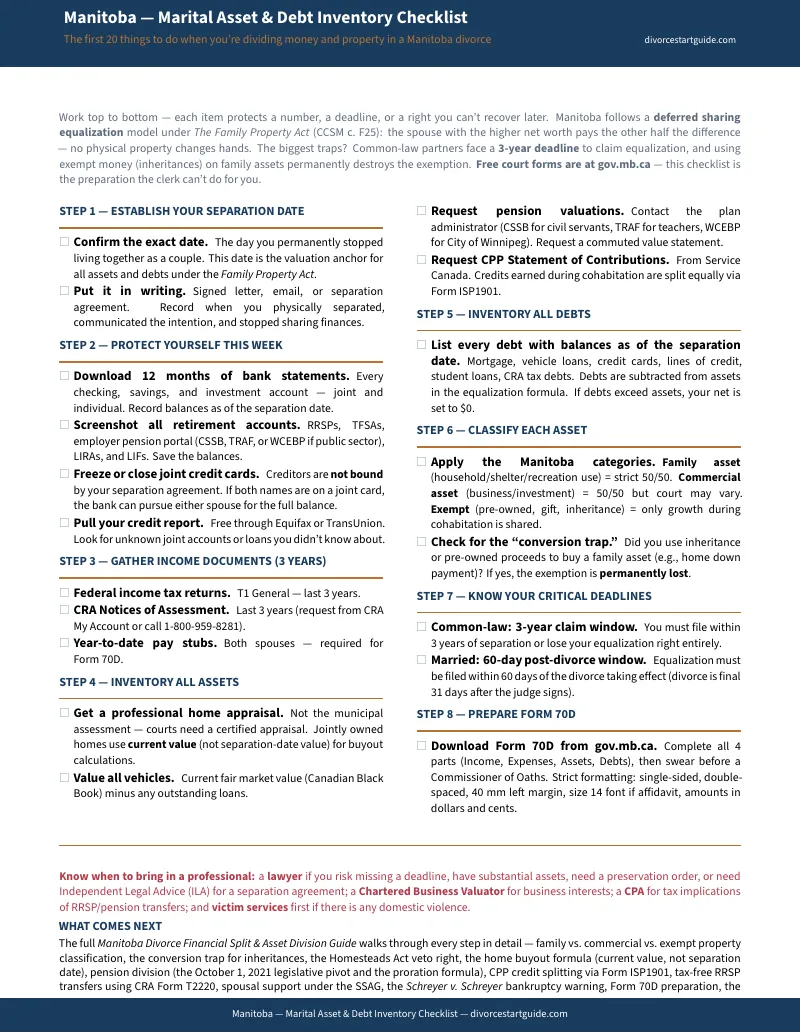
What's inside — 13 chapters, 8 standalone worksheets, and the free checklist
- The Asset Classification System — exactly how to identify what counts as a family asset (shared at 50/50 unless grossly unfair), what counts as a commercial asset (adjustable if clearly unfair), and what stays exempt. Covers the critical exceptions: pre-acquired property that increased in value during the marriage, gifts from third parties, and the conversion trap that turns an inheritance into a fully shareable family asset the moment you use it to buy a new home.
- The Family Home Decision Framework — sell, buyout, or defer? Calculates net equity after mortgage discharge and transaction costs. Covers the Homesteads Act veto right (your spouse cannot sell, mortgage, or transfer the home without your written consent — even if your name is not on title), occupation rent, the joint mortgage risk, and the Homestead Consent Form that must be signed before a lawyer.
- The Pension Proration Calculator — the statutory formula (cohabitation months ÷ total membership months × pension value) applied step by step. Covers the October 1, 2021 legislative pivot: pre-2021 separations are locked at 50/50, post-2021 separations can agree to any split from 0% to 50%. Includes TRAF, CSSB, WCEBP, and private pension administrator contacts and forms.
- CPP Credit Splitting Walkthrough — how to apply to Service Canada for the division of Canada Pension Plan credits earned during cohabitation. Form ISP1901, required documents, and the timeline.
- RRSP and RRIF Division — tax-free spousal rollover rules, the CRA transfer form, and the critical difference between a court-ordered transfer (no tax) and a voluntary withdrawal (fully taxable).
- The Debt Allocation Method — family debt identification, the joint-and-several liability trap (your separation agreement does not bind your creditors), credit card closure strategy, and what happens to your equalization claim if your spouse files for bankruptcy.
- Spousal Support & MEP — eligibility, the Spousal Support Advisory Guidelines ranges, the statutory priority of child support over spousal support, and how to register a support order with the Maintenance Enforcement Program for automatic collection.
- Form 70D Preparation Guide — a plain-English translation of every section of the Financial Statement, with the formatting requirements, the documents you need before you start, and a Form 70D.1 demand template for when your spouse won't disclose voluntarily.
- Master Equalization Worksheet — the five-step calculation that takes your classified assets and debts and produces the equalization payment amount. Fill in the values, subtract exempt property, calculate each spouse's net shareable property, and determine who owes whom — and how much.
- Post-Settlement Execution Checklist — the administrative actions required after you sign: pension transfer requests, CPP credit splitting application, title transfers, mortgage discharge, support enforcement registration, and tax filing updates.
Who this is for
The spouse quietly gathering financial records before raising the conversation. The self-represented litigant staring at Form 70D and trying to figure out where RRSPs go. The couple heading into mediation who want to arrive with a complete inventory instead of paying a mediator $400 per hour to organize receipts. The common-law partner who just learned they have three years from separation to file a property claim or lose the right forever. The person with a signed separation agreement who still needs to execute the pension transfers, the CPP split, and the title changes. And the person with a lawyer who wants to stop paying $350 per hour for document organization they can handle themselves.
Why not just use the free resources?
Because the free resources give you procedures, not calculations. The Manitoba Family Resolution Service explains that mediation is available and lists the court requirements. The Community Legal Education Association publishes an Uncontested Divorce Guide for $30 that walks you through filing steps — but it assumes you've already divided everything. Neither one tells you how to calculate the equalization payment, work out a home buyout after mortgage discharge costs, figure out how much pension is shareable under the post-2021 rules, or determine whether keeping the house or taking a pension offset puts you in a better financial position.
The national alternatives — LegalContracts.ca, Rocket Lawyer — generate fill-in-the-blank templates designed for Ontario. They don't account for Manitoba's Homesteads Act veto, the deferred sharing model under The Family Property Act, the specific pension division options that changed in 2021, or the fact that Manitoba courts require mandatory triage and case management before you can get a trial date.
An honest guarantee
Work through the Equalization Navigation System. If the guide doesn't make your financial split clearer and better organized than any blank form or free article could — email us at any time for a full refund. The risk of trying it is a fraction of one lawyer consultation. The risk of rushing into a separation agreement without running the numbers is permanent: once the equalization is finalized, it is extremely difficult to reopen.
For — less than fifteen minutes of lawyer time — you get the classification system, the pension proration math, the worksheets, and the step-by-step sequence that the blank forms leave out.
Stop staring at Form 70D. Get the guide, build your inventory, and walk into your separation with the numbers already done.