Alberta's court forms ask for your parenting plan. They don't tell you how to write one that the desk order clerk will accept.
You've found the Court of King's Bench forms — the Claim under the Family Law Act (Form FL-10), the Statement of Parenting, the Financial Disclosure Statement. And you've hit the wall: blank fields for your parenting schedule, your decision-making arrangements, your dispute resolution process, your holiday rotation. No instructions on what language the court expects. No examples of what "decision-making responsibility" actually looks like in a clause. No explanation of how to structure a consent order that won't bounce back from the desk order clerk for formatting errors.
Meanwhile, Alberta family lawyers charge $350 to $450 per hour. A standard retainer starts at several thousand dollars. Legal coaching — the "unbundled" model where a lawyer reviews your work — still runs $1,500 to $4,500 for a limited-scope engagement. If you walk into that session with blank worksheets and unstructured notes, you'll spend most of those billable hours on work you could have prepared at the kitchen table.
You don't need someone to write your parenting plan for you. You need to know what the plan must contain — and how to draft it in the language the Court of King's Bench requires.
The Family Focused Protocol Navigation System
This is a complete, step-by-step guide to building a parenting plan in Alberta — designed around the Family Focused Protocol that the Court of King's Bench implemented in January 2026. It is not legal representation and it does not file your papers. It is the planning and structuring intelligence that the blank court forms and free government information sheets leave out.
At its core is the Family Focused Protocol Navigation System — a structured method that walks you from "I know I need a parenting plan but I don't know where to start" to a comprehensive, child-focused agreement ready for the court registry. It handles the three things everyone gets wrong: translating the old "custody" and "access" language into the modern statutory terms (decision-making responsibility, parenting time, contact) that courts now require. Mapping parenting schedules against the 40% shared-parenting threshold that changes your child support calculation. And formatting your agreement as a consent order with clauses written from the judge's perspective — not the parent's — so it actually clears the desk order clerk.
What's inside — the 14-chapter guide, 6 standalone worksheets, and the free checklist
- Decision-Making Responsibility Worksheet — turns vague "we'll share decisions" into documented, enforceable terms across four categories: education, non-emergency health care, religious upbringing, and significant extracurricular activities. Includes a dispute resolution clause for deadlocks — because "joint decision-making" without a tiebreaker mechanism fails the first time the parents disagree.
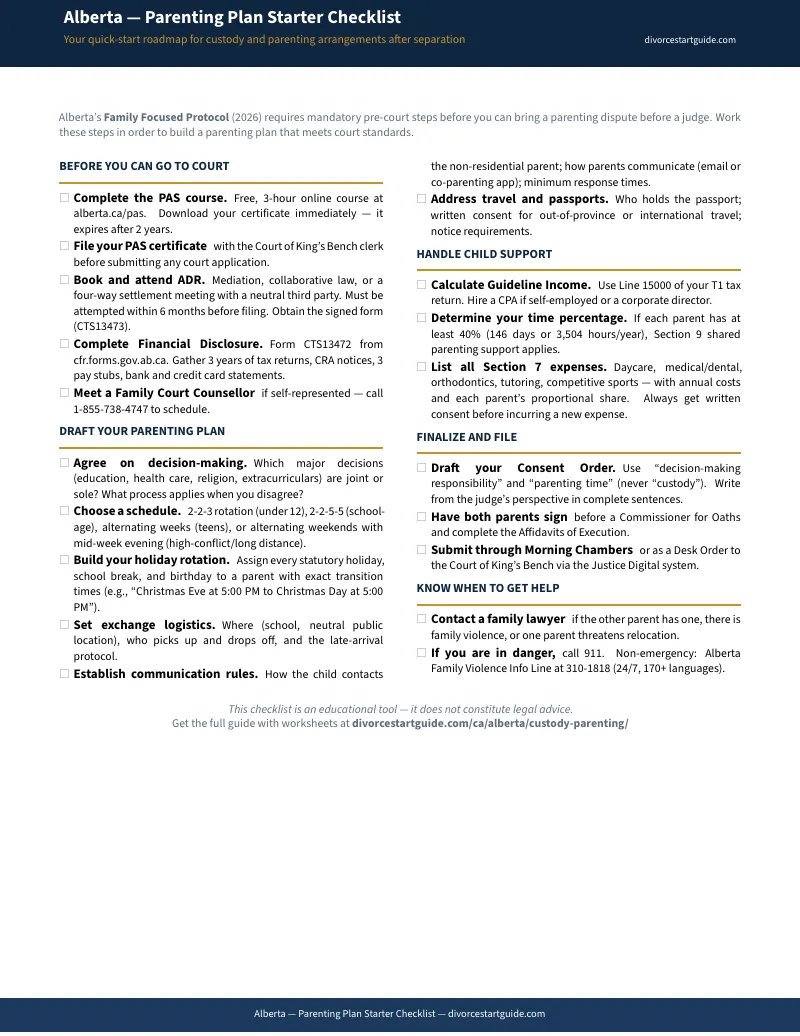
- Parenting Time Schedule Templates — four standard rotation patterns (alternating weeks, 2-2-3, 2-2-5-5, alternating weekends with mid-week evening) with overnight counts mapped against the 40% shared-parenting threshold under the Federal Child Support Guidelines. Each schedule includes a "specified" version with exact transition times and a "reasonable" version for low-conflict families.
- Holiday and Special Day Rotation Builder — every Alberta statutory holiday, school fall break, spring break, Christmas split, birthday, Mother's Day, and Father's Day assigned to a parent with exact transition times. No more ambiguity about who has the children on Family Day or Heritage Day.
- Section 9 Child Support Calculator Walkthrough — the set-off formula, the shared-parenting math, and Section 7 extraordinary expenses (daycare, orthodontics, competitive sports, tutoring) with proportional cost-sharing worksheets. Includes the Guideline Income calculation starting from Line 15000 of your T1 tax return.
- Consent Order Drafting Guide — step-by-step instructions for converting your parenting agreement into a legally binding Consent Order that the Court of King's Bench will accept. Covers clause formatting (from the judge's perspective, not the parent's), Affidavit of Execution preparation, and the desk order process for getting your agreement stamped without a hearing.
- Family Focused Protocol Compliance Roadmap — every mandatory step in order: PAS course registration, ADR participation, Financial Disclosure Statement, and the specific forms (CTS13473, CTS13472) you need to file. Includes the timeline — what must happen before you can bring any parenting dispute to court.
- Relocation and Variation Rules — the 60-day mandatory notice requirement under the 2021 Divorce Act amendments, the "material change in circumstances" threshold for modifying an existing order, and how the Maintenance Enforcement Program enforces compliance after your order is in place.
- Mediation Preparation Worksheets — structured pre-mediation planners so you walk into your ADR session with draft schedules, holiday rotations, and decision-making proposals already mapped. Saves hours of expensive mediation time and prevents you from being out-negotiated by a better-prepared co-parent.
Who this is for
The parent who just learned that "custody" and "access" aren't the legal terms anymore — and needs to understand what decision-making responsibility and parenting time actually mean for their agreement. The self-represented filer completing Form FL-10 who needs a parenting plan that won't get rejected for missing elements. The parent heading into mandatory ADR under the Family Focused Protocol who wants to arrive with draft schedules already mapped. The parent calculating whether their proposed schedule crosses the 40% shared-parenting threshold — and what Section 9 means for their child support obligation. And the parent with an existing order that no longer works because of a relocation, a job change, or a child starting school.
Why not just use the free resources?
Because free resources give you definitions, not decisions. CPLEA's booklets explain what decision-making responsibility means. The Alberta Government website lists the Family Focused Protocol steps. The court registry distributes blank Form FL-10. None of them give you a worksheet that maps your specific parenting week and calculates the overnight percentage against the 40% threshold. None provide a clause-by-clause consent order template formatted from the judge's perspective. None explain the difference between a "specified" schedule (exact pickup and drop-off times) and "reasonable" parenting time — or when each approach backfires.
The co-parenting apps — OurFamilyWizard at $110 to $300 per parent per year, Custody X Change on a monthly subscription — are built for ongoing scheduling and communication logging. They don't help you negotiate the initial agreement or draft the parenting plan text. They don't address Alberta's mandatory PAS course, the ADR requirement, or Section 7 expense sharing. They are useful tools after you have an agreement. This guide helps you build the agreement.
An honest guarantee
Work through the Family Focused Protocol Navigation System. If the guide doesn't make your parenting arrangements clearer and better organised than any free government page or blank court form could — email us at any time for a full refund. The risk of trying it is a fraction of one mediation session. The risk of filing an incomplete parenting plan is a rejected application and weeks of delay in a court system already backlogged.
For — less than fifteen minutes of attorney time — you get the 14-chapter guide, 6 printable standalone worksheets, and the step-by-step FFP compliance roadmap that the blank forms leave out.
Stop guessing what the Court of King's Bench expects. Get the guide, build your parenting plan, and walk into your next step — whether that's mediation, a lawyer's office, or the court registry — with the work already done.