The court forms are free. The sequence that stops your $1,170 filing fee from being wasted is not.
You've found the Application for Divorce on the Federal Circuit and Family Court website. You've registered on the Commonwealth Courts Portal. And you've hit the part nobody warns you about: the portal asks you to upload a scanned marriage certificate as a specific PDF version, limits your total upload to 30MB, deletes your draft after 90 days, and requires an Affidavit for eFiling witnessed by a Justice of the Peace whose registration number must appear in the exact right field. Get any of it wrong, and your application is rejected — but the $1,170 filing fee is not refunded.
A family lawyer in Sydney charges $1,200 to $1,500 as a fixed fee for a simple divorce application. A paralegal online service runs $349 to $699. Most of that cost is administrative — filling in forms, scanning documents, clicking through the portal. Work you can do yourself, if someone maps out the sequence before you start.
You don't need a lawyer to file for divorce. You need the filing sequence that makes the $1,170 fee stick on the first attempt.
The First-Try Filing Blueprint
This is a complete, step-by-step guide to filing for divorce in New South Wales — built around the specific court registries, hearing locations, and JP witnessing networks that make filing from NSW different from every other state. It is not legal advice, and it does not file your application for you. It is the structured sequence and portal navigation that the free forms leave out.
At its core is the First-Try Filing Blueprint — a method that takes you from "I think I'm eligible" to a successfully filed application, properly served documents, and a downloaded Divorce Order. It handles the part that trips up most self-represented filers: confirming your separation date with the reconciliation exception, choosing between joint and sole applications, navigating the CCP's technical requirements, coordinating JP witnessing, arranging valid service, and preparing for the hearing if you have children under 18.
What's inside — 14-chapter guide, 20-item checklist, and 10 standalone worksheets
- Eligibility and Separation Verification — the residency and connection test (citizenship, domicile, or 12-month continuous residence), the 12-month-and-one-day separation rule, and the three-month reconciliation exception that lets you count pre-reconciliation time without resetting the clock.
- Separation Under One Roof Evidence Builder — exactly what the court requires in your affidavit and your witness's affidavit when you separated but stayed in the same house. Covers sleeping arrangements, financial separation, social life changes, household duties, and the Services Australia SS293 form for government benefit recipients. Includes a printable evidence inventory worksheet.
- Joint vs. Sole Application Decision Framework — the practical differences: joint applicants skip service entirely and usually skip the hearing. Sole applicants must arrange service and attend the hearing if children are involved. The fee reduction rules differ too — both parties need concession cards for joint applications, but only the applicant needs one for sole applications. Includes a standalone decision worksheet.
- Filing Fee Strategy — the standard $1,170 fee, the $390 concession rate, which government cards qualify, and the financial hardship application for people who hold no concession card but genuinely cannot afford the fee. Includes a printable fee reduction checklist with the three-part hardship test.
- Commonwealth Courts Portal Step-by-Step — a guided walkthrough of every screen in the CCP, from creating your account through to locking and submitting your application. Covers the 30MB upload limit, PDF version requirements, saving and resuming drafts within the 90-day window, and selecting your hearing date and location.
- JP Witnessing Protocol — how to find a Justice of the Peace in NSW, what they need to see (original documents, not photocopies), ensuring their registration number appears correctly on the Affidavit for eFiling, and coordinating joint signatures when both applicants need witnessing. Includes a printable NSW court registries and JP locations card.
- Service of Documents Guide — who can serve papers (any person over 18, except you), what the service packet contains (sealed application, Affidavit for eFiling, and the Marriage, Families and Separation brochure), the difference between personal hand delivery and service by post, the Acknowledgement of Service form, and what to do when your spouse cannot be found. Includes a printable service tracking worksheet.
- Children Under 18 — Section 55A Requirements — the parenting statement you must include, what "proper arrangements" means for health, education, and financial support, and why sole applicants with children must attend the hearing while joint applicants are usually excused. Includes a printable parenting arrangements worksheet for Part F.
- The Hearing and After — what to expect at a divorce hearing (usually brief, often by Microsoft Teams), how the Registrar reviews your application, the one-month-and-one-day waiting period before the Divorce Order takes effect, and how to download your official sealed Order from the portal.
- Property, Super, and the 12-Month Deadline — divorce does not divide your assets or superannuation. You have 12 months after your Divorce Order takes effect to apply for property or spousal maintenance orders. After that, you need court permission. The guide explains the timeline and when to consult a solicitor.
- Plus: Filing Timeline Planner, Common Mistakes Reference, Forms Reference Card, and Key Contacts & Resources — all printable standalone PDFs you can pin up or keep in your filing folder.
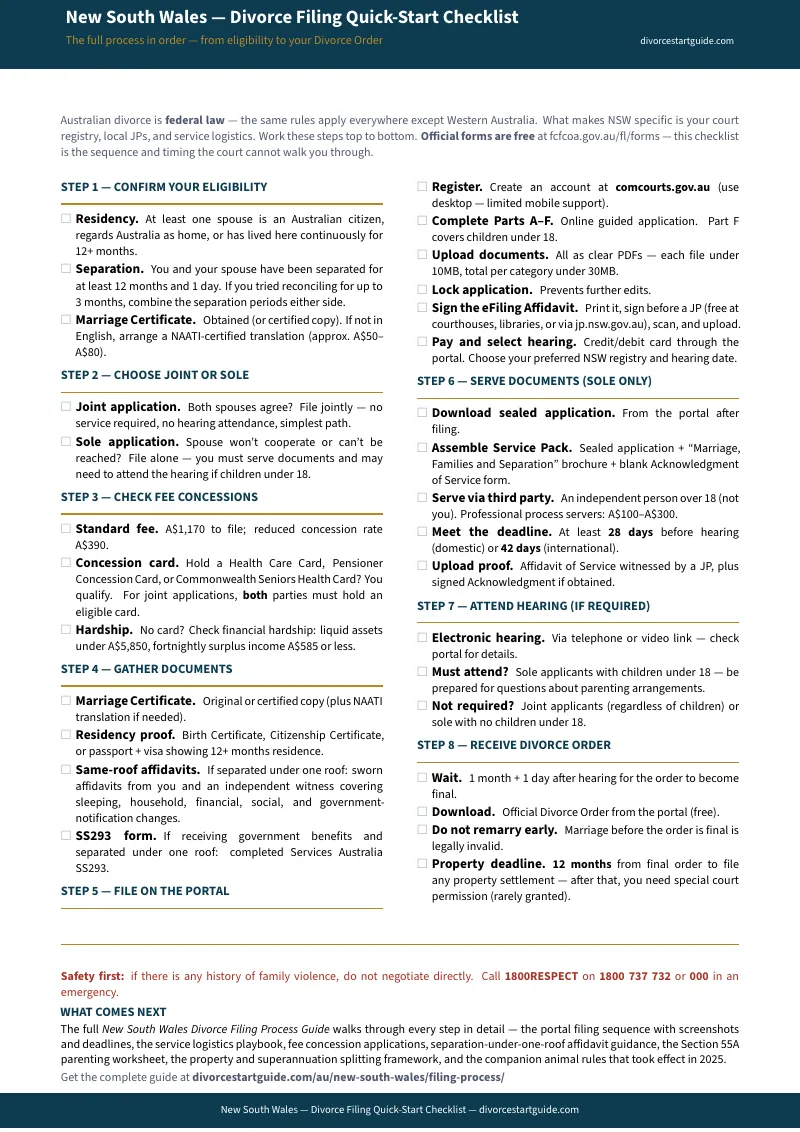
The free checklist gives you the 20-step filing sequence at a glance — print it, tick off each step as you go, and know exactly where you are in the process.
Who this is for
The person who just crossed the 12-month separation milestone and wants to file without paying a solicitor. The couple who agree on everything and want the fastest joint application path. The sole applicant anxious about serving papers on a spouse who won't cooperate. The parent who needs to understand the Section 55A requirements before the hearing. The person separated under one roof who needs to know exactly what evidence to gather for the affidavits. And the filer who registered on the Commonwealth Courts Portal, stared at the upload requirements, and closed the browser.
Why not just use the free resources?
Because the free resources give you pieces, not a sequence. Legal Aid NSW publishes four separate factsheets. The FCFCOA website has forms, fees, and general guides on different pages. Community legal centres explain the law clearly. But none of them walk you through the CCP portal screen by screen, tell you exactly what to say in a separation-under-one-roof affidavit, or explain the specific witnessing requirements that cause JP-related rejections. They explain what divorce requires — they don't map out the order you do it in.
The paralegal online services — AussieLegal at $697, Divorce Without A Lawyer at $349, Simple Separation at $499 to $699 — handle the filing for you. If you want hands-off, they're a fair option. But if you're comfortable filling in your own forms and clicking through a portal, you're paying hundreds of dollars for administrative work this guide teaches you to do in an afternoon.
An honest guarantee
Work through the First-Try Filing Blueprint. If the guide doesn't make the filing process clearer and more manageable than any free resource or government factsheet could — email us at any time for a full refund. The risk is a fraction of one solicitor consultation. The risk of filing incorrectly is a rejected application and a forfeited $1,170 fee.
For — less than fifteen minutes of solicitor time — you get the filing sequence, the portal walkthrough, the witnessing protocol, and the service instructions that the free forms leave out.
Stop guessing at which step comes next. Get the guide, follow the sequence, and file your divorce correctly on the first attempt.