
Mississippi Is One of Seven States With No Standard Divorce Forms. You're Expected to Draft Everything From Scratch.
Most states hand you a fill-in-the-blank packet. Mississippi doesn't. The Access to Justice Commission provides automated tools, but only for couples with no children, no real property, and no retirement accounts. If you have any of those — and most families do — you're locked out.
That means you're drafting a Joint Complaint for Irreconcilable Differences, a Property Settlement Agreement, a parenting plan, and a 10-page Rule 8.05 Financial Declaration entirely on your own. Then physically delivering it all to the Chancery Clerk's office — because self-represented filers can't use the MEC electronic filing system. And when you get to the counter, the clerk is legally prohibited from telling you whether you've done it right.
Meanwhile, a Mississippi family law attorney charges $260 per hour. An uncontested divorce runs $2,500 to $5,000 in legal fees. Even a flat-fee document service charges $300 to $600 — and they generate the paperwork without explaining how to actually navigate the court process.
That gap between "here's a blank form" and "here's how to get through Chancery Court" is exactly where pro se filers get stuck.
The Chancery Court Process Navigator
This is not a document-preparation service. It's not auto-generated forms repackaged at a markup. It's the step-by-step operational sequence the court doesn't publish — what to file, when to file it, which path your case follows, and every deadline between your first visit to the Chancery Clerk and the judge signing your final decree.
Every chapter is built around Mississippi's actual rules — the Chancery Court Rules, Miss. Code §§ 93-5-1 through 93-5-24, the mandatory Rule 8.05 financial disclosure, and the Ferguson v. Ferguson equitable distribution framework. Not generic "how to get divorced" content recycled from a national template.
What You Get
The Complete Filing Process Guide
A 10-chapter guide with four appendices, plus 9 standalone printable worksheets (separate PDFs you can print individually and bring to the courthouse, the clerk's office, or your negotiation table):
- Residency and Venue Verification — Mississippi requires six months of bona fide residency under Miss. Code § 93-5-5, and filing in the wrong county can get your case dismissed. The guide walks you through proving residency at the hearing, choosing between the defendant's county and your last shared county, and handling the military-stationed-in-state exception
- Rule 8.05 Financial Declaration Prep Worksheet — this mandatory 10-page sworn statement is the single most common reason Chancery judges reject pro se filings. You need three years of tax returns, three months of pay stubs, and a line-by-line inventory of every asset and debt. The worksheet organizes everything before you touch the court form, so nothing gets challenged as an omission — because Mississippi case law treats omissions as "fraud on the court"
- No-Fault vs. Fault Decision Guide — Mississippi's no-fault divorce requires both spouses to consent to irreconcilable differences. One spouse cannot file unilaterally. If your spouse refuses, you need a fault-based complaint with clear and convincing evidence of specific statutory grounds. The guide covers both tracks with step-by-step filing sequences
- Service of Process Timeline — you have 120 days after filing to serve your spouse. The guide explains sheriff delivery ($50–$75), private process servers ($75–$150), certified mail, and the signed Waiver of Process. Each method has different costs and legal consequences — service by publication, for example, strips the court of the ability to award support or divide assets
- Property Division Under Ferguson — Mississippi uses equitable distribution guided by eight factors from Ferguson v. Ferguson. The guide includes a property worksheet for classifying assets as marital or separate, documenting each factor, and presenting your agreement in the format the court expects
- Parenting Plan and Custody Schedule Builder — under the 2024 HB 1662 shared-custody presumption, courts start from a 50/50 split. The guide includes schedule templates for alternating weeks, 4-3 splits, and holiday rotations, plus a worksheet for documenting the Albright factors that judges evaluate when one parent objects
- Child Support Calculator Walkthrough — Mississippi uses a strict percentage-of-income formula (14% for one child through 26% for five or more), based solely on the paying parent's adjusted gross income. Unlike most states, there's no statutory formula for shared-custody adjustments — any deviation is pure judicial discretion. The guide walks through the calculation and documents the factors courts consider
- 60-Day Waiting Period and Hearing Preparation — the mandatory cooling-off period starts on your filing date and cannot be waived. The guide covers what to do during the wait, how to coordinate with the Court Administrator to schedule your hearing, what the judge will ask at the final hearing, and what documents to bring
- County Filing Directory — Mississippi's 82 counties each have their own local rules, accepted payment methods, and scheduling procedures. The directory provides Chancery Clerk contact information and filing logistics so you're not blindsided by a county-specific technicality
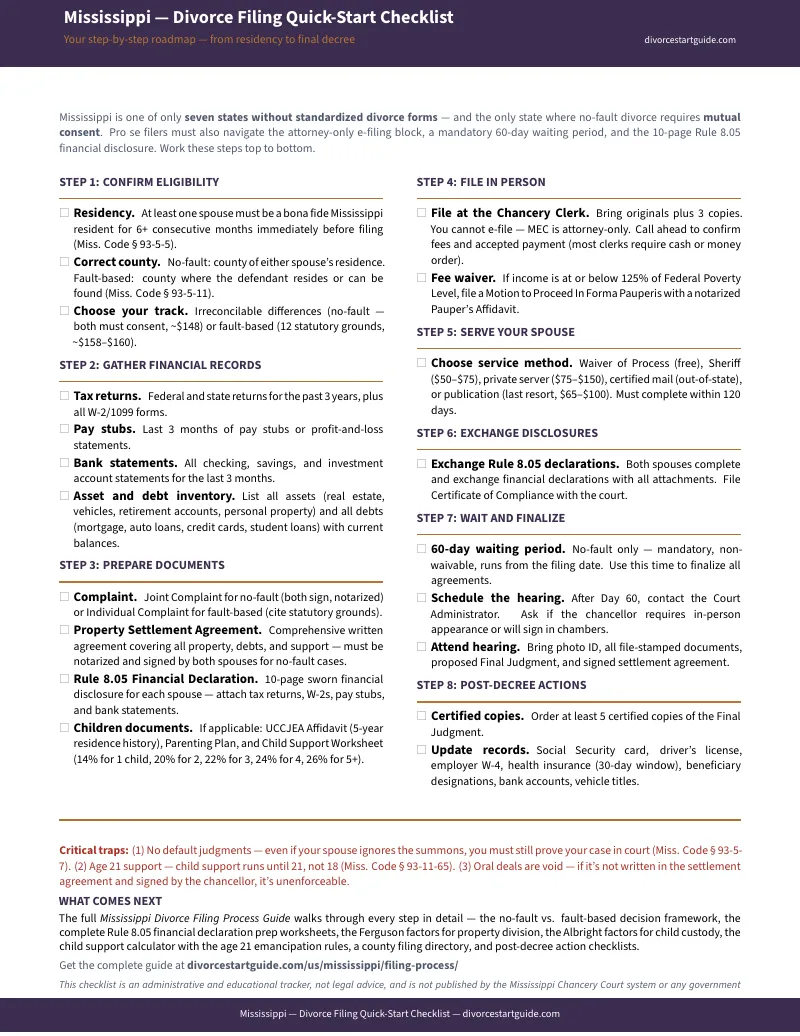
Quick-Start Checklist (Free Download)
A printable overview of the entire Mississippi divorce filing sequence — residency rules, document requirements, the 60-day waiting period, and critical deadlines. Enough to see the full picture and decide whether you need the complete guide.
Who This Is For
- You and your spouse agree on terms and want to handle the paperwork without a $2,500–$5,000 attorney retainer — but you have children, a mortgage, or retirement accounts, so the state's free automated tools won't work for you
- You're not sure your spouse will cooperate — you want an uncontested no-fault divorce, but because Mississippi requires mutual consent, you need to understand both the no-fault and fault-based tracks before you commit to a path
- You downloaded free templates from a DIY site and realized there's no filing sequence, no deadline tracker, and no explanation of what happens after you hand the papers to the Chancery Clerk
- You want to understand the full process before deciding whether to hire a lawyer, use a mediator, or go pro se — the guide makes every step visible so you can make that decision with real information instead of fear
Why Free Tools and $137–$299 Document Services Don't Solve This
Mississippi's Access to Justice Commission provides free automated forms — but only for couples with no children, no real property, and no retirement accounts. If you have any of those, the system won't generate documents for you.
National document-preparation services (3StepDivorce at $299, DivorceWriter at $137, LegalZoom at $150–$500) charge you to auto-fill forms through a questionnaire. They generate the paperwork. They don't explain Mississippi's physical in-person filing requirement. They don't tell you how to navigate the Rule 8.05 financial declaration. They don't walk you through the 120-day service deadline. And they don't prepare you for the final hearing where the judge evaluates your property agreement under the Ferguson factors.
Those services sell filled-in documents. This guide sells the process knowledge that makes those documents mean something when a Chancery judge reviews them.
100% Satisfaction Guarantee
If the guide doesn't give you a clear, usable path through Mississippi's divorce filing process, email [email protected] and we'll make it right — no hoops, no time limit.
— Less Than One Hour of Attorney Time
The average Mississippi family law attorney charges $260 per hour. A full-service uncontested divorce runs $2,500 to $5,000 in legal fees. Even a flat-fee document preparation service costs $300 to $600 — and they generate paperwork without explaining the process.
This guide costs less than a single certified copy from the Chancery Clerk's office. One purchase, instant download, no subscription. You keep it for your entire case.