In a Tasmania separation, there's no fixed split — the court weighs four factors and decides what's "just and equitable." This guide gives you the worksheets to build your case before anyone else builds it for you.
Australia doesn't have a 50/50 rule. Under Section 79 of the Family Law Act 1975, the Federal Circuit and Family Court pools everything — your super, the family home, savings, shares, debts, trusts, even assets you brought into the relationship — and divides it using the codified four-step framework: identify the pool, weigh contributions, assess future needs, then confirm the result is just and equitable. The split might be 55/45, 60/40, or 70/30. It depends on your numbers.
That's why "what percentage will I get?" is the wrong first question. The right question is: can you document your contributions, value your assets accurately, and model future needs adjustments before you negotiate, mediate, or file? Because whoever arrives with organised numbers — not guesses — controls the outcome.
The problem isn't the forms. It's knowing how to fill them in.
The Federal Circuit and Family Court gives you every Application for Consent Orders form for free at fcfcoa.gov.au — and you should download them there. But the court registrar is prohibited from giving legal advice. They can't tell you how to value superannuation. They can't explain when your non-financial contributions as a stay-at-home parent shift the split by 5% or 15%. They can't walk you through the 28-day procedural fairness rule for super splitting.
So you're left with two paths that both cost you:
- Download the free blank forms — and face complex fields about asset pools, contributions, and proposed percentage splits with zero guidance on what numbers to put in.
- Hire a family lawyer — at $300–$700 per hour in Tasmania, where even straightforward consent orders run $2,000–$5,500 and the most expensive hours are the ones spent organising documents you could have prepared yourself.
There's nothing in between. Until now.
The Four-Step Settlement Method
This guide is built on one idea: the court gives you the empty forms for free — we give you the framework, worksheets, and Tasmania-specific strategy to fill those forms out correctly before you sign anything or walk into a lawyer's office.
It is not a stack of forms (those are free). It is not generic financial advice. It is a process-navigation and financial-modelling toolkit built specifically around the Family Law Act 1975 — the codified four-step framework, Section 75(2) future needs factors, the superannuation splitting regulations, Tasmanian stamp duty exemptions, and the consent orders process — so that every number you bring to the table is defensible, organised, and working for you instead of against you.
For — less than a single hour of a Hobart family lawyer's time — you get the exact worksheets and calculations that make the difference between a fair settlement and one you regret for a decade.
What's inside — and why each piece exists
- The Complete Asset Pool Ledger — every joint and individual asset, liability, and financial resource in one structured worksheet, ready for the Section 79 "identify and value" step. Solves: the terrifying realisation at mediation that you forgot to disclose a superannuation fund or undervalued the family home.
- The Contributions Assessment Worksheet — document your financial, non-financial, homemaker, and parenting contributions across the entire relationship using the court's own criteria, including the 2025 codification of family violence economic impact. Solves: being told your years of raising children "don't count" because you can't articulate them in the framework judges actually use.
- The Future Needs Adjustment Calculator — model the Section 75(2) factors (age, health, earning capacity, primary care of children) and estimate what percentage adjustment the court is likely to apply. Solves: walking into mediation with no idea whether your case leans 50/50, 60/40, or something else entirely.
- The Superannuation Splitting Guide & Form 6 Walkthrough — step-by-step for splitting retail, industry, and defined-benefit super funds, including when you need an actuarial valuation versus a member statement, and the strict 28-day procedural fairness notification to the trustee. Solves: accepting a "fair" split that ignores tens of thousands locked in super because the splitting process looked too hard.
- The Family Home Buyout Calculator — the exact formula (Current Value minus Mortgage minus Transfer Costs times Equitable Share), plus the Tasmanian SRO stamp duty exemption process under Section 56/56A of the Duties Act 2001 that eliminates thousands in transfer duty. Solves: overpaying for a buyout or losing the stamp duty exemption because nobody explained the State Revenue Office paperwork.
- The Consent Orders Drafting Checklist — every requirement for a successful Application for Consent Orders, the 28-day super trustee notice rule, the $205 filing fee, and the exact sequence that avoids registrar requisitions. Solves: having your application bounced back weeks later because a required paragraph was missing or the super trustee wasn't properly served.
- The Spousal Maintenance Assessment — model whether maintenance applies, how much, and for how long using the Section 75(2) "reasonable necessity" test — with a clear decision tree for when it's worth claiming versus when it weakens your negotiating position. Solves: either leaving money on the table or triggering a fight over maintenance that costs more in legal fees than it's worth.
- The Debt Allocation Ledger & Joint Liability Checklist — split credit cards, personal loans, HECS-HELP, and the joint mortgage, with the warning most people learn too late: consent orders bind you and your ex, but they don't bind your bank. Solves: being chased by a lender for your ex's debt years after the settlement because the refinance wasn't completed.
Who this is for
- You earn too much for Legal Aid Tasmania but can't justify draining thousands from the asset pool on billable hours before the split even happens.
- You're self-representing and need a sequential roadmap from separation to sealed consent orders — one step at a time, in the right order.
- You are hiring a lawyer — and want to walk in with your asset pool valued, your contributions documented, and your super split modelled, so you're paying for advocacy and strategy, not document organisation.
- You have a de facto relationship (including same-sex) and need clarity on the two-year limitation period and jurisdictional thresholds before you can access the property settlement system.
- You have something to protect: a pre-relationship home, superannuation you built over decades, an inheritance, or a family trust that needs careful tracing.
Why not just use the free tools?
Because they stop exactly where the hard part starts.
- The FCFCOA Portal (free) gives you blank, legally accepted forms — and staff who are prohibited by law from explaining a single strategic consequence of how you fill them in. The rejection rate for self-filed consent orders is high because most people don't know the formatting and content requirements.
- amica.gov.au ($270–$900+) is useful for simple separations, but its $270 property agreement is not legally binding and excludes superannuation splitting entirely. Draft consent orders cost $900 or more — and there's still no contribution-assessment modelling or negotiation guidance.
- Simple Separation ($2,899+) provides fixed-fee end-to-end support — but at a cost that exceeds many small asset pools, and it requires both parties to agree before work begins.
- Tasmania Legal Aid (free) provides duty lawyers and outreach, but strict income limits shut out most dual-income households, and wait times can push past the 12-month limitation period.
- A private family lawyer ($2,000–$5,500 for consent orders alone) can handle everything — while the meter runs on hours you spend handing over bank statements you could have organised for .
This guide is the missing bridge: the worksheets and modelling tools that let you build a fair, defensible settlement position first — then fill out the free forms, draft your own consent orders, or hand a mediator or lawyer a clean, court-ready file.
An honest promise
This is an educational financial-organisation and process-navigation tool. It is not legal advice, it doesn't represent you in court, and it doesn't pretend a download replaces a lawyer when your case genuinely needs one — it tells you plainly when to bring one in. What it does promise: to hand you the exact framework and worksheets that most Tasmanians pay hundreds of dollars an hour to have someone else assemble.
Try it. Work through the asset pool ledger and the contributions worksheet. If it doesn't give you more clarity and control over your financial settlement than anything else you've found, it isn't doing its job — reply to your receipt and we'll make it right.
Start where you are
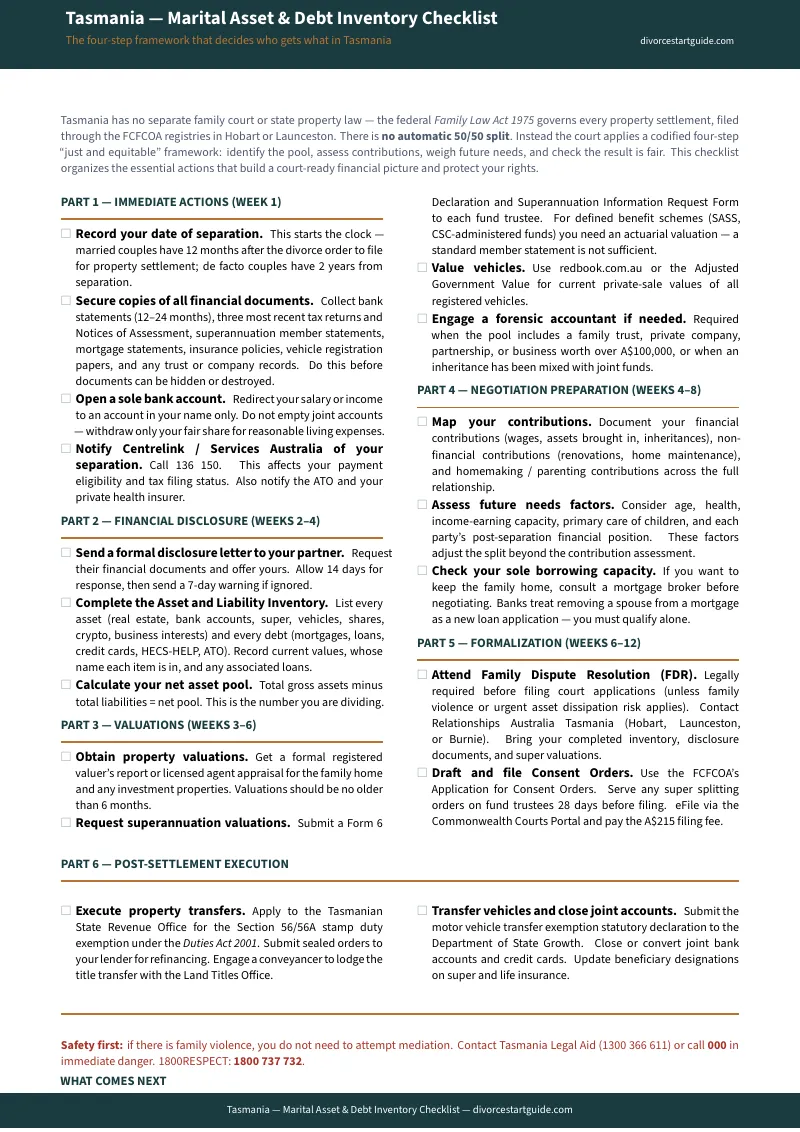
Not ready for the full guide? Begin free with the Tasmania — Marital Asset & Debt Inventory Checklist: a one-page inventory that captures every asset, debt, and superannuation interest in one place — the raw numbers you'll need before you touch the court's Application for Consent Orders.
When you're ready to turn that inventory into a settlement — with the contributions assessment, the super splitting walkthrough, the buyout calculator, and the future needs modeller — get the complete Tasmania Divorce Financial Split & Asset Division Guide and fill in every box with numbers you can defend.