
In a Missouri divorce, a judge decides what's "fair" — and "fair" is almost never a clean 50/50. This guide gives you the numbers to make sure fair works in your favor.
Missouri is not a community-property state. It's an equitable-distribution state, governed by RSMo § 452.330 — which means the court divides your marital estate however a judge decides is "just," weighing five statutory factors. A significant income gap, who kept the home fires burning, whose conduct hurt the finances: any of these can tip a division to 60/40 or 70/30. Nothing is automatic, and nothing is guaranteed.
And here's the trap that catches people who assume their "separate" property is safe. Under Missouri's marital presumption, everything acquired during the marriage is presumed marital — even if it's titled in your name alone. Your inheritance, your premarital home, the 401(k) you started before the wedding: these stay yours only if you can trace them with clear and convincing evidence. Mix an inheritance into a joint account, or add your spouse's name to a premarital deed, and Missouri courts can — and do — treat the whole thing as marital and divisible.
The problem isn't finding the forms. It's knowing the numbers to put in them.
Missouri hands you every official divorce form for free at courts.mo.gov — the Statement of Property and Debt (Form CAFC040), the Statement of Income and Expenses (Form CAFC050), the Form 14 child-support worksheet — and you should download them there. But the court clerk is legally barred from telling you how to fill them out. They can't value your house. They can't calculate your maintenance exposure. They can't trace your premarital 401(k) or tell you what portion of a pension is even marital.
So you're left with two options that both cost you:
- Download the free blank forms — and stare at empty boxes you must fill in under oath, with zero guidance on how to value, trace, or negotiate a single number.
- Hire an attorney — at $200–$500 an hour on top of a $2,000–$10,000 retainer, where the most expensive hours are the ones spent sorting through the shoebox of bank statements you could have organized yourself.
There's nothing in between. Until now.
The Missouri Source-of-Funds Method
This guide is built on one idea: the state gives you the empty boxes for free — we give you the math, the formulas, and the Missouri-specific case law to fill those boxes out correctly before you sign a sworn document or walk into a lawyer's office.
It is not a stack of forms (those are free). It is not generic financial advice. It is a process-navigation and financial-modeling toolkit built specifically around Missouri statutes and precedent — the equitable-distribution factors of RSMo § 452.330, the Hoffman v. Hoffman source-of-funds rule, the Reed v. Reed tracing standard, the Szuba pension coverture fraction, the two-part maintenance test of RSMo § 452.335 — so that every number you bring to the table is defensible, organized, and working for you instead of against you.
For — a fraction of one hour of an attorney's time — you get the exact worksheets and calculations that make the difference between a settlement you designed and one a judge imposes on you.
What's inside — and the fear each part solves
- The Source-of-Funds Home Equity Worksheet — the exact Hoffman v. Hoffman proportional formula: input your premarital value, down payment, and marital mortgage paydown, and see precisely what share of the home is protected as separate versus divisible as marital. Solves: losing the separate equity in a home you brought into the marriage because you never calculated — or could never prove — your share.
- The Separate-Property Tracing Worksheet — one row per asset, building the uninterrupted, clear-and-convincing paper trail Missouri courts demand under Reed v. Reed to overcome the marital presumption. Solves: watching an inheritance or premarital account get swept into the marital pool because your testimony wasn't backed by documents.
- The Five-Factor Scorecard — score yourself on each of the five statutory factors a judge actually weighs under RSMo § 452.330, so you can argue for a "just" split instead of hoping for one. Solves: walking in blind, with no idea whether your case leans 50/50 or something very different.
- The Szuba Coverture Pension Worksheet & QDRO checklist — calculate the marital portion of a pension with the coverture fraction, model a buyout to keep it intact, and follow the step-by-step QDRO drafting-and-pre-approval sequence. Solves: overpaying for a pension split — or getting hit with a $500–$1,200 plan-administrator surprise — because nobody ran the coverture math.
- The Missouri Maintenance Modeler — work the two-part RSMo § 452.335 threshold test and the ten statutory factors, and understand modifiable versus non-modifiable maintenance before you agree to either. Solves: not knowing whether you'll pay (or receive) support, how much, or for how long — and locking in a number you can't change.
- The Debt-Allocation Ledger & refinance-trap checklist — split credit cards, loans, and joint tax liability equitably, with the warning most people learn too late: a Missouri decree binds your spouse, not your creditors. Solves: getting chased for your ex's debt years after the divorce is "final."
- The After-Tax Negotiation Ledger — value every asset by fair market value, cost basis, and after-tax worth, because equal on paper is rarely equal after the IRS takes its cut (IRC § 1041, the carryover-basis trap, capital gains). Solves: splitting the estate "evenly" and quietly walking away with the worse half.
- The Form CAFC040 Structural Preparation Workbook — a section-by-section prep assistant for the notarized Statement of Property and Debt, so you draft precise, defensible asset values, avoid double-counting secured debt, and don't expose yourself to sanctions on a form signed under penalty of perjury. Solves: a rejected filing — or a settlement reopened years later — because a sworn form was filled out wrong.
Who this is for
- You earn too much for free legal aid but can't justify draining thousands from the marital estate on billable hours.
- You're representing yourself and need a sequential map from "everything's presumed marital" to a signed dissolution decree.
- You are hiring a lawyer — and want to walk in with your assets valued, your maintenance modeled, and your tracing done, so you're paying for advocacy, not data entry.
- You have something to protect: a premarital home, an inheritance, a pension, a business, or a retirement account you built before you said "I do."
Why not just use the free tools?
Because they stop exactly where the hard part starts.
- Missouri Courts (courts.mo.gov, free) gives you legally accepted blank forms — and clerks who are barred by law from explaining a single strategic consequence of how you fill them in.
- Legal Services of Missouri (free) is excellent for simple, low-income cases, but strict income limits shut out the middle class, and its templates carry no source-of-funds or coverture math.
- 3 Step Divorce ($299) and Divorce.com / LegalZoom automate filling out the forms. Neither helps you trace a premarital 401(k), run the Hoffman formula on your home, or model a pension offset before you commit the numbers.
- A specialized QDRO service ($500–$1,000) drafts one retirement order and nothing else — no house, no debt, no maintenance, no strategy.
- A private attorney ($2,000–$10,000 retainer) can do all of it — while the meter runs on hours you spend handing over documents you could have organized for .
This guide is the missing bridge: the math and worksheets that let you design a fair, structurally sound agreement first — then fill out the free forms, or hand a mediator or attorney a clean, organized file.
An honest promise
This is an educational financial-organization and process-navigation tool. It is not legal advice, it doesn't represent you in court, and it doesn't pretend a download replaces a lawyer when your case genuinely needs one — it tells you plainly when to bring one in. What it does promise: to hand you the exact Missouri-specific calculations and worksheets that most people pay hundreds of dollars an hour to have someone else assemble.
Try it. Work through the source-of-funds worksheet and the maintenance modeler. If it doesn't give you more clarity and control over your financial split than anything else you've found, it isn't doing its job — reply to your receipt and we'll make it right.
Start where you are
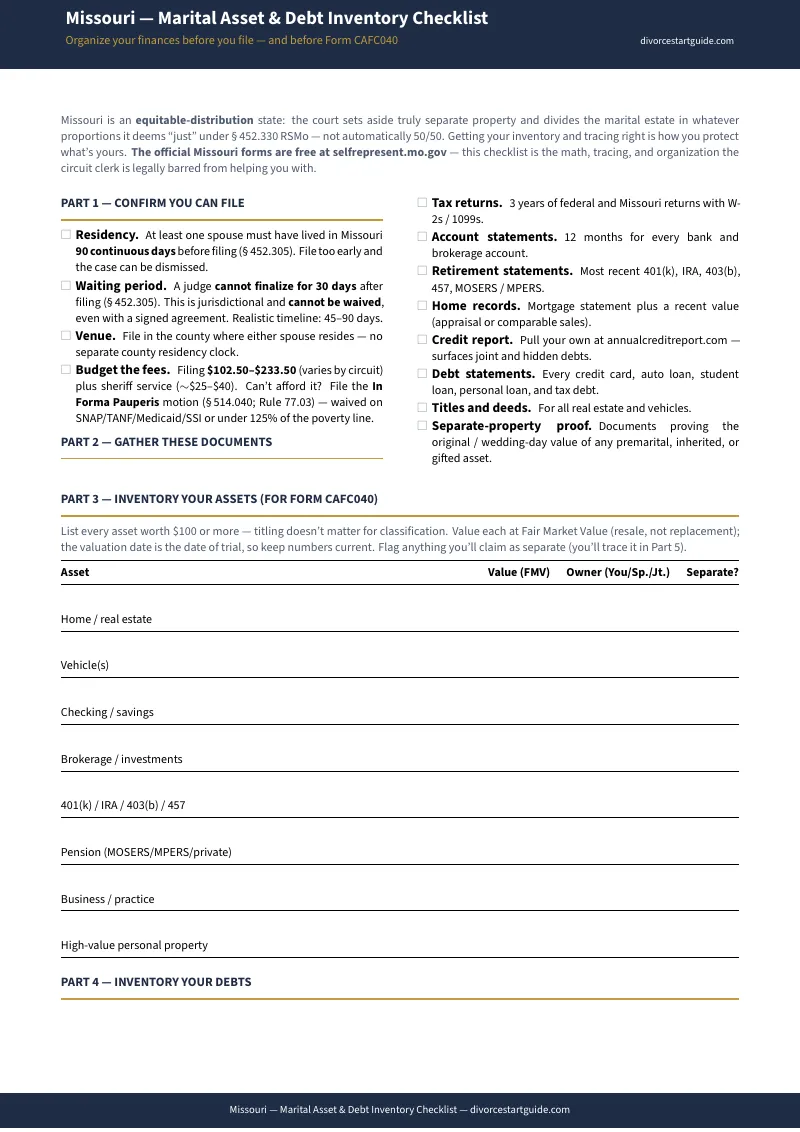
Not ready for the full guide? Begin free with the Missouri — Marital Asset & Debt Inventory Checklist: a one-page inventory that captures every asset, debt, and property item in one place — the raw numbers you'll need before you touch the state's mandatory, notarized Statement of Property and Debt.
When you're ready to turn that inventory into a settlement — with the source-of-funds math, the tracing, the coverture formula, and the after-tax ledger — get the complete Missouri Divorce Financial Split & Asset Division Guide and fill in every box with numbers you can defend.