
You're Not Splitting "Stuff" — You're Deciding Your Financial Future
Utah doesn't do 50/50. Under equitable distribution, the judge looks at your marriage length, each spouse's earning capacity, non-monetary contributions, and even fault — then decides what's "fair." That flexibility means the person who walks into mediation with organized numbers, completed worksheets, and a clear proposal has a structural advantage over the person who shows up hoping for the best.
The problem is that free resources don't help you do any of this. The Utah Courts self-help center gives you blank forms. Attorney blogs give you overviews. Neither one gives you a method for classifying your property, calculating a home buyout, splitting a pension correctly, or protecting yourself from debts the decree assigns to your spouse.
The Utah Marital Equity Workspace
This guide is a step-by-step financial workspace built for Utah Code Title 81. Not a stack of blank court forms. Not a generic national overview. A calculation-and-organization system that walks you through the exact financial decisions your divorce requires — with worksheets you fill in, formulas you run, and checklists that map to the court's actual deadlines.
What's Inside
- Property Classification System — a structured ledger for sorting every asset and debt into marital vs. separate, with a tracing worksheet for premarital accounts, inheritances, and commingled funds. The burden of proving something is separate is on you — this tool builds your evidence trail.
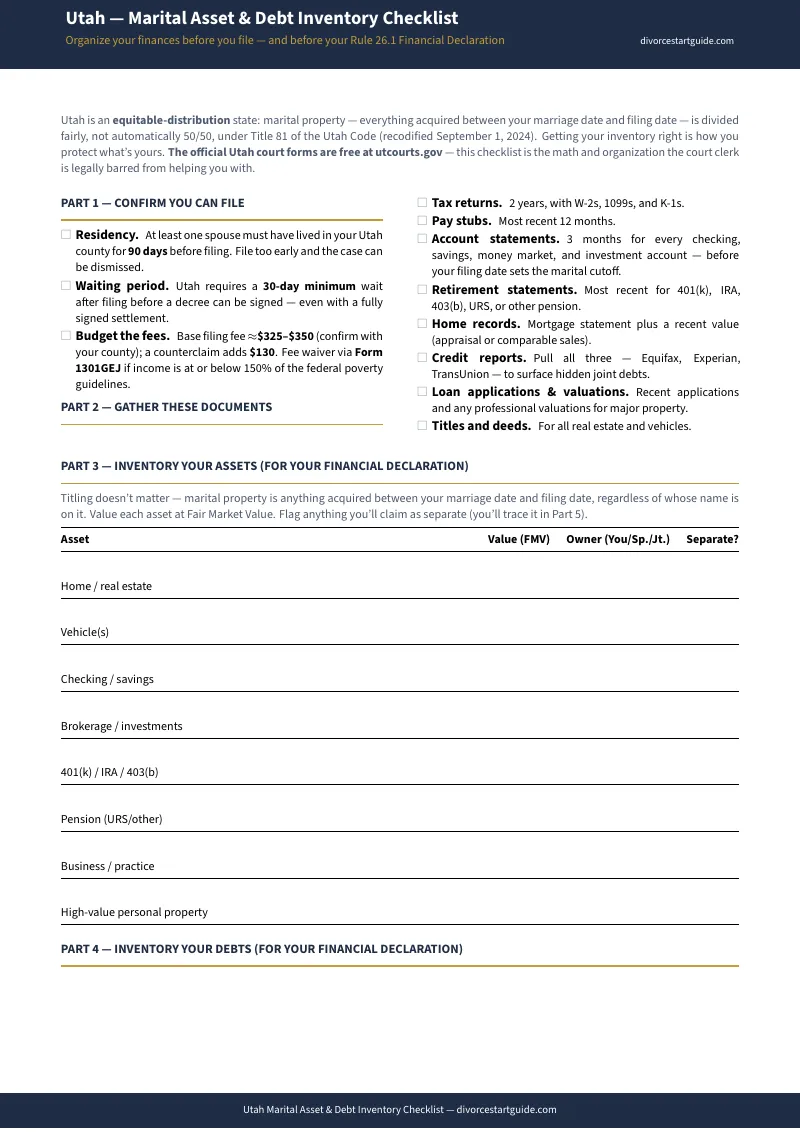
- Rule 26.1 Financial Declaration Prep Kit — the exact documents the court demands (2 years of tax returns, 12 months of pay stubs, 3 months of bank and retirement statements), organized by category with deadlines mapped. Miss the 14-day disclosure window and you risk Rule 37 sanctions — including losing undisclosed assets entirely.
- Family Home Decision Matrix — the four options (sell, buyout, equity offset, deferred sale) with a step-by-step buyout calculator. Includes the critical warning most people learn too late: a Quitclaim Deed removes your name from the title but not the mortgage.
- Retirement Splitting Toolkit — the 5-step QDRO process for 401(k) and 403(b) plans, the Woodward coverture formula for pensions (with a worked example), URS DRO rules for Utah public employees, and military pension division under the USFSPA including the SBP one-year deadline.
- Debt Protection Playbook — why a divorce decree does not bind your creditors, and the specific actions (refinance, close, freeze, hold-harmless clause) that actually remove your liability for each type of joint debt.
- Spousal Support Calculator — a three-part worksheet covering monthly budget need analysis, the statutory durational cap (alimony cannot exceed the length of the marriage), and a lump-sum buyout calculation for negotiating a one-time settlement.
- Complete Procedural Timeline — every filing fee, service deadline, mandatory course, mediation requirement, and waiting period from petition to decree. Built for Utah's current system, not a generic multi-state checklist.
- Post-Decree Execution Tracker — the transfers, refinances, title changes, and retirement order filings that must happen after the judge signs. Each one has a suggested deadline because a signed decree with unexecuted transfers is worth nothing.
Who This Is For
- Spouses dividing a home, retirement accounts, or shared debts in a Utah divorce who want a clear, organized method
- People preparing for mediation who want to arrive with their numbers already calculated and their proposal already drafted
- Self-represented litigants navigating Rule 26.1 disclosure requirements and court deadlines
- Anyone working with an attorney who wants to reduce billable hours by doing the financial organization themselves
Why Not Just Use Free Resources?
The Utah Courts self-help center is excellent for what it does — it provides the official forms and explains the basic process. But it explicitly cannot provide strategic guidance, help you calculate an equity offset, or tell you how to protect yourself when your spouse gets assigned a joint debt they won't pay.
Attorney blogs explain concepts. This guide gives you a workspace to execute. The difference is the difference between reading about how a home buyout works and actually running the math with your numbers in the cells.
A contested divorce in Utah costs $10,000–$50,000 in attorney fees at $250–$400/hour. This guide won't replace a lawyer in a complex case — and it tells you exactly when you need one. But for the financial organization, calculation, and preparation work that makes up the bulk of those billable hours, it gives you a method you can follow yourself.
— One-Time Purchase, Instant Download
Immediate PDF download. No subscription. No upsells. Every worksheet, calculator, and checklist in one package — built for Utah's current Title 81 rules and ready to use today.
Not sure yet? Download the free Utah Marital Asset & Debt Inventory Checklist — an 18-item action list that walks you through the highest-priority steps for securing your financial baseline.