
You Agreed to a "Temporary" Custody Arrangement. In New York, That Arrangement May Already Be Permanent.
New York judges lean heavily on the status quo when deciding custody. Under the standard set in Friederwitzer v. Friederwitzer, whatever living arrangement your child is in today carries enormous weight in court — even if you never meant it to be permanent. That informal schedule you agreed to "just until things settle down" can quietly become the baseline a judge uses to deny you the arrangement you actually want.
That's the first trap most New York parents walk into. The second is the court system itself. New York splits custody between two entirely separate courts. Only the Supreme Court can grant a divorce and divide property. Family Court handles custody for unmarried parents and separated spouses who aren't filing for divorce. Both courts hear custody cases, but they follow different procedural tracks, accept different forms, and have different fee structures. File in the wrong one and you lose weeks. File the right forms in the wrong order and the clerk sends you home.
The New York Unified Court System gives you blank forms for free — Form GF-17 for a custody petition, Form GF-40 for modifications, the entire Uncontested Divorce Packet with the UD-8 Child Support Worksheet. But the clerk cannot tell you which form to use, what order to file in, or how to fill in the terms of a parenting plan that a judge will actually approve. The forms are free. The sequence of actions that makes them work isn't — and that's where most self-represented parents fail.
The Custody Process Navigator
This guide is not forms, not legal advice, and not a $72-to-$288/year scheduling subscription that requires your co-parent to sign up too. It's the plain-language, step-by-step action sequence that the court system doesn't provide: what to file, in what order, by what deadline, and how to structure a parenting plan that addresses every factor New York judges actually evaluate.
Every chapter is built around New York's actual statutes (DRL Section 240, Family Court Act Section 652) and the case law judges cite when deciding custody — Eschbach v. Eschbach for best-interest factors, Tropea v. Tropea for relocation, Bast v. Rossoff and Smisek v. DeSantis for the shared-custody child support calculation that blindsides most parents. This is not generic custody content recycled from a national template.
What You Get
The Complete Custody and Parenting Plan Guide
A 14-chapter guide plus 8 printable standalone worksheets — 10 PDFs total:
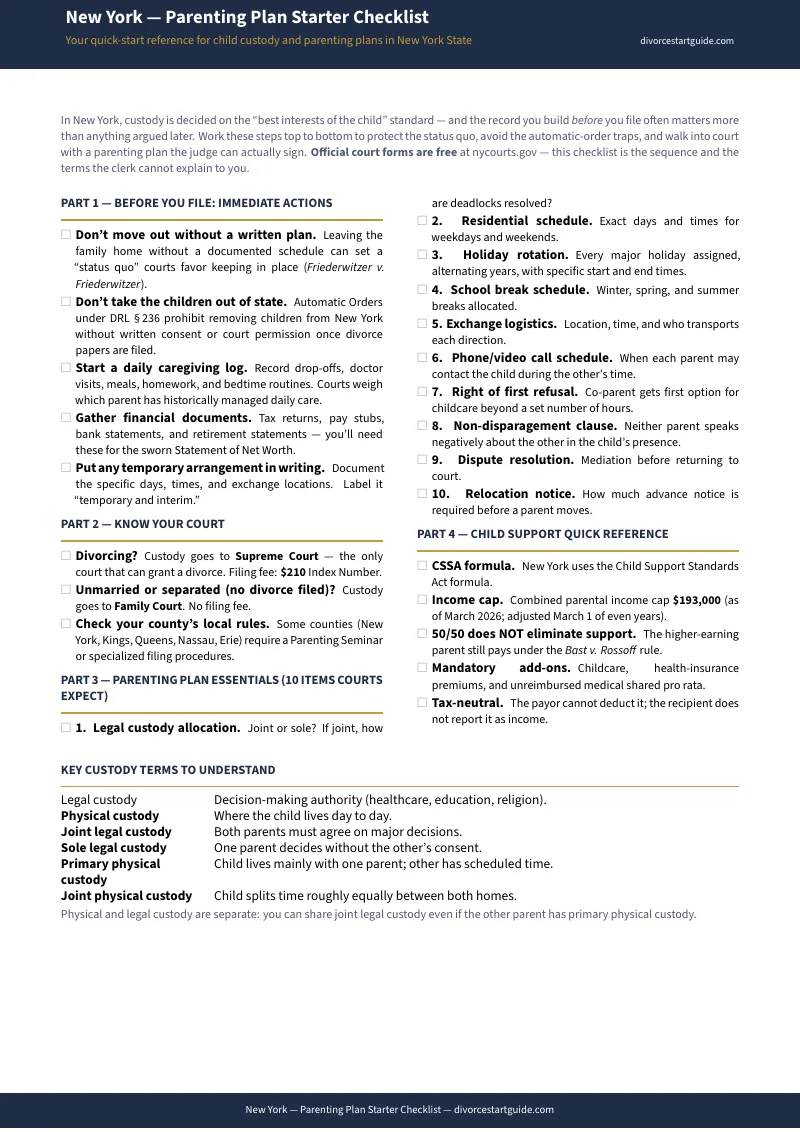
- Parenting Plan Builder — fillable worksheet covering legal custody allocation, residential schedule, communication rules, right of first refusal, transportation logistics, dispute resolution, and financial terms
- Holiday & School Break Rotation Planner — assign every holiday with exact start and end times, alternating-year rotations, and transportation responsibilities
- Child Support Calculation Worksheet — the 11-line CSSA formula step by step, plus an add-on expense tracker for childcare, health insurance, and extracurriculars
- Best-Interest Self-Assessment — evaluate your situation against the 9 factors from Eschbach v. Eschbach that judges actually weigh, with space to identify your strongest positions and areas to prepare
- Mediation Preparation Worksheet — structure your proposals, rank your priorities, define your non-negotiables and areas of flexibility before the Presumptive ADR session
- Status Quo Documentation Log — log every temporary custody arrangement with dates, terms, and evidence so it doesn't silently become the permanent baseline under the Friederwitzer doctrine
- Relocation Decision Worksheet — plan a proposed move (or build your case to oppose one) under the Tropea v. Tropea standard
- Court Forms Quick Reference Card — all 17 New York custody forms, key statutes, landmark case law, and filing fees on one printable sheet
Quick-Start Checklist (Free Tier)
A printable parenting plan checklist and custody-basics overview — covering legal vs. physical custody definitions, the best-interest factors, and a scheduling framework with space to draft your initial proposals before mediation or your first attorney consultation.
Who This Is For
- You and your co-parent mostly agree on custody and want to draft a parenting plan without paying a $3,000-to-$15,000 attorney retainer for work you can do yourselves
- You're heading into court-ordered mediation and want to walk in with structured proposals instead of improvising on the spot
- You're filing an uncontested divorce with children and need to understand how the custody sections of the Supreme Court packet work — especially the UD-8 Child Support Worksheet
- You're an unmarried parent filing for custody in Family Court and need the step-by-step process for Form GF-17
- You have an existing custody order that no longer works and want to understand whether your situation qualifies as a "substantial change in circumstances" before you file for modification
- You want to understand the full process before deciding whether to hire a lawyer or navigate it yourself
Why Free Forms, Scheduling Apps, and National Guides Don't Solve This
The NYS Unified Court System provides blank PDF forms for free — download them at nycourts.gov. But court clerks are legally prohibited from telling you which form to use, how to negotiate the terms you write on those forms, or what a judge will look for when reviewing your parenting plan. The forms are there. The process map is missing.
Custody X Change ($72-to-$288/year) generates visual custody calendars and parenting plan PDFs. It's useful software — but it's a scheduling tool, not a process guide. It doesn't explain which court has jurisdiction, how the best-interest factors work, or what happens when your co-parent refuses to cooperate. And it requires a recurring subscription.
OurFamilyWizard ($110-to-$300/year per parent) and TalkingParents ($77-to-$353/year) are post-agreement communication platforms. They help you manage custody after you have a plan. They don't help you draft one, prepare for mediation, or navigate the filing process.
Nolo's national custody guide ($22.99-$25.99) provides a solid general framework — but it covers all 50 states generically. It doesn't explain New York's dual-court system, the Presumptive ADR program, the status quo doctrine, or how Smisek v. DeSantis changes the child support math in shared custody.
This guide costs — one purchase, instant download, no subscription, no co-parent buy-in required. Built specifically for New York custody law, not adapted from a national template.
100% Satisfaction Guarantee
If the guide doesn't give you a clear path through New York's custody process, email [email protected] and we'll make it right — no hoops, no time limit.
— A Fraction of One Attorney Consultation
A typical New York family law attorney bills $350 to $500 per hour. A custody retainer runs $3,000 to $15,000 upfront. This guide gives you the complete custody process sequence, parenting plan worksheets, and child support reality check for less than the cost of a 15-minute attorney phone call — and you keep it for your entire case.